The route evidence is stronger than the speed headline
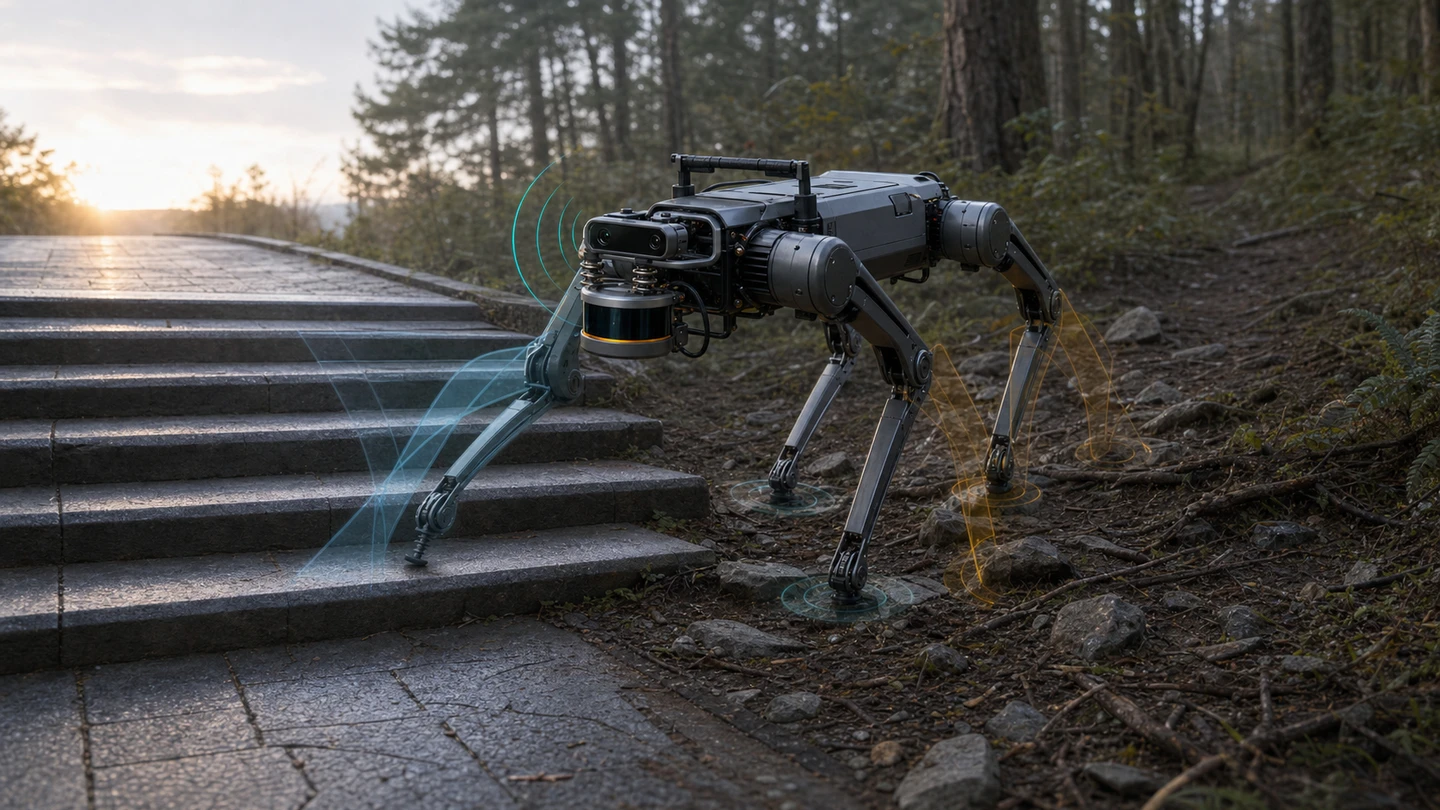
A South Korean research team has put one locomotion policy through two materially different outdoor routes. In a study published in Science Robotics, the 45-kilogram KAIST HOUND completed a 1.1-kilometer campus route with stairs, grass and ramps, then a separate 0.34-kilometer forest route with roots, logs and slippery leaf cover. APT-RL selected between trotting and bounding from terrain geometry, robot state and commanded speed. A depth camera, 2D LiDAR and all policy and perception computation were onboard; the system did not use motion capture or offboard state estimation.[1,2,3,5]
The paper's most eye-catching number needs a narrower label. HOUND reached an instantaneous 4.25 meters per second while clearing a 60-centimeter step. Its 6-meter-per-second result occurred during a drop down three 30-centimeter stairs and was measured immediately before ground impact. That is a dynamic-maneuver peak, not evidence that the robot sustained 6 meters per second across either route. Yonhap's Korean-language report likewise described the figure as a momentary maximum of 22 kilometers per hour.[1,2,3,5]
The outdoor runs extend the evidence beyond a single obstacle demo, but they are still demonstrations rather than a reliability study. The paper does not report how many full-route attempts were made, how often the robot fell or required intervention, or confidence intervals for physical performance. Its statistical section says the quantitative comparisons are descriptive and use no hypothesis tests, p-values or confidence intervals.[1,2]
Eight minutes of torque data supplies the prior
APT-RL's central mechanism starts before reinforcement learning. The team used a simplified two-dimensional body model and trajectory optimization to produce 90,000 trotting and 90,000 bounding trajectories with joint-torque labels. The 5,560,286 time steps represent about 15.5 hours of motion, yet optimization, preprocessing and saving took roughly eight minutes. That converts a compact physics model into a cheap bank of control priors instead of collecting equivalent motion on hardware.[1,2]
A transformer-based variational autoencoder places both gaits in a shared latent representation, while separate decoders turn latent actions into torque. The reinforcement-learning policy selects a gait every half-second and adds faster auxiliary corrections for three-dimensional terrain that the flat two-dimensional data did not contain. A teacher-student stage then distills simulated height-map perception into a deployable encoder for depth and LiDAR. In a simulation ablation, removing the pretrained torque contribution reduced high-step success from 94.6% to 2.9%, supporting the torque prior as a real part of the mechanism rather than decorative pretraining.[1,2]
The sensor needed its own shock absorber
High-speed perception exposed a hardware limit. The supplementary materials say bounding impacts often exceeded 10 g at the onboard inertial sensor, producing unreliable LiDAR measurements and frequently causing malfunctions or complete failure. The team added a custom 3D-printed spring-and-damping mechanism between the robot head and the LiDAR. The paper calls that modification critical to reliable sensor performance, making mechanical isolation part of the deployed capability rather than an implementation footnote.[1,2,3]
The public evidence package is useful but incomplete. Zenodo contains raw experimental data and figure-generation code under a CC BY 4.0 license; the project page does not link training or deployment code, policy weights or a reproducible hardware stack. The controller also covers only trot and bound, focuses on fore-aft motion, and takes commanded velocity rather than performing semantic navigation. The next proof is independent deployment on another quadruped with released code and weights, repeated route counts, falls and interventions, sensor-failure rates and mean time between failures, plus rapid turning and lateral motion.[1,2,3,4]