Three sites, one much larger claim
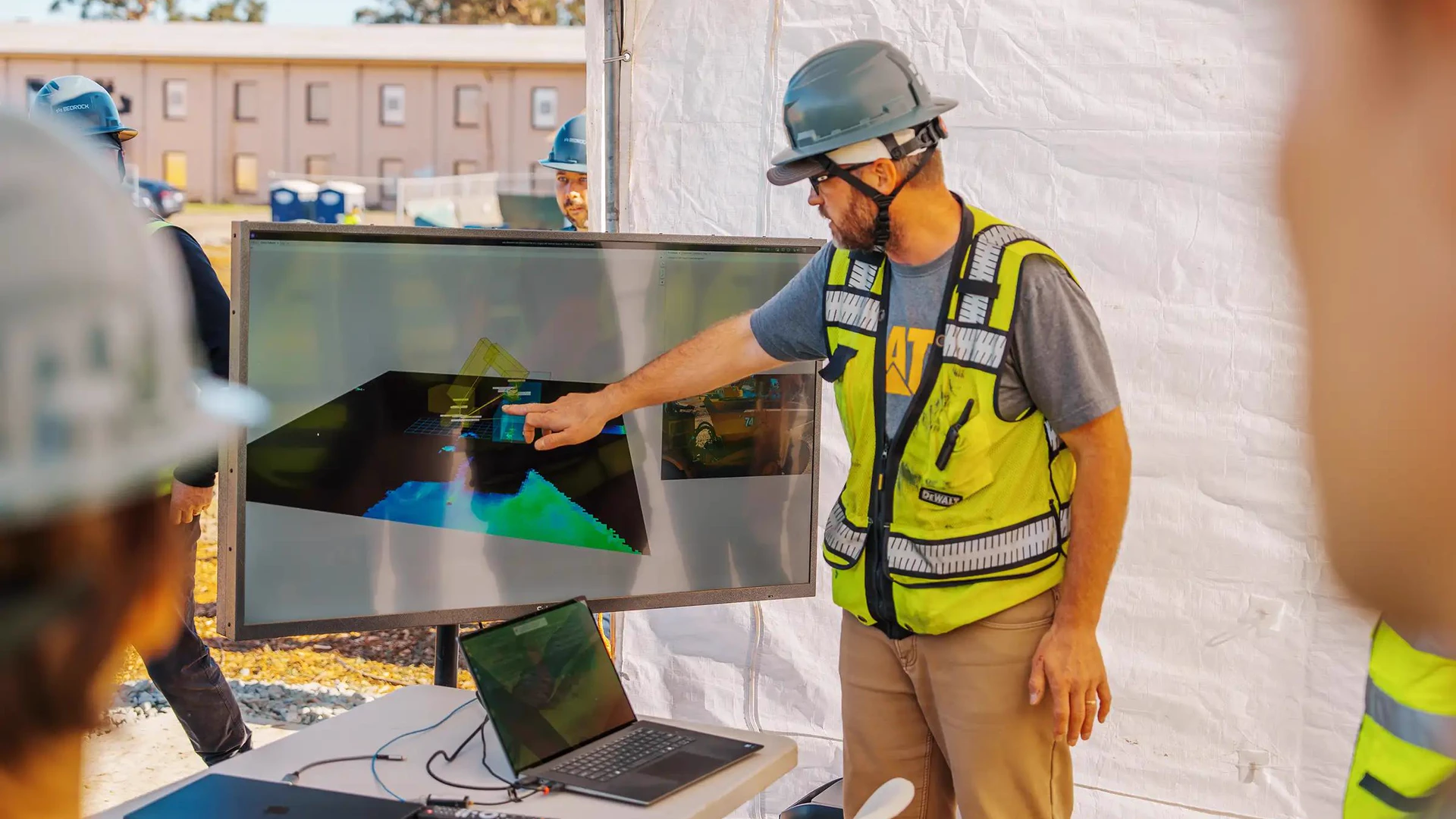
Bedrock Robotics says excavators fitted with its Operator system are now working without a person in the cab at three live U.S. customer sites. The company named a Nevada water-treatment facility with Sundt Construction, a multi-million-cubic-yard earthwork project with Champion Site Prep in Texas, and a 1.2 million-cubic-yard civil sitework project with Zachry Construction Corporation. Its August 17 release calls this the first fully autonomous excavator work on real commercial sites. The claim is material because the customer, the site and the work are no longer hypothetical, even though the operating record is still largely supplier-reported.[1,2,3]
The two independent accounts add useful context without closing that evidence gap. Construction Dive reported on August 19 that the retrofit system was active on infrastructure projects and described the company’s transition from a year of supervised testing. Bricks & Bytes published field reporting on August 20 after taking a film crew to Texas; its trailer shows the outlet visited the work, but the full documentary had not yet been released. That is stronger than a launch video or a test-track demonstration, but it does not independently measure the status of all three projects or prove the company’s productivity claims.[1,2,3]
The operating boundary moved out of the cab
The important change is not simply that Bedrock added more sensors to an excavator. Earlier work was supervised: a human operator remained responsible while the machine performed the task. The new claim moves that human out of the seat on live customer work. That changes the deployment question from whether the model can control the boom and bucket to whether a construction site can commission, monitor and recover a machine that is expected to work as part of a crew.[1,2,3]
It does not mean the site becomes people-free. Bedrock says a site manager sets the initial plan and that the excavators operate only in approved conditions. The system is designed to stop when a person or unauthorized object comes too close, and to pause if it detects a fault. Those controls are part of the product, not footnotes. They define the conditions under which operator-out mode is allowed and the recovery boundary when the work stops. The public record does not yet show how often those stops occur, who responds, how quickly work resumes or whether a remote operator intervenes.[1,2]
Retrofit changes the commissioning problem
Bedrock’s commercial wedge is the fleet a contractor already has. The company says its sensor and compute suite can be installed on existing excavators in a day without permanent modification, across machines from 20 to 80 tons. Construction Dive likewise described a same-day retrofit and a workflow in which the site manager supplies the initial plan. That matters to buyers: the adoption decision is not only whether to purchase a new robot, but whether an existing fleet can be made predictable enough for autonomous work without changing the rest of the site around it.[1,2]
The deployment therefore has at least three layers. The excavator must execute the task. The site must provide a valid plan, acceptable operating conditions and coordination with other equipment. The contractor must own the exception path when the machine pauses, encounters a person or detects a fault. A cab-empty machine that needs frequent human rescue may still be useful, but its economics and staffing model are different from the headline version of full autonomy. That is why intervention data belongs in the first customer acceptance record, alongside the volume moved.[1,2,3]
The proof is still missing
The current public record establishes a deployment claim, not a benchmark. It does not disclose how many excavators are working at each site, how many hours they have operated autonomously, what share of shifts ran without intervention, or how much earth was moved in operator-out mode. It also gives no uptime, cycle-time, rework, maintenance, remote-operations or cost-per-cubic-yard comparison against a human-operated baseline.[1,2,3]
Bricks & Bytes makes the gap explicit: it says Bedrock has not published cycle times, cost per cubic yard or uptime against a human-operated baseline. Construction Dive reports the safety architecture and operating claims, but does not provide customer-side acceptance data. Those omissions do not erase the significance of live-site work. They set the boundary on what can be concluded: the system appears to have crossed from supervised field development into early operator-out deployment, while repeatable productivity and commercial payback remain unproven in public evidence.[1,2,3]
What builders should ask next
The next useful release is not another autonomy superlative. It is a named customer operating record: machine count, site duration, autonomous hours, human interventions, stop-and-resume events, uptime, rework and output against the contractor’s normal baseline. The record should also separate Bedrock’s system performance from the conditions the contractor supplied, including the initial plan, approved work zone and staffing around the machine.[1,2,3]
The evidence clears a real deployment story: Bedrock says operator-out excavators are working on live customer sites, and independent reporting places that claim in active construction rather than a laboratory. It does not clear a claim that the model has already produced superior economics or a scalable autonomous fleet. For construction operators, the decision point has moved from whether an excavator can be automated to whether the entire exception, safety and maintenance system can be commissioned without putting the hidden operator back into the business case.[1,2,3]