A measured baseline, then a harder task
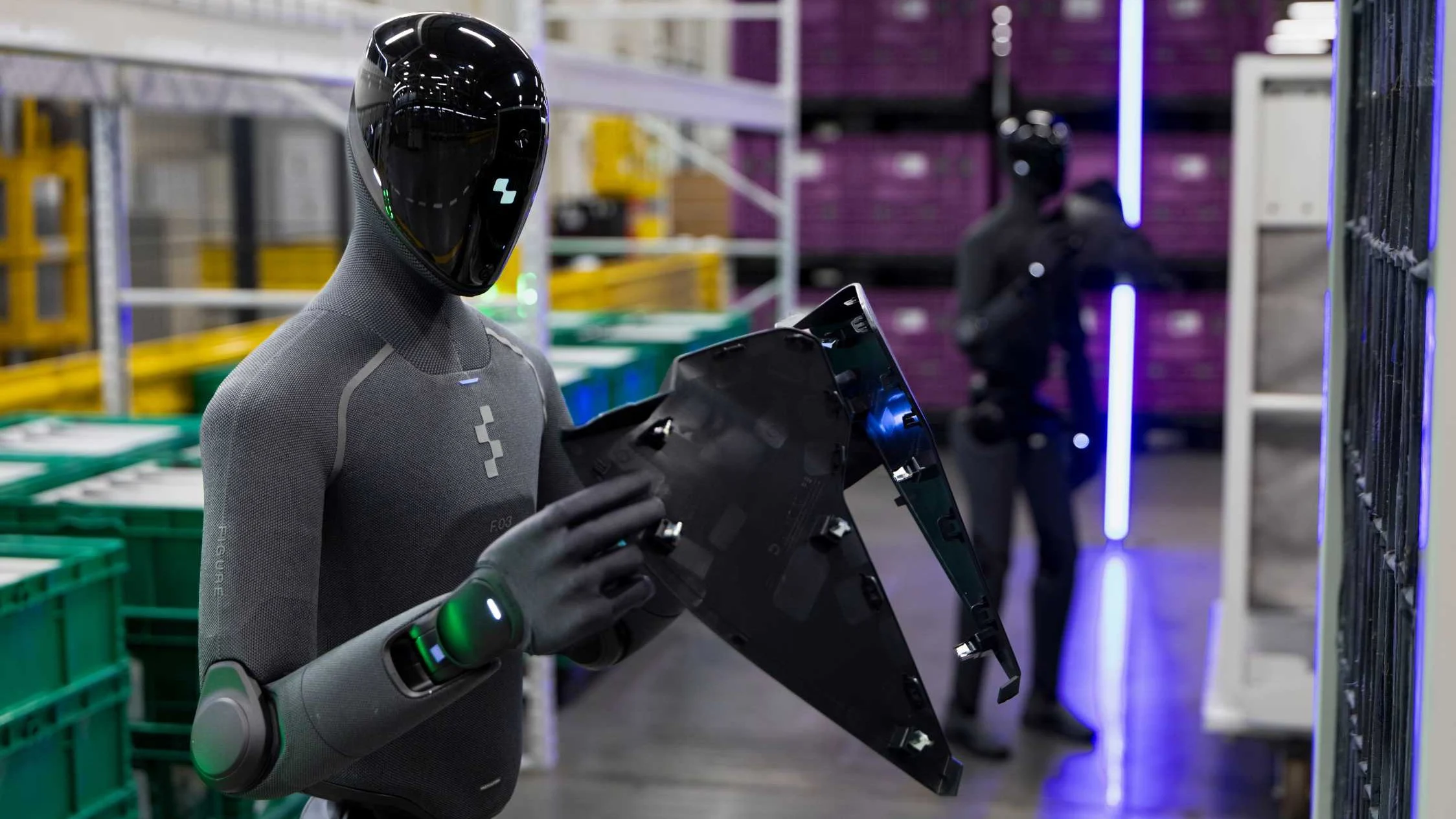
BMW and Figure AI are moving their Spartanburg experiment from a known pick-and-place task toward a logistics problem that is harder to hide inside a demonstration. The new Figure 03 project is described as sequencing unsorted vehicle components into a trolley before the material is moved to the production line. GCN reported the development on August 30, while BMW and Figure’s primary accounts establish the plant, the machine and the workflow. The evidence supports a live manufacturing project or evaluation, not a claim that Figure 03 has already delivered a repeatable production result.[1,2,3]
The earlier Figure 02 record is useful precisely because it is bounded. BMW says that project ran for more than ten months and supported production of more than 30,000 BMW X3s. It reports five-day weeks, ten-hour shifts, more than 90,000 components, about 1,250 operating hours and roughly 1.2 million steps. Those are material operating facts from BMW’s prior project. They are not Figure 03 figures, and they do not prove that the successor can handle the new sequencing workflow at the same cadence.[2,3]
The operator boundary moved upstream
The deployment question has changed from whether a humanoid can repeat a constrained placement to whether it can make a reliable decision before the placement begins. Figure’s account describes parts arriving unsorted, with variation in orientation and occlusion, and the robot selecting, manipulating and correcting them before placing them into the sequence trolley. BMW’s account connects that trolley to an automated tugger or Smart Transport Robot that carries the material onward. The robot is therefore part of a chain whose failure modes sit across perception, gripping, body motion, container organization and line delivery.[2,3]
That makes sequencing a better operator test than a clean pick. A factory can isolate a repeated placement with fixtures, fixed presentation and a narrow safety envelope. A sequencing cell must absorb the disorder created upstream and still produce an ordered, traceable handoff downstream. If the robot cannot identify a part, establish a stable grip or recover from a changed orientation, the exception lands somewhere else: a person, a supervisor, the material-handling system or the line itself. The public sources describe the intended mechanism, but they do not disclose how often those exceptions occur.[1,2,3]
BMW’s own prior project shows that the robot is only one part of the commissioning work. BMW says the Figure 02 program produced revised safety concepts involving barriers and partitions and required improved 5G coverage. Those details matter because the physical AI story is also a plant-infrastructure story. A buyer has to provide connectivity, protected operating space, material presentation, stop rules and a recovery path. The next robot may have better sensors and control, but it still enters a system that must be designed around its uncertainty.[2]
What the production numbers do—and do not—say
The most tempting number in this story is the more-than-30,000 BMW X3 figure. It is also the easiest number to misuse. BMW attributes that production support to the earlier Figure 02 project, and the record does not say that each vehicle was built by the robot, that every relevant shift ran autonomously or that the humanoid determined plant throughput. The number establishes duration and proximity to real production. It does not establish Figure 03 throughput, availability, labor substitution or return on investment.[1,2,3]
There is also a small but important source discrepancy. GCN described an 11-month deployment involving two robots, while BMW’s primary account describes the prior Figure 02 work as lasting more than ten months and reports its operating totals without using the same two-robot framing. That difference does not invalidate the story, but it is a reason to keep the baseline attributed and separate from the Figure 03 project. The current record is strongest on what the companies are evaluating and weakest on the denominator needed to compare the systems.[1,2]
The missing denominator is an operating record for the new task. A useful release would identify the number of Figure 03 units, the hours spent in sequencing mode, the number of parts presented, successful and failed picks, human interventions, stop-and-resume events, uptime and the handoff rate to the downstream transport system. It would also say whether the measurement covers a controlled demonstration, a limited pilot or normal line supply. Without those fields, a photograph of a humanoid holding a component remains evidence of activity, not evidence of production performance.[1,2,3]
The next proof point is exception handling
For BMW, Figure and the plant operators, the commercial question is now less theatrical and more exact: can the system keep the line supplied when the input is not arranged for it? The answer depends on the exception path as much as on the successful pick. A sequencing robot that performs well on nominal parts but requires frequent human sorting, recovery or rework may still be useful, but it has a different staffing and integration model from a machine that can sustain the workflow with a measured intervention load.[1,2,3]
The evidence clears a meaningful deployment story: Figure 03 is being evaluated in a real BMW manufacturing-logistics setting, and the project targets unsorted parts rather than only a fixed presentation. BMW’s earlier Figure 02 record shows that the partnership has already produced a reported operating baseline near production. What it does not clear is a claim of general-purpose factory autonomy, superior economics or scaled Figure 03 performance. Those conclusions wait for task-level logs, customer-side acceptance criteria and a transparent account of every human handoff.[1,2,3]
BMW AG’s current investor-relations page identifies the ordinary shares as listed in Frankfurt and Munich under Reuters symbol BMWG.DE. That market identity is included for reference because BMW is a materially covered public company; it does not change the operating conclusion. The decision-relevant checkpoint remains the same: whether Figure 03 can turn an unsorted component stream into a dependable, measurable line-supply service, with the plant’s connectivity, safety and recovery burden included in the result.[2,4]