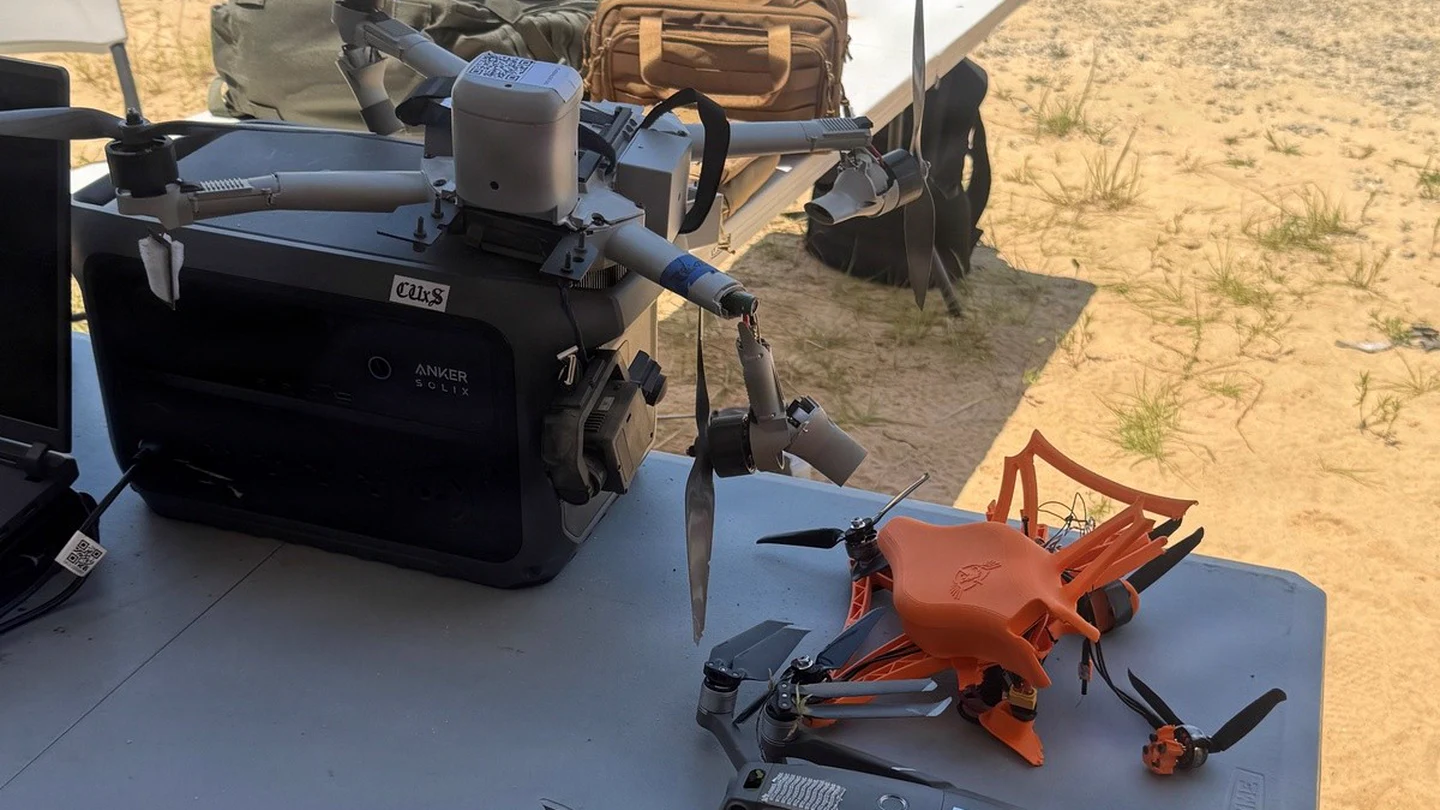
An operational test, not a fielding decision
Joint Interagency Task Force 401 and the 3rd Battalion, 75th Ranger Regiment completed a five-day exercise at Fort Benning, Georgia, from July 6 through July 10 to evaluate and employ the Bumblebee V2 counter-drone system. The Army described the event as operational training for defending military installations and domestic critical infrastructure. That establishes use by representative soldiers in a training environment; it does not establish that V2 is fielded, production-ready or deployed for an operational mission.[1,2,3]
The interceptor is designed to disable a small drone through direct physical collision rather than an explosive payload. The Army says V2 adds a three-camera array and automated target recognition that can track and complete an intercept while an operator remains in the engagement process. JIATF-401 also evaluated DRACOE software and target aircraft used to automate representative training targets. Defense Daily attended the July 8 event and reported progress in the targeting software, while also reporting that further development is needed before the technology is ready for production.[1,2,3]
The contract ceiling is not a Bumblebee order
The Army's account links Bumblebee to a three-year indefinite-delivery, indefinite-quantity contract awarded to Perennial Autonomy in May with a $500 million ceiling. The underlying announcement says that vehicle covers a range of systems, including Merops interceptors, Bumblebee quadcopters and Hornet drones. A ceiling is the maximum potential value of orders under the vehicle, not money already obligated to Bumblebee V2. None of the sources opened for this report discloses a July task order, V2 quantity, unit price or production award.[1,5]
The development trail also argues for a narrower readiness claim. At an April assessment, SIGNAL reported that soldiers tested V2 prototypes and that the version would move into an engineering sprint. A task-force official described it then as an iterative product rather than an end-state configuration. The July Ranger exercise is evidence that the test program advanced to another military user and setting, but the independent account still places the targeting software before production.[2,4]
The missing evidence is performance
The July disclosures do not publish an intercept success rate, target speeds or profiles, false-acquisition rate, operator-takeover rate, safety record, reliability figure, reuse rate or cost per engagement. They also do not say how many V2 aircraft Rangers used. Without those measurements, the exercise cannot show whether automated targeting has crossed the production threshold or whether collision intercepts are economical outside controlled training.[1,2,3]
The defensible milestone is therefore operational evaluation, not deployment. Bumblebee V2 has moved beyond a lab-only claim and into repeated tests with Army formations, now including Rangers and a separate target-management stack. The next proof should be a defined production configuration, a disclosed order or fielding unit, and test results that show how often the autonomous terminal phase succeeds under representative conditions. Until then, the public evidence supports continued development under a broad contract vehicle—not a claim of production readiness.[1,2,4,5]