From pilot equipment to a commercial order
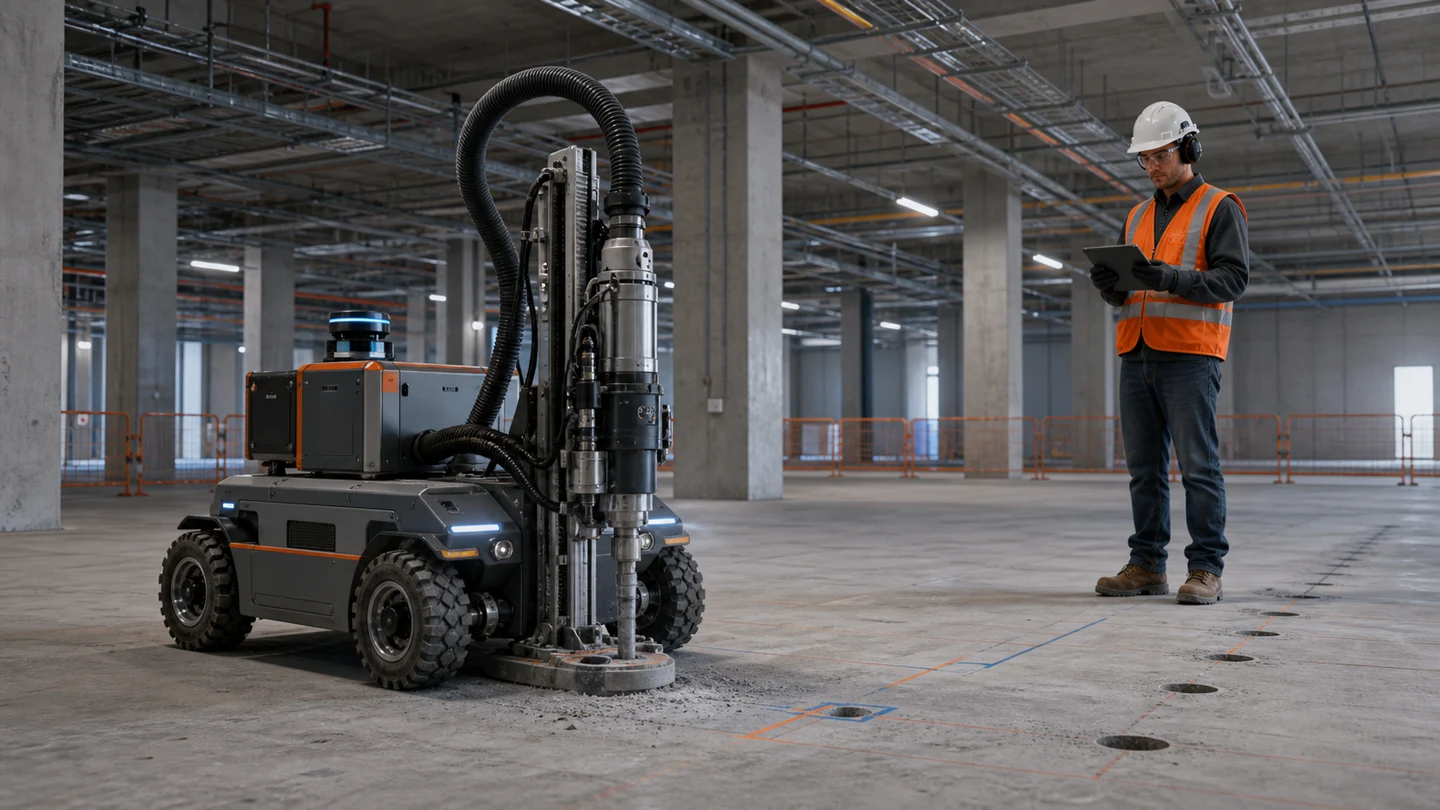
DEWALT said on July 9 that DALE, the autonomous downward-drilling robot it developed with August Robotics, is now available for commercial order. The launch follows what DEWALT describes as a year-long pilot with an unnamed major technology company. The company says the system drilled more than 230,000 holes, achieved 99.97% accuracy and reduced construction schedules by an aggregate 190 weeks across 26 data-center construction phases. Those are DEWALT's figures; the buyer has not published its own operating record and the totals have not been independently audited.[1]
The verified change is commercial status, not a newly disclosed customer rollout. DALE has moved from a pilot that was expected to reach the market in mid-2026 to a product that DEWALT says can be ordered now. The release does not identify the hyperscaler, the construction sites, the number of robots used, a purchase price or any post-pilot customer. That makes the launch evidence of productization after field use, but not evidence of broad adoption.[1,2,3]
The larger totals mostly show a larger pilot
The public metric trail began much lower. Independent construction reporting in February described more than 90,000 holes across 10 data-center phases, 80 aggregate weeks of schedule reduction and the same 99.97% accuracy claim. Fast Company reported in January that the robot had already passed 90,000 holes and that DEWALT and August Robotics expected commercial availability around midyear. The July release therefore adds a larger body of claimed field work and confirms the planned sales step.[1,2,3]
From the earlier disclosure to July, reported holes increased by more than 156%, phases by 160% and aggregate weeks saved by 137.5%. Normalizing those totals changes the picture: the lower-bound average stayed close to 9,000 holes per phase, moving from at least 9,000 to about 8,846, while claimed schedule reduction moved from 8.0 weeks per phase to about 7.3. Because the phases can differ in size and scope, those ratios are not productivity benchmarks. They show that most of the headline growth came from expanding the pilot footprint, not from a disclosed gain in per-phase performance.[1,3]
The source language also limits what can be counted. DEWALT's July summary calls the work 26 major projects, while the body calls it 26 construction phases. Earlier coverage similarly moved between phases and projects when describing the initial 10. A phase can be one portion of a building rather than a separate facility, so the record does not support a claim that DALE operated at 26 distinct data centers.[1,3]
Autonomy still has an operator boundary
DALE automates a narrow but schedule-critical workflow: locating and drilling concrete holes for server-rack stops and supports for mechanical, electrical and plumbing systems. A DEWALT field implementation manager told Daily Commercial News that crews import coordinates from CAD or building-information models rather than marking every location on the slab. The same account says accurate ground control points are essential and that contractors learned to set up and break down the system after the first two projects.[1,3]
Human work remains in the loop. Operators replace drill consumables, empty silica-dust bags, swap batteries and watch hole status on a tablet. The robots retry holes they cannot complete; persistent exceptions are flagged for the operator. Daily Commercial News reported teams of four robots, with eight used on a larger job, and battery endurance ranging from roughly two hours for large holes to four hours for smaller ones. DEWALT's commercial release mentions fast-swap batteries, remote monitoring and automatic dust extraction, but does not disclose the current operator-to-robot ratio, intervention rate or uptime.[1,3]
The economic evidence is also narrower than the launch language suggests. Earlier interviews attributed to DEWALT put robotic drilling near $20 per hole versus about $65 for conventional work on the pilot and described a 7,000-hole phase completed in seven days rather than a scheduled six to eight weeks. Fast Company reported that DPR Construction planned to prioritize the robot for testing and validation during 2026. The July release does not update those cost figures, publish a price, identify the buyer's accounting basis or show that the same payback carries across sites.[1,2,3]
What commercial proof should come next
The defensible conclusion is narrower than the launch superlatives: a specialized construction robot completed a substantial supplier-reported field program and has reached commercial ordering on schedule. The next proof is a named operator publishing how many robots it bought, where they work, what acceptance test they passed, how often humans intervene, what uptime and rework look like, and whether schedule savings survive after equipment, service, consumables and integration costs are counted.[1,2,3]
That does not make DALE a demo. Drilling hundreds of thousands of holes in an active construction program is operating evidence, and turning a one-task fleet into an orderable product is a real deployment milestone. It does mean the current public record proves more about task fit and pilot expansion than about repeatable commercial economics. For operators, the important boundary is now the one DEWALT has not published: whether an unnamed hyperscaler's success can be commissioned, maintained and paid back by the next customer.[1,2,3]