The U.S. Department of Energy’s October 8 selection of four scientific-robotics projects sets a useful test for autonomous laboratories: a robot must produce an experiment that can be trusted and repeated, not merely complete a movement. The projects link learning, stress testing, reproducible integration and operation at scientific facilities. Those are proposed capabilities, not reported performance results.[1]
Four projects, one evidence chain
Argonne’s MAESTRO will develop robot skills and infrastructure that improve through use. Brookhaven’s DART will test reliability and transfer between robotic platforms, including whether physical and scientific outcomes satisfy an experiment. Oak Ridge’s TRACE will package connected workflows and their provenance, the record of how results were produced. SLAC’s SPIRE will integrate sample handling with scientific instruments and computing.[1]
Read together, the assignments expose four separate failure points. A learned skill may fail on another robot; a completed movement may produce an invalid sample; an apparently good result may lack a reproducible record; and a working laboratory prototype may fail under facility operating constraints. Treating these as separate tests makes deployment evidence more useful than one aggregate task-success score. This is our interpretation of the programme design.[1,2]
A prototype shows the gap
Brookhaven’s April 2025 account supplies a concrete comparison. Its prototype used a UR3e robot, a gripper and a depth camera to handle sample holders. The laboratory reported 195 continuous sample manipulations overnight without errors. The system selected samples, loaded a receiving mount and returned them, but took simulated measurements. That is evidence about handling and workflow orchestration, not a count of 195 scientifically validated experiments.[3]
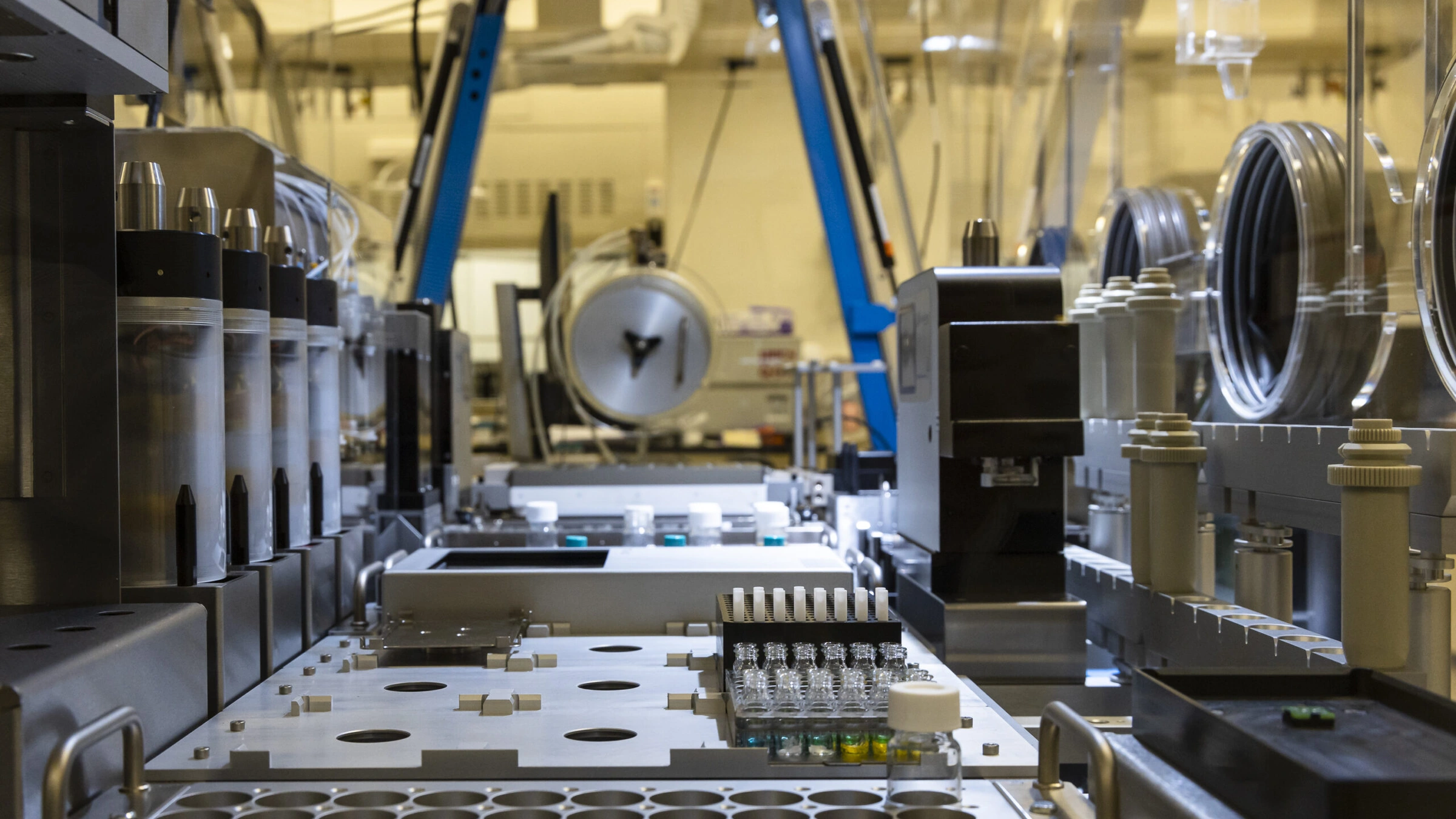
Oak Ridge also has an established starting point. Its February 2023 INTERSECT report described chemistry robots doing sample transport and catalyst work, then operating independently with collaboration planned. DOE says TRACE will build on that ecosystem. The archival photograph above shows the earlier chemistry laboratory; it does not depict a newly delivered TRACE testbed.[1,4]
Funding is still conditional
The planned total is $30 million, including $2 million for fiscal year 2026. Later funding depends on congressional appropriations. DOE explicitly says selection starts award negotiations and does not commit it to issuing an award or providing funds. The May solicitation anticipated two or three awards; October’s announcement names four selections. It supplies no project-by-project allocation, so dividing the headline total equally would invent a budget.[1,2]
The older call offers a stronger checkpoint than the funding headline. It asks teams to measure reproducibility, provenance, time to a result and the average interval between human interventions, alongside task success and generalization across sites. Each research thrust also requires substantive industry participation. It does not name the selected projects’ eventual industry partners.[2]
For researchers and robotics suppliers, the next useful evidence is a benchmark and workflow that another laboratory can rerun: the same sample identity, an auditable data trail, a valid measurement and disclosed operator interventions. Faster motion alone cannot establish that outcome. Negotiated awards, published interfaces and measured transfer results will show whether these selections create reusable infrastructure rather than four isolated demonstrations.[1,2,3]