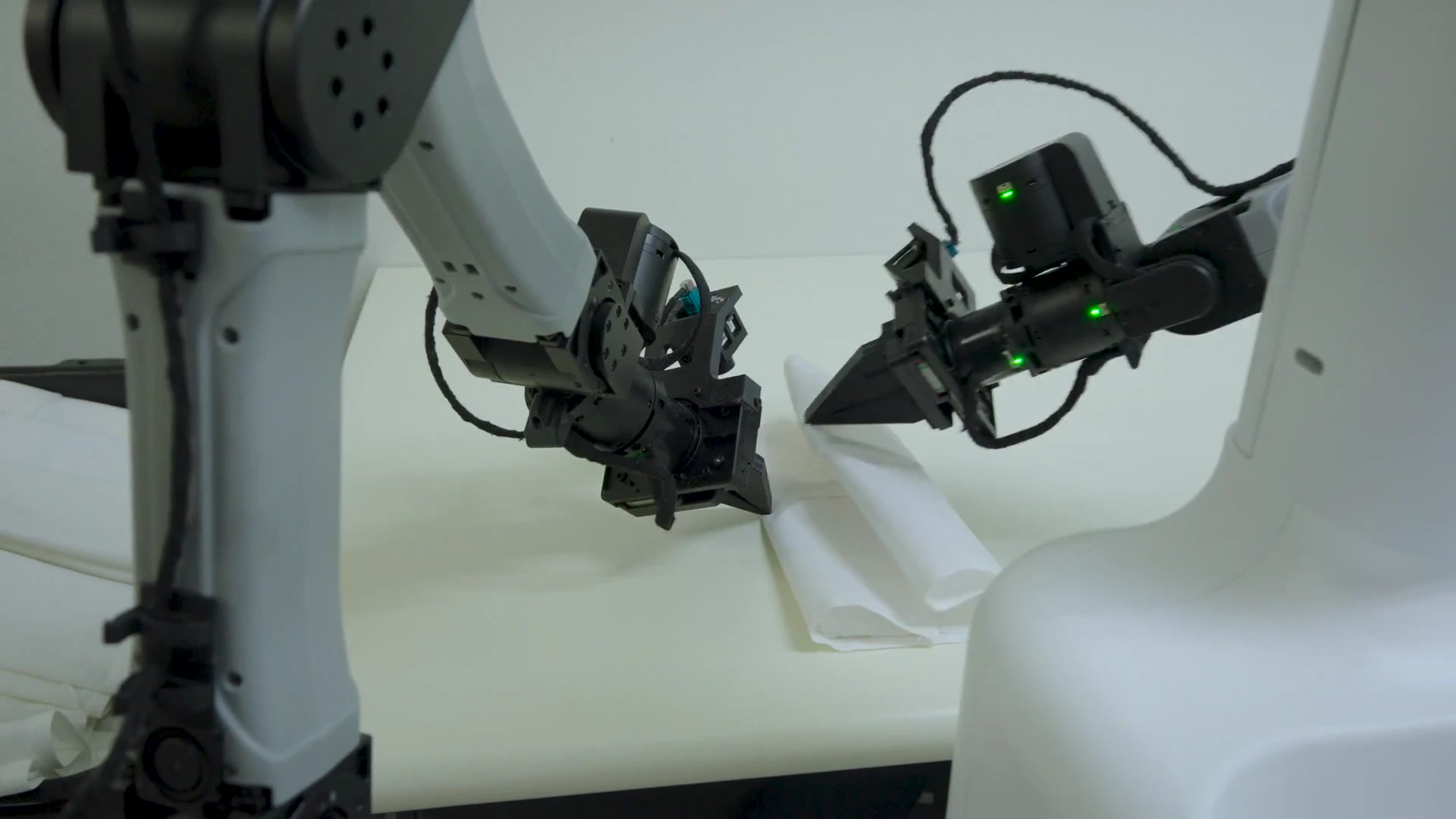
The output target is the story
Dyna Robotics has put a number on the restaurant-robot deployment it says is expanding through Din Tai Fung’s network. In an August research account, Dyna says the customer needed 1,500 table-ready napkins in an 18-hour production window and that its newer Dyna-2 system reached 1,590 napkins per day. Tao and RuntimeWire independently reported the same rollout account on August 31 and August 27. The important boundary is that the public evidence is still a Dyna-reported operator case, not a customer-authenticated production audit.[1,2,3]
Dyna’s comparison is designed to show a step change inside one narrow task. The company says an earlier Dyna-1 system produced about 480 napkins, or roughly 35 per hour, at 75% quality. Dyna says Dyna-2 reached 95 per hour at 93% quality and cleared the stated daily target. Those figures are useful because they define the work and the acceptance bar. They are not a general robot utilization rate, a restaurant labor-cost result or a measure of the system’s performance outside the napkin station.[1,2,3]
The hidden work is between folds
The deployment account becomes more credible when it describes the work that the headline number leaves out. Dyna says the first system could fold napkins but left the finished stacks disorganized in their bins, requiring restaurant staff to square them. The newer system was instructed to place each stack into a defined position and cycle through those positions. That is a small change in the workflow, but it is exactly where a demonstration becomes an operating system: the output has to arrive in the form that the next human or machine can use.[1,2,3]
The same account contains a useful failure mode. Dyna says one site’s throughput slipped as missed grabs rose and total failures roughly doubled. The company attributed the change to a worn gripper and used telemetry and vision records to distinguish hardware degradation from a policy problem. That is not proof that the maintenance loop works in every location. It is evidence that the deployed system needs a maintenance and diagnosis path alongside the manipulation policy. A customer buying the service is buying that recovery path too, whether or not the contract labels it software.[1,2]
Dyna also says the system collects camera data, robot state, control commands, application events and hardware telemetry, while Tao reports that the deployment generates more than a terabyte of data per day. The operational implication is clear even if the volume claim remains company-sourced: the path to repeatability runs through event records, not just a better-looking successful cycle. Operators need to know whether a miss came from presentation, grasping, placement, container geometry, component wear or a human reset. Without that classification, a reported average can hide the cost of keeping the average alive.[1,2,3]
A reported ROI threshold is not a payback result
Dyna describes the new deployment as crossing an ROI threshold and says the path from setup to that bar can be as short as three days. That is the most commercially important claim in the report and the least independently testable part of it. The public account does not give a subscription or purchase price, labor hours before and after deployment, maintenance cost, gripper replacement interval, uptime, human intervention rate or customer financial statement. Reaching 1,590 napkins per day can be a meaningful production result without being enough information to calculate payback.[1,2,3]
The scale claim needs the same discipline. Dyna says Din Tai Fung is rolling the robots through its restaurant network and that the fleet could reach hundreds by the first half of 2027. Tao and RuntimeWire repeat that framing, but none of the three reopened sources provides a current site count, robot count or location-by-location operating record. The evidence therefore supports a named-customer rollout claim and a defined task result. It does not support a claim that the chain has already achieved uniform performance across its estate.[1,2,3]
The deployment checkpoint is repeatability
For restaurant operators, Dyna’s case changes the diligence question from whether a robot can fold a napkin to whether a service can hold the target when the gripper wears, the bins change, a person has to recover a miss or the station runs outside its demonstration conditions. The customer-defined output target is a useful starting point because it can be measured at the task boundary. It still needs a denominator: hours available, successful cycles, intervention minutes, rework, maintenance events and the share of shifts that finish without manual reset.[1,2,3]
For Dyna, the next proof is not another demonstration of folding. It is a customer-side operating record that shows how many systems are active, how often they stop, how long recovery takes and what the maintenance burden costs. Din Tai Fung confirmation of the target, the deployment footprint and the labor or service result would also move the claim beyond vendor reporting. Until those records appear, the clearest conclusion is narrower: Dyna has described a robot deployment around a customer output target and exposed the hardware-maintenance work needed to protect it.[1,2,3]
That is enough to make the case worth tracking. A robot that meets a defined service output, places its work for the next step and records the difference between model failure and worn hardware is closer to an operating product than a showroom demo. It is not yet enough to price the product, infer a chain-wide return or declare a repeatable deployment template. The next decision should follow the evidence: ask for the site, unit, uptime, intervention, maintenance and payback fields before treating the rollout as scale proof.[1,2,3]