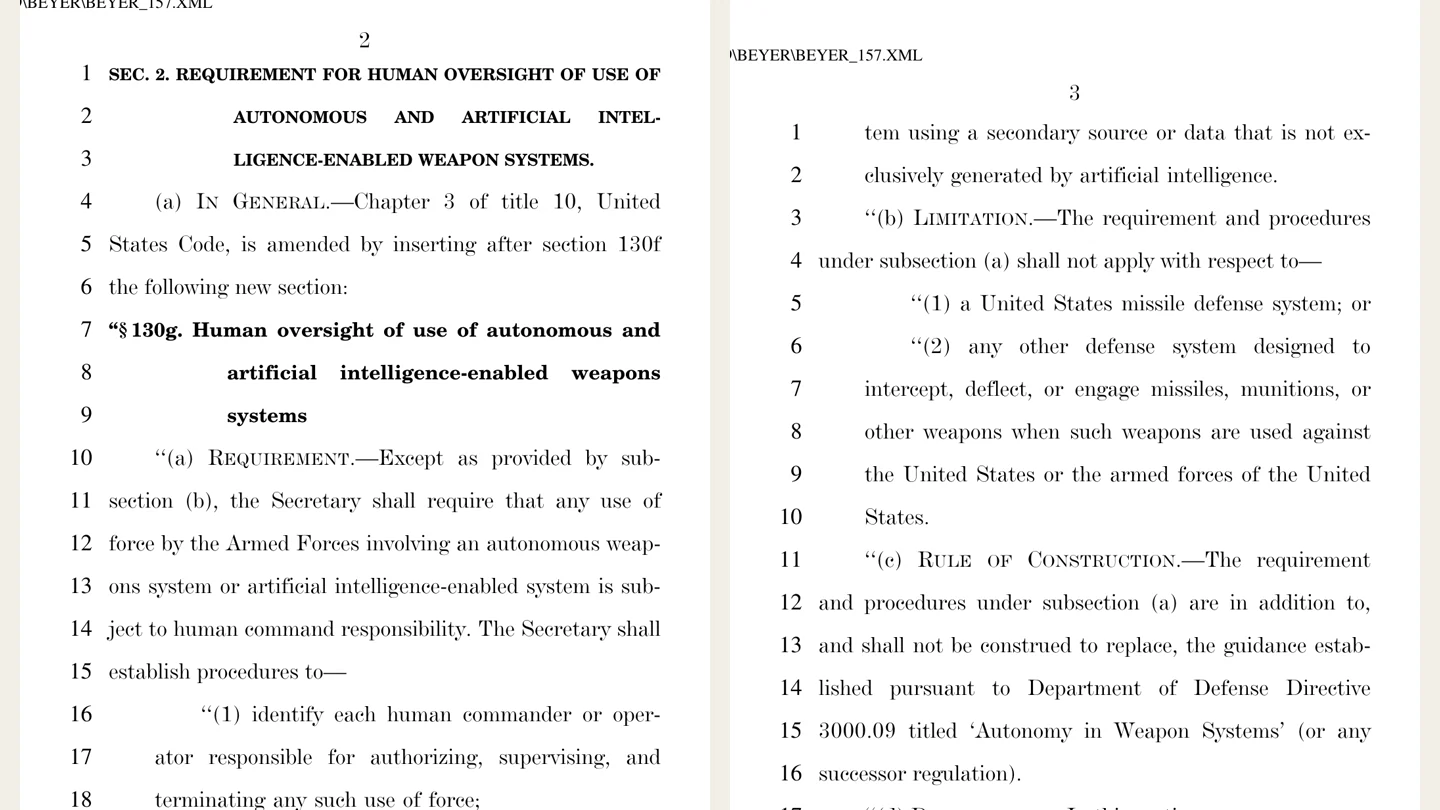
The exception is inside the operative text
A bipartisan group of House lawmakers introduced H.R. 9729, the Human Authority over Autonomous Weapons Act, on July 16 and it was referred that day to the House Armed Services Committee. The proposal would add a new section to Title 10 requiring human command responsibility whenever U.S. armed forces use force involving an autonomous weapon or an artificial intelligence-enabled system. Required procedures would identify the humans responsible for authorizing, supervising and terminating a covered use of force, and would require human oversight, approval or a human-in-the-loop for an intentionally lethal purpose. For five years after enactment, a commander or operator using a covered system would also have to verify any target of that system using a secondary source or data not exclusively generated by artificial intelligence.[1,2,3,7]
The operative text then draws a specific boundary. The proposed requirements and procedures would not apply to a U.S. missile-defense system or to another defensive system designed to intercept, deflect or engage missiles, munitions or other weapons used against the United States or its armed forces. That wording is broader than missile defense alone: it reaches the defensive interceptor category defined by function and threat. It does not create a general exemption for every defensive autonomous system, and it applies only to the new subsection described in the bill.[1,3]
A statutory layer, not a replacement policy
Current Defense Department Directive 3000.09 already requires autonomous and semi-autonomous weapon systems to be designed so commanders and operators can exercise appropriate levels of human judgment over the use of force. The bill explicitly says its proposed requirements would be in addition to, and would not replace, that directive or a successor. The interceptor exception therefore should not be read as removing defensive systems from all existing controls; it would leave them outside the proposed statutory procedures while the directive remains the underlying department-wide policy.[1,3,4]
The decision delta is narrower than the public slogan that humans should control lethal military AI. The bill translates that principle into named command duties and a temporary rule requiring any target of a covered system to be checked against a secondary source or data not exclusively generated by AI, then exposes a functional exception for defensive interceptors. Commanders, operators, acquisition offices and weapon-system vendors would have to map covered workflows to those duties if the proposal became law; missile-defense and counter-weapon teams would still answer to the existing directive, but not to the bill's new subsection. No implementation duty exists yet because the measure is a proposal. The bill has been referred to the House Armed Services Committee, and the reviewed sources establish no later committee action or inclusion in a defense authorization bill.[1,2,3,4,7]
The next measurable catalysts are legislative action on the proposal, including possible consideration alongside the annual defense-policy bill, and the Defense Department's separate update to Directive 3000.09. A June 5 presidential memorandum directed that update within 90 days and required annual review. Those are distinct tracks: Congress would decide whether the proposed Title 10 language advances, while the department must revise its existing policy under the executive-branch timetable. The comparison to watch is whether the updated directive preserves, narrows or otherwise changes the current human-judgment standard before lawmakers act.[3,4,5,6]