
The finding
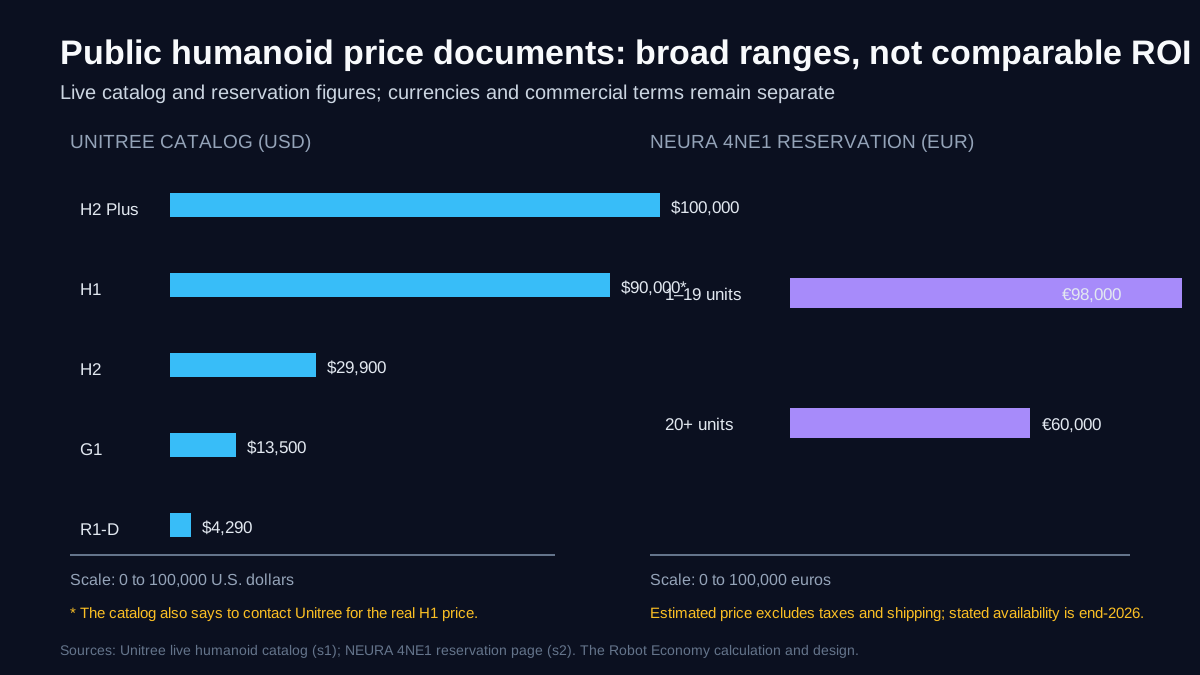
Humanoid robot pricing is becoming visible before humanoid unit economics are. Unitree's live catalog lists six humanoid products from 4,290 U.S. dollars for the R1-D to 100,000 U.S. dollars for the H2 Plus. NEURA's reservation page lists an estimated 98,000-euro price for one to nineteen 4NE1 Gen 3.5 units and 60,000 euros for twenty or more. Those are useful observations because the hardware price is a necessary input to an investment case. They are not, however, comparable quotations for a factory task. The Unitree catalog mixes models and configurations, and the H1 entry itself asks the buyer to contact the company for the real price. NEURA says its prices exclude tax and shipping, describes them as estimated, expects availability at the end of 2026, and directs commercial buyers to contact sales. The first conclusion is therefore narrow: public documents provide purchase-price anchors, not a standardized installed-system quote.[1,2]
That distinction matters because an investment committee does not buy a robot-shaped price tag. It buys completed work. The useful comparison is not price against a country's average wage; it is fully loaded cost per verified unit of useful output against the labor, quality, throughput and risk it changes in a defined workflow. The public documents reviewed here do not state the cost of integration, service contract, spare parts, site safety work, insurance, remote assistance, operator supervision, failed-cycle handling, task-cycle time, first-pass yield, or customer-site availability. The absence is not evidence that these costs are high or low. It is evidence that the two reviewed pages cannot alone support a claim that a buyer will recover the purchase price in a known period.[1,2]
There is a tempting shortcut here: take a headline price, divide it by an annual wage and call the answer payback. That shortcut fails twice. First, a humanoid can be a development platform, a reservation product or a configured industrial system; the catalog label does not identify the task, tooling or acceptance criteria. Second, a payroll line measures an employer's labor cost, while a robot project changes a workflow with exceptions, quality checks and shared human responsibility. A lower purchase price can make a serious evaluation easier to justify, but it cannot say whether the system produces enough useful work to displace overtime, cover a shift, reduce a bottleneck or add work for an already scarce operator. The calculation must begin with the task, not the robot's silhouette.[1,2,3]
A price-only screen is a floor, not a return
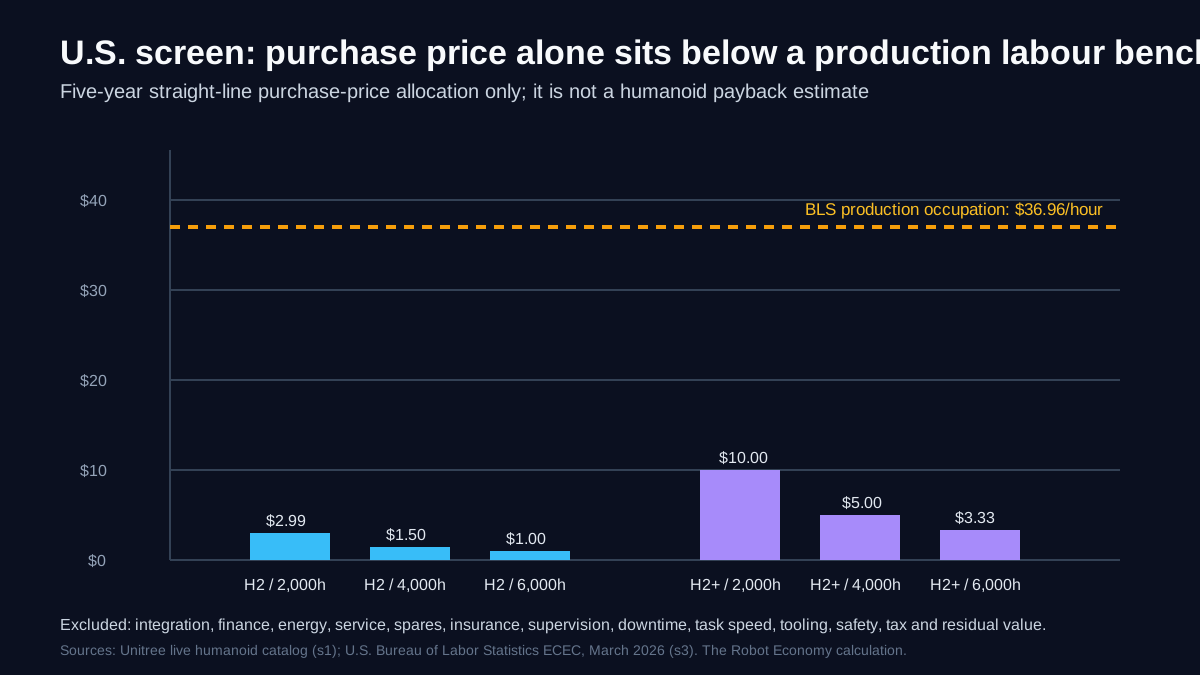
To show what the price documents can and cannot do, this report divides purchase price by five years and by three disclosed scenario ranges of 2,000, 4,000 and 6,000 productive hours per year. The calculation assumes neither a financing cost nor a residual value. It also deliberately excludes every operating variable named above. Under that screen, a 29,900-dollar Unitree H2 contributes 2.99 dollars per productive hour at 2,000 hours, 1.50 dollars at 4,000 hours and 1.00 dollar at 6,000 hours. A 100,000-dollar H2 Plus contributes 10.00, 5.00 and 3.33 dollars under the same hours. These are arithmetic results, not estimates of the robot's total cost or claims about what either machine can do in a customer workflow.[1,3]
For U.S. context, the Bureau of Labor Statistics reported March 2026 private-industry production occupations at 36.96 dollars per hour in total employer compensation, including wages and benefits. That labor figure exceeds the calculated purchase-price allocation in all six Unitree examples. The comparison is deliberately incomplete. A robot may require a human supervisor, may be slower than the task benchmark, may only run during part of a shift, or may add enough tooling and service cost to erase the apparent spread. Conversely, a machine that protects a scarce shift or improves quality might create value that is not captured by a direct labor substitution. The price-only screen establishes only that the purchase-price component is not automatically larger than the cited U.S. labor-cost context; it does not establish savings.[1,3]
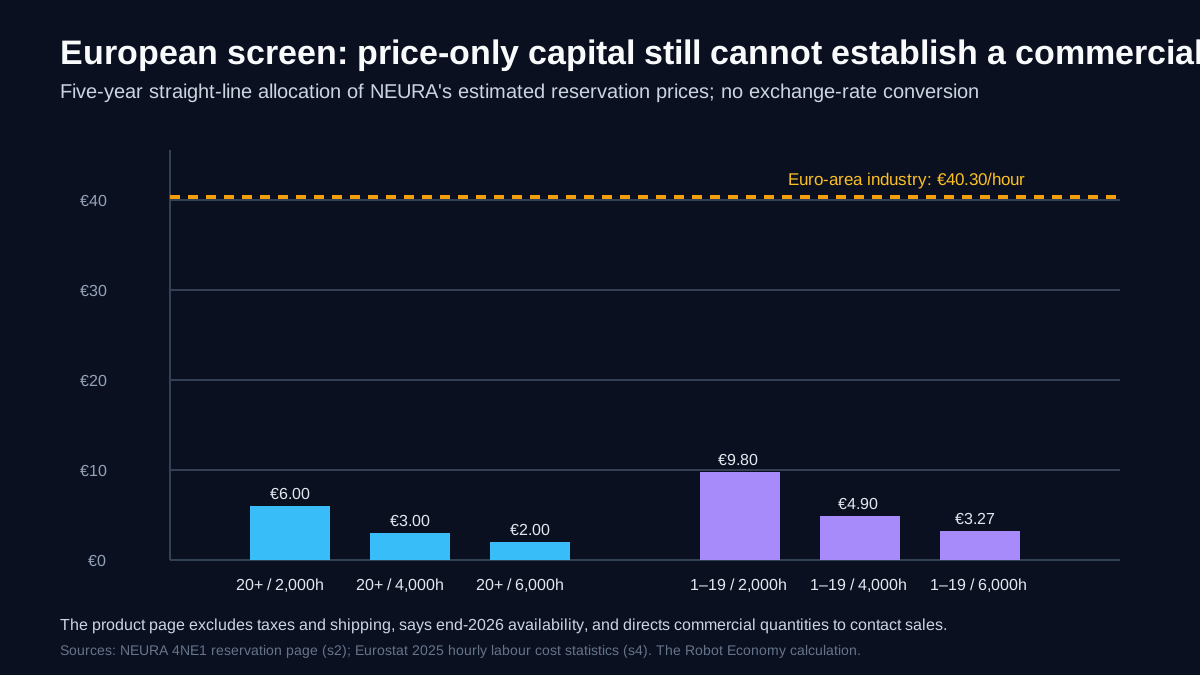
The European screen produces the same warning. NEURA's 60,000-euro estimated twenty-unit price becomes 6.00, 3.00 and 2.00 euros per productive hour across the three scenarios. The 98,000-euro one-to-nineteen-unit estimate becomes 9.80, 4.90 and 3.27 euros. Eurostat estimates euro-area industry labor cost at 40.3 euros an hour in 2025. That makes purchase price look modest in relation to an industry-level employer cost, but it is not a conclusion about any European plant. Eurostat's estimate covers enterprises with ten or more employees and is extrapolated from the 2020 Labour Cost Survey using the Labour Cost Index. NEURA's product page states a reservation price and expected availability, not a production-line task rate, a service commitment or a measured performance series.[2,4]
The model is most useful as a challenge to lazy pessimism and lazy optimism at the same time. It challenges the claim that humanoid hardware is automatically too expensive to study: the quoted purchase-price component can be small relative to local labor-cost context. It also challenges the claim that low capital allocation equals automation economics: a company cannot bank the apparent difference until it shows that work is completed at the needed rate and quality with an acceptable human-support burden. That burden may be near zero for a narrow, stable task, or it may dominate the project in a variable environment. The reviewed documents do not let a reader choose between those states.[1,2,3,4]
Regional labor is context, not a global ranking
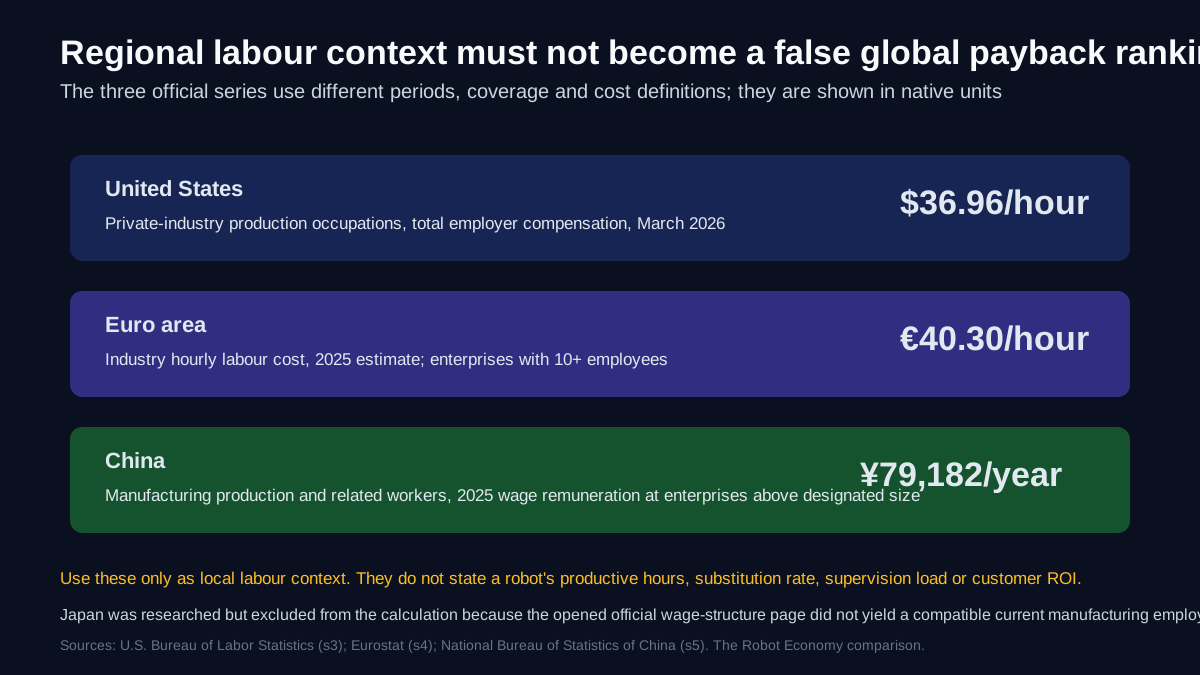
The China lane makes the comparability problem obvious. China's National Bureau of Statistics reports that manufacturing production and related workers in enterprises above designated size received an average annual wage of 79,182 yuan in 2025. This is wage remuneration, not hourly employer compensation. The U.S. series is an hourly employer-cost measure; Eurostat's series is an hourly labor-cost estimate with a different coverage and method; the Chinese series is annual wage remuneration in a defined enterprise group. Turning those three into one currency ranking would hide more than it reveals. The data still matters: buyer labor context differs by region, and a vendor's price must be tested locally. But no national wage series can tell a reader whether a particular humanoid replaces, augments, delays or merely adds human work at a specific plant.[3,4,5]
Japan was also researched because it is in the agenda's comparison set. The Ministry of Health, Labour and Welfare wage-structure page was opened, including its correction notice for the 2024 tables. It did not furnish a directly comparable current manufacturing employer-cost measure for this calculation, so the report excludes Japan from the arithmetic rather than filling the gap with a non-equivalent number. That is a limitation, not a claim about Japanese humanoid economics. A future version should add Japan only when an official source can be mapped transparently to the other inputs or can stand as its own clearly bounded local case.[6]
The missing variables are the payback variables
A rigorous humanoid case should disclose seven items together: delivered price and contract scope; installation and safety cost; productive uptime at the customer site; human supervision and remote-assistance minutes; task cycle and useful output; service, spares and energy; and the labor, quality or capacity baseline being changed. The two public product documents reviewed here publish portions of the first item and partial availability or order terms. They do not publish the remaining task-level series. It would be wrong to transform vendor capabilities, reservation prices or national wage pressure into a claim of autonomous labor replacement. The less dramatic, more useful conclusion is that public price transparency has arrived before public operating transparency.[1,2]
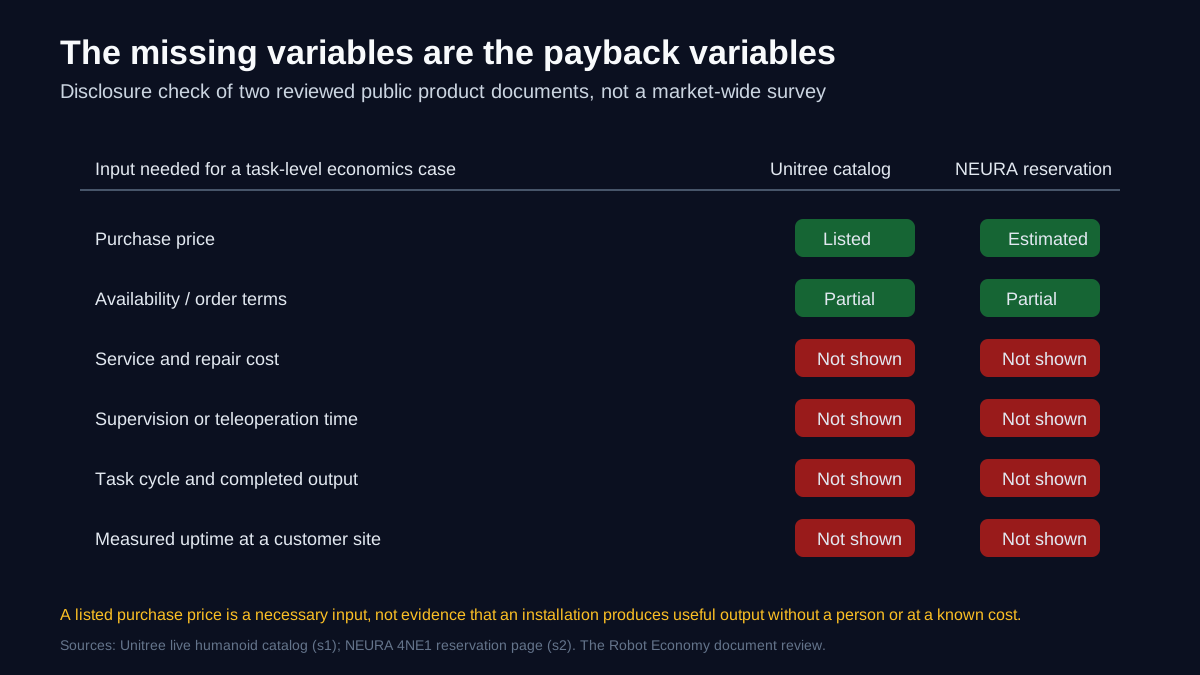
The operational comparison also has to name the economic counterfactual. In some sites the relevant alternative is a production worker; in others it is overtime, a temporary labor pool, a fixed automation cell, a delayed shipment, a quality failure or a task left undone because the line lacks capacity. A humanoid that allows a stable line to use an existing fixture may be assessed differently from a system that requires a new safety zone and dedicated attendant. These distinctions are why a credible customer disclosure needs output, intervention and cost boundaries together. They are also why this report does not put an ROI percentage, a vendor ranking or a national adoption forecast beside a retail price.[1,2,3,4,5]
What would change the conclusion
The report's base case is intentionally modest: public purchase-price information can make the capital floor legible, but it cannot establish a defensible operator payback. An upside case would require a named customer to publish a repeatable task with high productive hours, low exception handling, a defined supervision ratio and fully loaded service and integration terms. A downside case would be a disclosed project in which downtime, operator intervention, task variation or service costs consume the price-only spread. Neither outcome is implied by the catalog pages. The next useful work is not another market-size forecast. It is a small dataset of customer-site operating disclosures that allows the same task to be measured before and after deployment.[1,2,3,4,5]
- By 2027-06-30, a named customer publishes at least six months of task-level productive hours, intervention minutes, completed output, service cost and labor baseline for a humanoid installation; that record could turn this price screen into a testable ROI case.
- By 2027-12-31, comparable customer disclosures show whether a multi-shift humanoid installation keeps the price-only capital component below its fully loaded integration, service and supervision burden; that would strengthen or weaken the report's central disclosure finding.
- A vendor publishes a binding commercial quote that pairs price with service level, planned uptime, human-support assumptions and a defined output rate. That would invalidate the claim that the reviewed public documents leave the payback variables blank.