What the experiment established
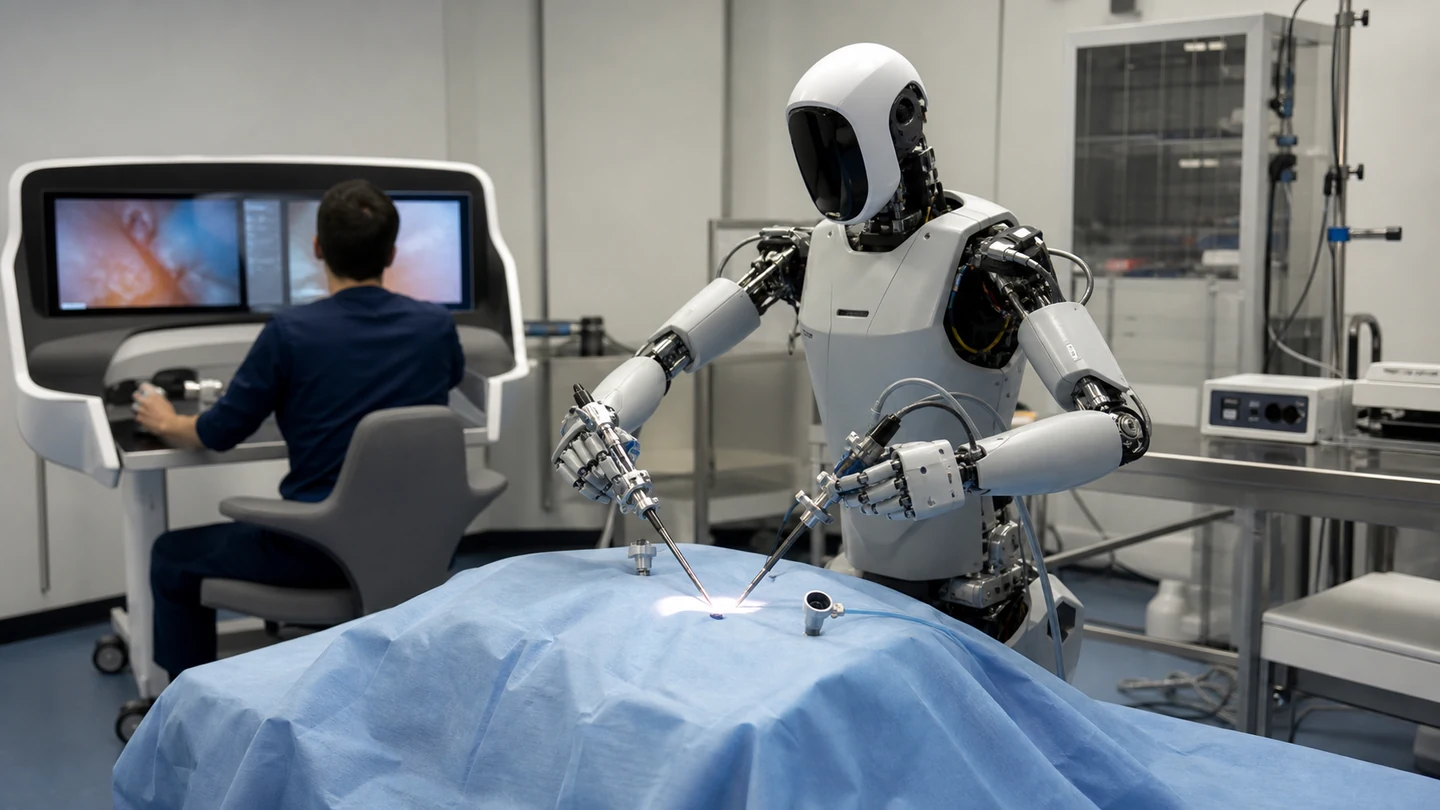
UC San Diego researchers report that a teleoperated humanoid surgical system completed two laparoscopic cholecystectomies in live pigs. The peer-reviewed Nature study used a Unitree G1 with manual wristed instruments and a surgeon-operated console; it was not an autonomous operation and did not involve human patients.[1,2]
The paper also benchmarks the system before the animal work. Eighteen participants performed a ring-transfer task, while 13 medically trained participants performed a standard peg-transfer task across humanoid, manual and surgical-robot conditions. The humanoid generally sat between manual operation and the more mature da Vinci platform, which remained faster and more accurate on the harder peg-transfer test.[1]
The workflow exposes the deployment gap
The two animal procedures show learning within a tightly controlled setup, not clinical readiness. Active console time fell from 56:15 in the first case to 31:59 in the second, and robot deployments fell from eight to four. Yet the cases still included two and three major pauses respectively, plus seven and four minor pauses. Major pauses covered recalibration or physical repositioning lasting at least three minutes.[1]
Human labor remained integral. Surgeons placed the ports, a human assistant handled most camera control, retraction and bedside adjustments, and a second humanoid assisted only briefly in the first case. Because compatible robotic clip appliers were unavailable, cystic duct clipping and cystic artery ligation were completed laparoscopically before the robot resumed gallbladder mobilization.[1,3]
The second case included minor biliary spillage and liver-bed bleeding, managed with suction and electrocautery; neither case converted to conventional or open surgery. The four-person post-procedure survey gave overall clinical readiness a mean score of 2.5 out of 5 and flagged range of motion, strength, recalibration and intermittent overheating. Those constraints—not the successful video moments—are the useful baseline for judging the next study.[1,2]
Independent coverage has emphasized the novelty of live surgery and the need for recalibration. The stronger interpretation is narrower: the study shows that a general-purpose humanoid can mediate precise surgical tool motion under expert teleoperation in two preclinical cases. It does not yet establish repeatability across sites, patient safety, regulatory readiness, cost advantage or autonomous surgical capability.[1,3]