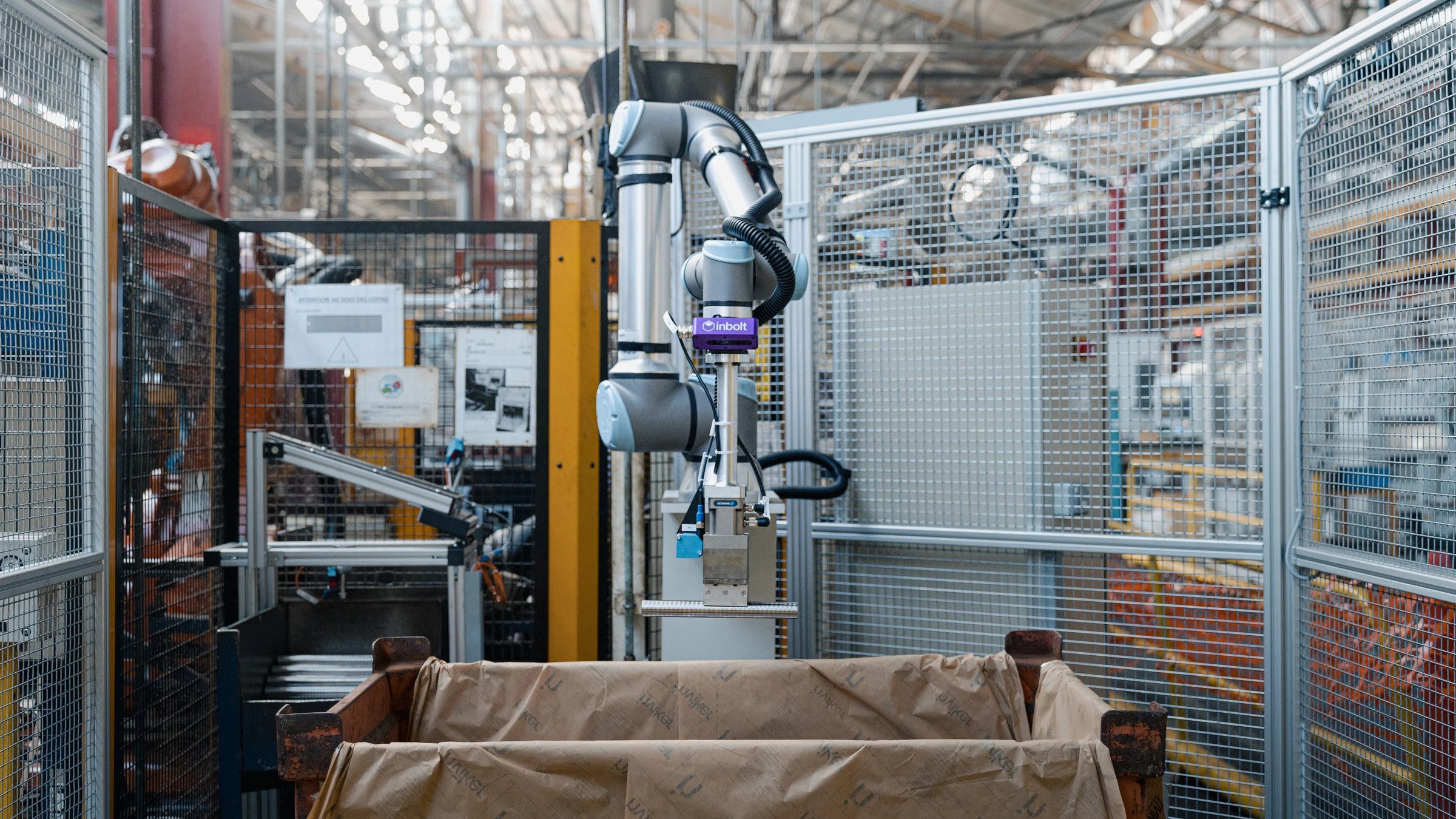
Capital for a repeatable factory upgrade
Inbolt announced €11 million in funding on September 30, 2026, in statements published by participating investors Shift4Good and Bridges Fund Management. Shift4Good led the round; BNP Paribas Développement and Ora Global also participated. The announcements put total funding at €30 million. They give no valuation or ownership terms, so the round establishes a financing milestone without showing how investors priced the business.[1,2,4]
Bridges says the capital will support expansion in the United States and Asia-Pacific and entry into data centers and electronics manufacturing. Its statement also reports a Detroit office opened in 2026. These are the announced uses of the money. They do not establish that the expansion has already produced new paid installations, or disclose how the budget is divided between sales, engineering and deployment support.[2]
The mechanism is integration
Inbolt’s June 2 technical commentary describes its approach as connecting perception to the robot’s existing programmed motion. It uses geometry from computer-aided design (CAD) models to locate parts and correct trajectories against their observed positions. The company argues that this can reduce the extra sensors, fixture checks and custom control logic needed in a cell. That is the supplier’s technical and economic proposition; the article does not treat its broader zero-integration language as a measured result.[3]
The commercial implication is a retrofit opportunity: improve how installed equipment handles variation in parts or positioning. Our analysis is that this creates two tests for the supplier. The first is whether a particular station performs its task reliably. The second is whether the next station can be delivered with less engineering effort. A successful custom installation can satisfy the first while leaving the second unresolved.[1,3]
Deployment counts leave the economics open
The investor announcements report more than 200 robots in more than 100 factories across three continents. Those figures are attributed deployment claims. The two releases repeat common material and come from financial backers; they are not independent audits of plant operation. Neither supplies a breakdown of paid installations, pilot work, robots per plant, deployment dates or customer retention. The counts therefore cannot establish average installation density or a repeat-purchase rate.[1,2]
The company’s public numbers also need care. In a LinkedIn post announcing the round, co-founder Rudy Cohen described more than 200 robots in more than 50 manufacturers’ plants. The investor releases say more than 100 factories. Both are lower-bound descriptions, so they are not necessarily contradictory, but neither explains the comparison’s scope or timing. We cannot use them to calculate installation density or infer how far customers have expanded beyond initial stations.[1,2,4]
For a factory buyer, a useful comparison would record engineering hours, commissioning time, accepted output and operating interruptions before and after an upgrade on comparable work. It would also include the camera, compute, licenses, training and service costs. These are evaluation criteria derived from the proposed integration mechanism. We have no cross-customer dataset here that would let us calculate the supplier’s typical payback or rank it against another system.[3]
The distinction matters as a supplier enters additional sectors. A reusable perception and control layer can still encounter application-specific work around tooling, inspection and recovery. Our inference is that the economic advantage strengthens when those tasks transfer between deployments. If every station needs extensive bespoke support, growing the installation base may also grow the delivery burden. The funding announcements do not disclose that burden or a service-margin measure.[2,3]
What would change the assessment
The next useful evidence is a series of customer-confirmed production deployments with a consistent measurement period and disclosed scope. Repeat orders from the same customer, a stated number of commissioning hours and comparable support needs would make the scaling question easier to assess. A single favorable case study would be informative for its own application, but would still leave the portfolio-wide result open.[1,2]
For now, the decision delta is specific: participating investors have announced additional capital for expansion of an existing industrial-robot vision business. The opportunity is to make useful factory upgrades repeatable. The evidence boundary is equally specific: financing and attributed deployment totals do not prove that integration costs have fallen across customers. The strongest next signal would connect new installations to accepted operating results and a delivery process that becomes easier to reproduce.[1,2,3]