The useful claim
Perceptron released Isaac 0.5 on August 26 as a 36-billion-parameter sparse model that puts video understanding, spatial grounding, task-state estimation and robot control behind one shared backbone. The release includes a technical report, a Hugging Face model card and a public code repository. That is a material new package for robot-learning teams, not just a staged demo: the published materials describe action interfaces, model manifests, evaluation settings and configurations for more than 35 robot interfaces.[1,2,3,4]
The release's central proposition is also genuinely interesting. Isaac trains on a mixture of general video, egocentric video, handheld-gripper data and robot trajectories. Perceptron says that, at a fixed action-loss threshold of 2.50, increasing general video from 1,000 hours to one million hours moves the within-grid teleoperation crossing from about 5,884 hours to 28. That is a data-efficiency result: it asks how much recorded robot control can be replaced in a specified training recipe, rather than claiming that raw video has taught a robot a new job by itself.[1,2]
What the report actually measures
That distinction is the decision delta. The 210.3× figure is a crossing on an offline action-prediction loss curve, and the report says the adjacent teleoperation measurements bound the ratio between 83× and 300×. It is not a direct measurement of the number of operator hours required to reach a real-world success rate. The authors also describe the exchange as conditional: at the low end of teleoperation, additional general video had almost no measured effect; the benefit settled only once the mixture included more action-grounded data.[1,2]
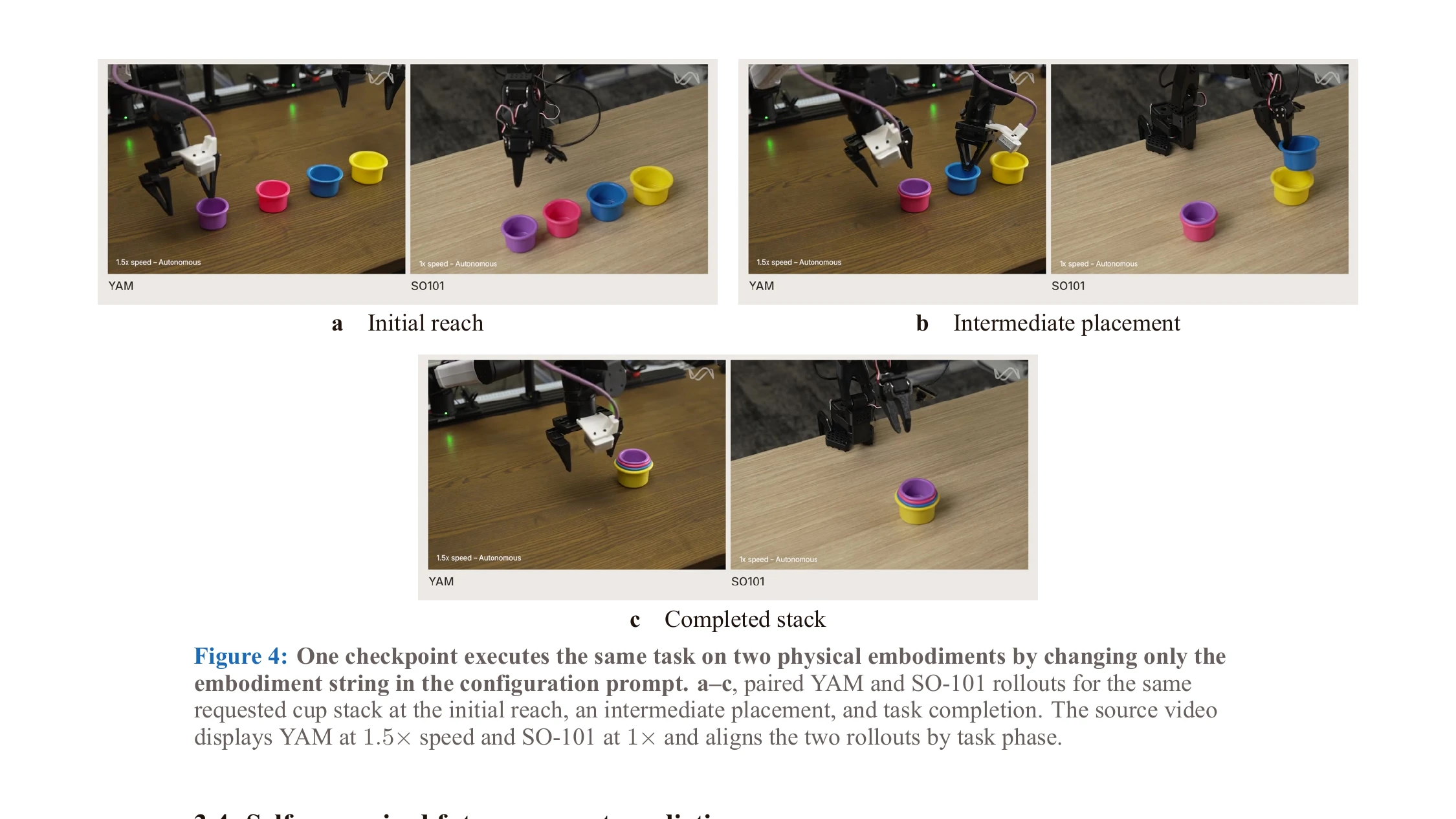
The scored control comparison is similarly narrower than a release headline suggests. Isaac reports a 97.2% average after adaptation across the four deterministic LIBERO suites, each using 500 benchmark-specific demonstrations. Those are useful simulation results, and the paper compares them with published baseline figures under their source protocols. But the report explicitly separates its physical cup-stacking, chess and T-shirt-folding videos from that scorecard, calling the physical rollouts qualitative demonstrations. The paper therefore does not establish a task-balanced physical success rate, field reliability or a customer operating result.[1]
Even the advertised 14.3 hertz policy rate needs that same discipline. The relevant table says Isaac's 70-millisecond figure is an architecture calculation for one H100 SXM at 40% of dense-BF16 peak, three 1,024-by-1,024 images and ten Flow steps. It is not a measured end-to-end deployment latency. That does not make the engineering work irrelevant; it means a prospective operator still needs a measured request shape, real hardware, a concrete control frequency and failure data before treating the number as a production constraint.[1]
Open is not yet runnable
The public-access boundary is more practical than philosophical. The model card directs users to a pinned Isaac repository and a pinned LeRobot submodule, rather than stock Transformers or stock LeRobot. The repository gives installation and fine-tuning commands and publishes its own code under Apache 2.0. That is meaningful release work: a team can inspect the declared interface, source revisions and the training path instead of taking a video at face value.[2,3]
But Perceptron's own README says the public extra does not declare the mHarmony runtime and that mHarmony and TensorStream are maintained separately. Its stated consequence is unusually clear: a clean checkout is not enough to render, train or run inference. The technical report also describes mHarmony as the component that validates and lowers heterogeneous video, state and action inputs before packing. So the released model is a substantial research artifact, while the one-command reproducibility path that would let an outside team test the reported stack remains incomplete.[1,3]
What changes for robot teams
The important conclusion is not that general video fails to matter. Isaac offers a concrete, inspectable hypothesis: once a model has enough action grounding, broad video may reduce the robot data needed to reach a specified offline prediction target. That can change how labs allocate collection budgets and which data mixtures they test. It does not yet show that a buyer can trade 210 hours of teleoperation for one hour of video work, nor that the same curve survives new objects, actuators, lighting, latency, safety limits or an unattended workflow.[1,2]
The next decisive evidence is modest and falsifiable: Perceptron or an independent team should make the declared runtime install complete, reproduce the pinned checkpoint from a clean environment, and publish task-balanced physical results with the same failure accounting used in the paper's simulation discussion. Until then, Isaac 0.5 is a consequential open research release and a useful data-collection thesis, not proof that video has removed the hard operational cost of robot learning.[1,3]