The Cabinet moved physical AI into the national plan
Japan's Cabinet adopted the second-phase Artificial Intelligence Basic Plan on July 14 under Article 18 of the AI Act. The final document makes vertical AI and physical AI national priorities. It describes physical AI as applying machine intelligence in the real world and names autonomous driving, factory and infrastructure management, and autonomous robots that work with people as target uses.[1,2,3]
The plan's most consequential number is an anticipated ¥10.5 trillion in combined public-private investment in physical AI, especially AI robots, through fiscal 2040. The figure appears in a footnote alongside separate estimates for vertical AI and core semiconductors. It is a policy envelope inherited from a June growth-strategy meeting, not a new appropriation, contract award or promise of government spending alone.[1,3,4]
The mechanism spans demand, components and electricity
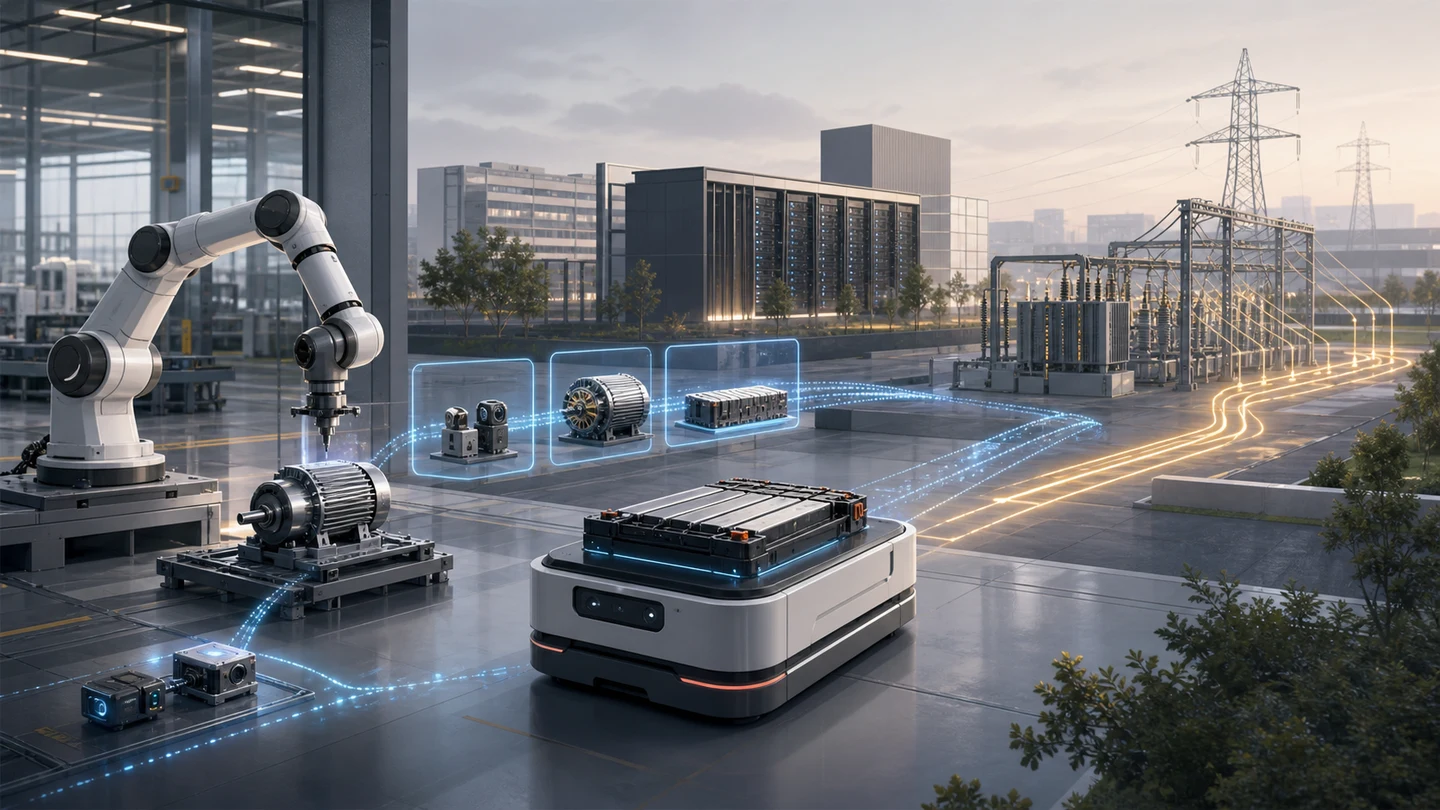
Across the AI program, government adoption and regulatory reform are supposed to create initial demand, while investment and research tax measures help draw in private capital. For physical AI specifically, the plan calls for a domestic foundation model, stronger domestic robot makers and system integrators, and reinforced design and supply capacity for motors, reducers, sensors, storage batteries and actuators. The policy therefore reaches beyond model research into the industrial stack needed to build and integrate machines.[1]
Power is a separate but connected constraint. The plan calls for coordinated electricity and communications infrastructure for AI, periodic checks of power-demand forecasts and stable supply for domestic AI infrastructure. Those provisions primarily address compute and data centers; they should not be read as a robot-energy subsidy. The robot supply-chain section separately names storage batteries among the components Japan wants to strengthen.[1]
An implementation vehicle predates the Cabinet decision. On June 30, AIST said that NEDO had selected a Noetra-AIST proposal to develop multimodal foundation models and physical-AI platform technology. Diamond reported on July 15 that this broader domestic development structure links research institutions, Noetra and new compute capacity. That project shows an existing route for implementation, but it is context—not evidence that the July 14 plan created a fresh award.[4,5]
The proof will be named budgets and deployments
The final plan supplies direction and a mechanism, but not an execution ledger. It names no annual physical-AI budget, procurement recipient, order volume, installation or deployment deadline. The next measurable catalysts are fiscal 2027 budget and tax measures, domain-specific strategies, and public procurement or testbed awards that identify who receives money, what is bought and when systems are expected to operate. Until those records appear, ¥10.5 trillion is an investment ambition rather than deployed robotics capacity.[1,2,4,5]