The voucher now has a supplier gate
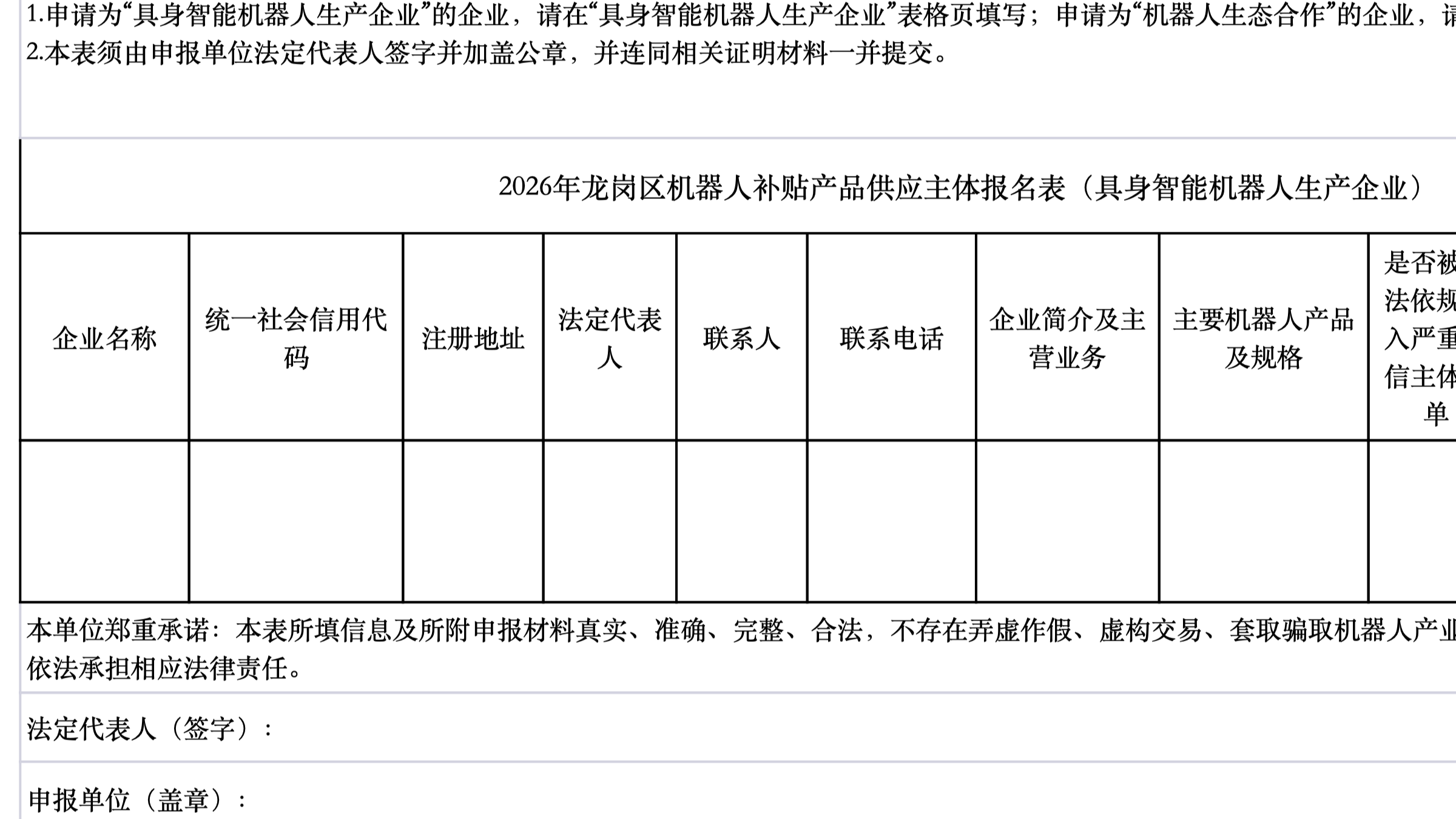
Longgang District in Shenzhen has begun selecting the companies that may supply products under its embodied-robot voucher scheme. An August 21 notice from the district's Artificial Intelligence (Robotics) Office invites two groups to apply: manufacturers that directly provide eligible robots, and ecosystem partners such as integrators, solution providers and agents that have a formal relationship with a manufacturer. Applications run through November 30, and the district says results will be released in batches after a compliance review. The notice is a supplier-selection action, not an award to a robot maker or a record of a buyer receiving a subsidy.[1]
The selection matters because the district's enacted implementation rules make the approved list a condition of the voucher. A buyer may use the support only for an embodied-robot product supplied either by a selected manufacturer or by a selected partner with a formal manufacturer relationship. The rules allow a voucher to offset up to 50 percent of the product price; each voucher has a face value of 100,000 Chinese yuan, and each user may receive no more than 1 million Chinese yuan in a year. Qualifying rentals must run for at least one year, and voucher redemption requires a contract, payment evidence, invoice and proof of delivery and use.[1,2]
The mechanism filters delivery, not only hardware
For manufacturers, the new gate asks for more than a product listing. Direct suppliers must show their own research, development and production capability, an actual production setting and compliance; the notice explicitly excludes traders and intermediaries. Ecosystem partners must show formal authorization from a robot manufacturer and an ability to deliver, install, commission and provide after-sales service. That makes the policy an attempt to shape a local delivery channel before public money offsets a transaction: the district is screening who bears the integration and service responsibility as well as which physical robot is sold.[1,2]
The implementation rules took effect on July 6 and run for three years, but they leave the voucher's detailed issuance, redemption process and management rules for the robotics office to publish separately. The district's policy explanation also says funding comes from the industrial and information-technology development special fund and is subject to overall budget control. Those boundaries matter: the new registry does not establish how much money has been allocated this year, whether any voucher has been issued, which products will make the list, or whether an eligible purchase has produced an operating robot at a customer site.[2,3]
The buyer subsidy has a hard financial boundary
The published numbers are a ceiling on an individual transaction, not a district spending commitment. A 100,000 Chinese yuan voucher can offset no more than half of an eligible price, so a buyer must still fund at least the other half. A buyer that reaches the 1 million Chinese yuan annual cap would need enough qualifying purchases or rentals to use ten vouchers, but the rules disclose neither an annual programme envelope nor the number of vouchers available. The rules also make the final reimbursement depend on documentary evidence of a real contract, payment, invoice, delivery and use. That creates a paper trail for a completed transaction, but not a published utilisation or performance record for the robot itself.[2,3]
There is also a local operating condition. A supplier without an operating entity in Longgang may apply, but must establish one in the district after selection. Combined with the direct manufacturer's production requirement and the partner's service requirement, that gives the policy a market-structure effect: an outside robot maker can access the channel, but the supported transaction must pass through a named local operating and delivery relationship. It does not prove that manufacturers will set up locally or that buyers will adopt their systems. It does identify the institutional path the district is creating for those decisions.[1,2]
What would show a real market effect
The ordinary reading is that Longgang has announced a robot subsidy. The more specific change is that it has opened the supplier registry the subsidy depends on. That can reduce buyer cost only after the district publishes eligible suppliers and operating voucher rules, then shows actual voucher redemption against deliveries or qualifying rentals. The strongest limit is therefore execution, not policy intent. The next measurable checkpoints are the first published supplier batches, a dated issuance and redemption guide, and records that identify a buyer, product, installation and verified use. Until then, the programme is a funded-policy framework with a newly opened access gate, not evidence of scaled embodied-robot adoption.[1,2,3]