The physical result is real, but narrow
A Texas A&M team’s August 25 NeurRAFT preprint argues that a neural motion planner can move a Franka manipulator through clutter with more clearance without adding a correction stage at inference. The authors report more than 500 physical planning problems across tabletop, drawer and shelf scenes. Their setup uses three depth cameras, varies obstacle placements, start configurations and goal poses, and tests a model trained entirely in simulation. That is materially stronger evidence than a short laboratory montage: the paper publishes task-family averages and its project page shows real-time clips. But the result remains author-reported preprint evidence, not an independent safety certification or a demonstrated production workflow.[1,2]
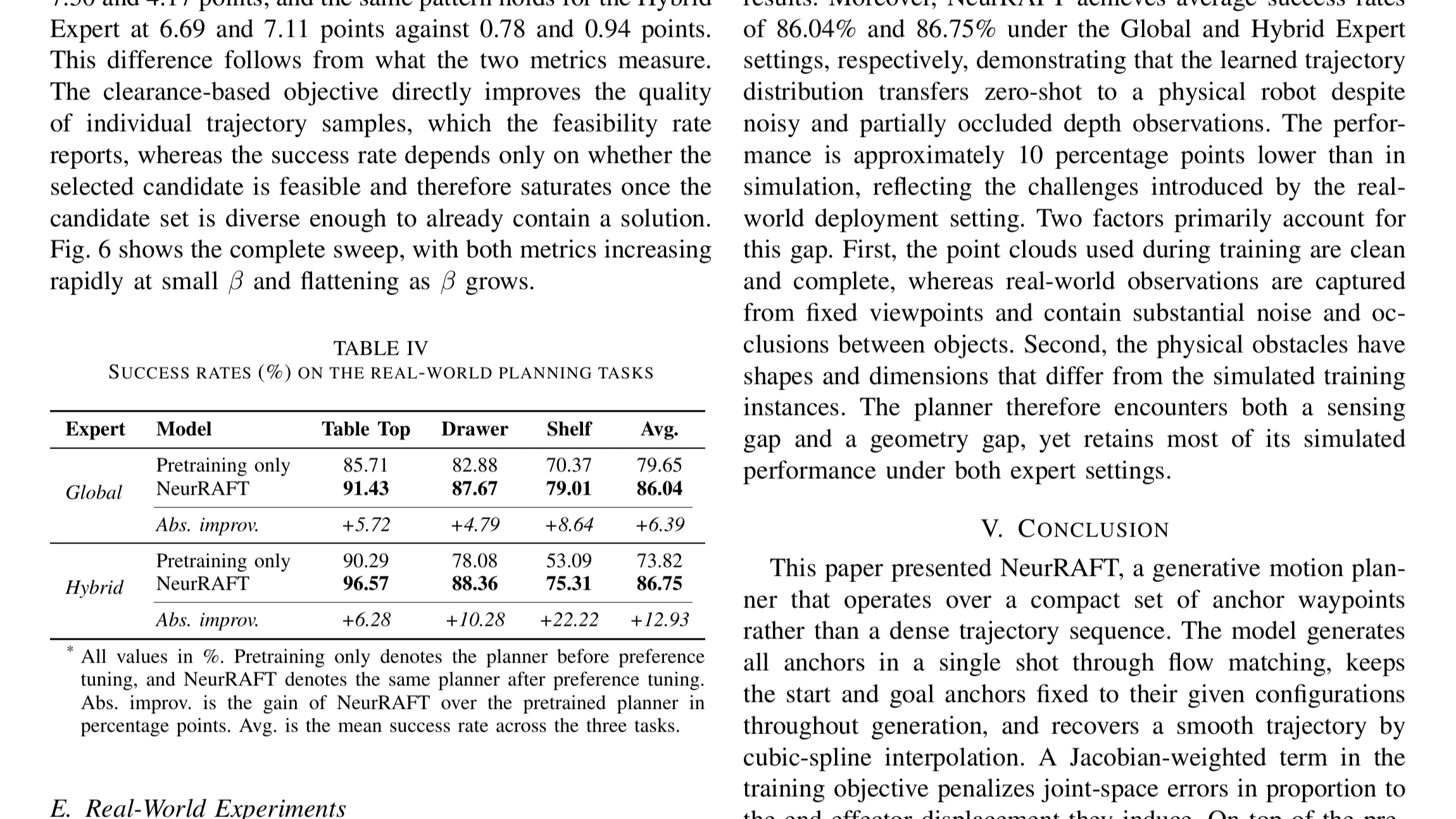
The reported comparison is useful because it holds the base planner fixed. Before clearance-aware preference tuning, the Global-expert version averaged 79.65% across the three physical task families; the tuned version averaged 86.04%, a 6.39-percentage-point gain. The Hybrid-expert version rose from 73.82% to 86.75%, a 12.93-point gain. Those are gains over the authors’ own pretraining-only model, not a comparison with a human operator, a certified motion stack or an industrial cell. The paper does not provide a public trial-by-trial log, per-scene count or independent rerun for those more-than-500 physical problems.[1,2]
Static clutter is not dynamic safety
NeurRAFT takes a point-cloud observation, fixed start configuration and target pose, then generates a complete trajectory. It uses more obstacle clearance as an offline preference signal during training, while its test-time planner works from the observed point cloud rather than a privileged scene model. That narrows one important problem: repeated planning around partly occluded static objects. The paper is explicit about the boundary. It assumes a static environment; if something changes while the arm is moving, the system must replan from scratch instead of continuously adapting the trajectory.[1]
That distinction changes the practical reading. A score on fixed tabletop, drawer and shelf layouts can indicate that an offline-trained planner has transferred across sensing noise and unseen object geometry. It does not establish behavior around a person reaching into the work area, a moving tote, a changing fixture or a delayed camera update. Motion planning is only one layer of a safe cell; this paper does not test protective stopping, human detection, task execution, grasp reliability, recovery, cycle time or uptime. It should therefore be read as planning evidence for static scenes, not as a safety or deployment result.[1,3]
The benchmark is large, but the release is not yet reproducible
The simulation scores are also more conditional than a headline number suggests. NeurRAFT is evaluated on MπNets test splits with 1,800 planning problems each, generated for a seven-degree-of-freedom Franka arm in tabletop, cubby and dresser scenes. Its best reported result uses multiple sampled trajectories and feasible inverse-kinematics goal configurations, followed by mesh filtering from the observed point cloud. That is a credible test of static motion planning under the benchmark’s defined conditions, but it is not one single-shot path through arbitrary clutter. The original MπNets project makes its data, checkpoint and evaluation files available, so its training and test boundary is inspectable.[1,3,4]
NeurRAFT does not yet offer the same audit path. The opened project page is anonymized for double-blind review and supplies method graphics, videos and reported charts, but no links to code, model weights, training data or the physical evaluation set. The preprint itself says the work was submitted to arXiv on August 25. Absence from those two opened author-controlled pages is not proof that material will never be released, but it means an outside lab cannot currently rerun the training pipeline or independently verify the physical-task accounting from the published materials.[1,2]
What changed
The important change is not that a robot arm is now proven safe in clutter. It is that this paper offers a bounded, testable alternative to inference-time refinement: preference-tune a compact trajectory generator against clearance before deployment, then measure whether that improves the raw trajectory distribution. The reported physical gains make the method worth tracking for static, vision-guided manipulation cells where new path candidates can be checked and replanned. The exposed industry mechanism is reliability engineering: reducing collision-prone plans could lower the amount of downstream correction logic a cell needs, if the effect survives outside this benchmark and hardware setup.[1,2,3]
The next measurable checkpoint is straightforward: release code, weights and the physical-evaluation protocol; publish per-trial outcomes and failure classes; then test moving obstacles, camera latency and recovery across another arm and cell layout. Until then, the strongest defensible conclusion is narrower than the paper’s high average: NeurRAFT has author-reported evidence of better static real-robot planning after clearance tuning, while dynamic safety, reproducibility and operating value remain unproven. That makes this a 3-out-of-5 supporting signal for The Briefing, not a field-readiness claim.[1,2,3,4]