What changed
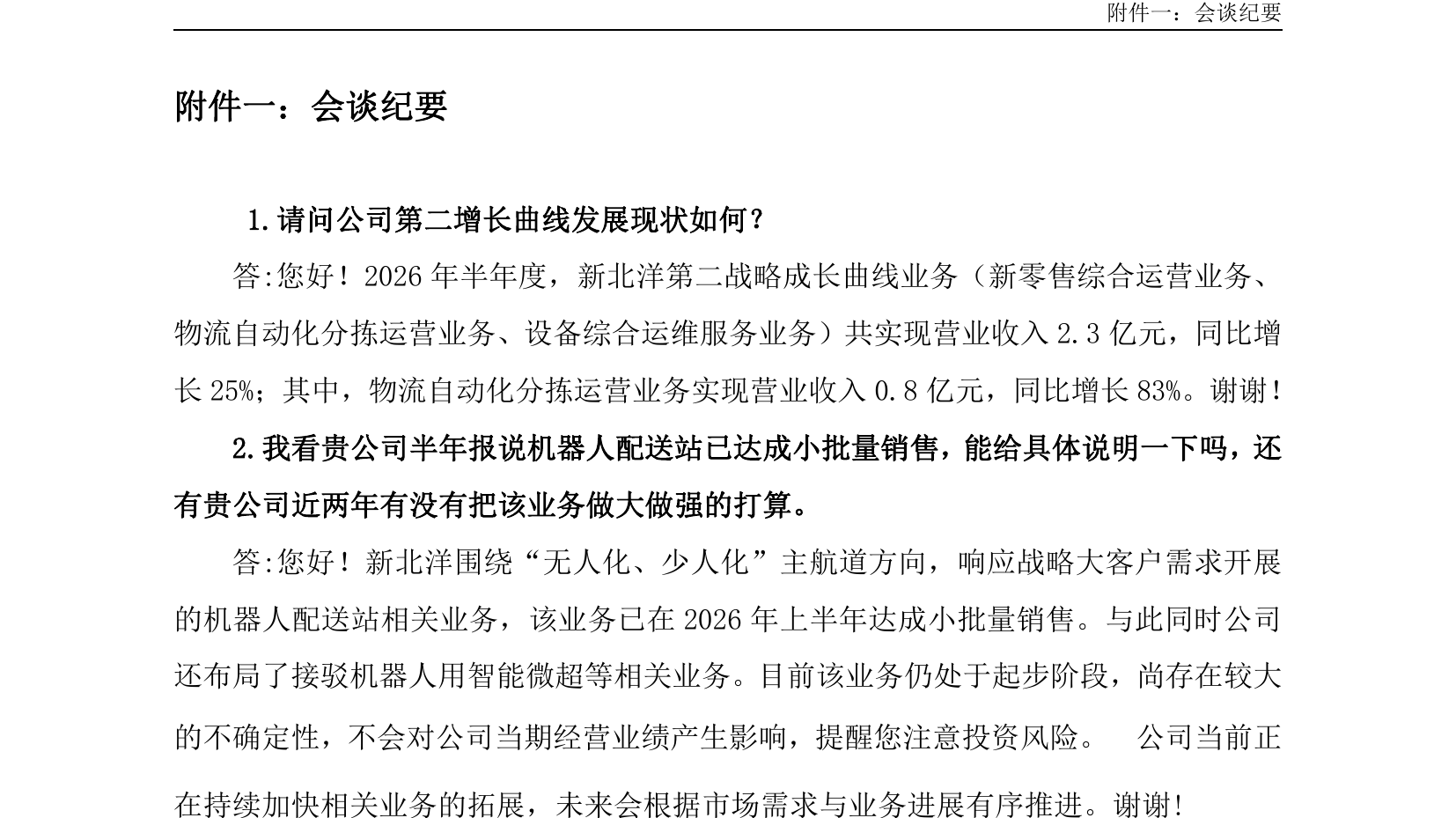
China's Securities Times reported on September 7 that Shandong New Beiyang told investors its robot-delivery-station business achieved small-batch sales during the first half of 2026. The company's investor-relations record says the work responds to strategic-customer demand and that it is also developing smart micro-supermarkets for shuttle robots. The record does not name those customers or describe a live site.[1,2]
New Beiyang's own account is cautious: the business remains at an early stage, carries substantial uncertainty and will not affect current operating results, while expansion will follow market demand and business progress. That caveat is the central fact, not a footnote. It marks commercial movement without proving an operating deployment.[1,2]
A commercial checkpoint, not scale proof
The disclosure changes the picture from a planned robotics adjacency to at least some completed sales, but it does not establish scale. The public record gives no unit count, contract value, buyer identity, delivery date, site, robot model, utilization, margin or repeat-order evidence. New Beiyang reported 527 million Chinese yuan of first-half smart self-service-terminal revenue, up 54 percent, but that broader segment cannot be assigned to the robot stations.[1,3]
This is a small commercial checkpoint inside a larger terminal business, not evidence that New Beiyang has built a scaled robot-delivery operation. The next useful record would be a named customer or site, delivered-unit count, recurring orders and operating measures such as completed deliveries, human intervention and service cost. Until then, the defensible read is small-batch sales with disclosed uncertainty.[1,2,3]