The advisory
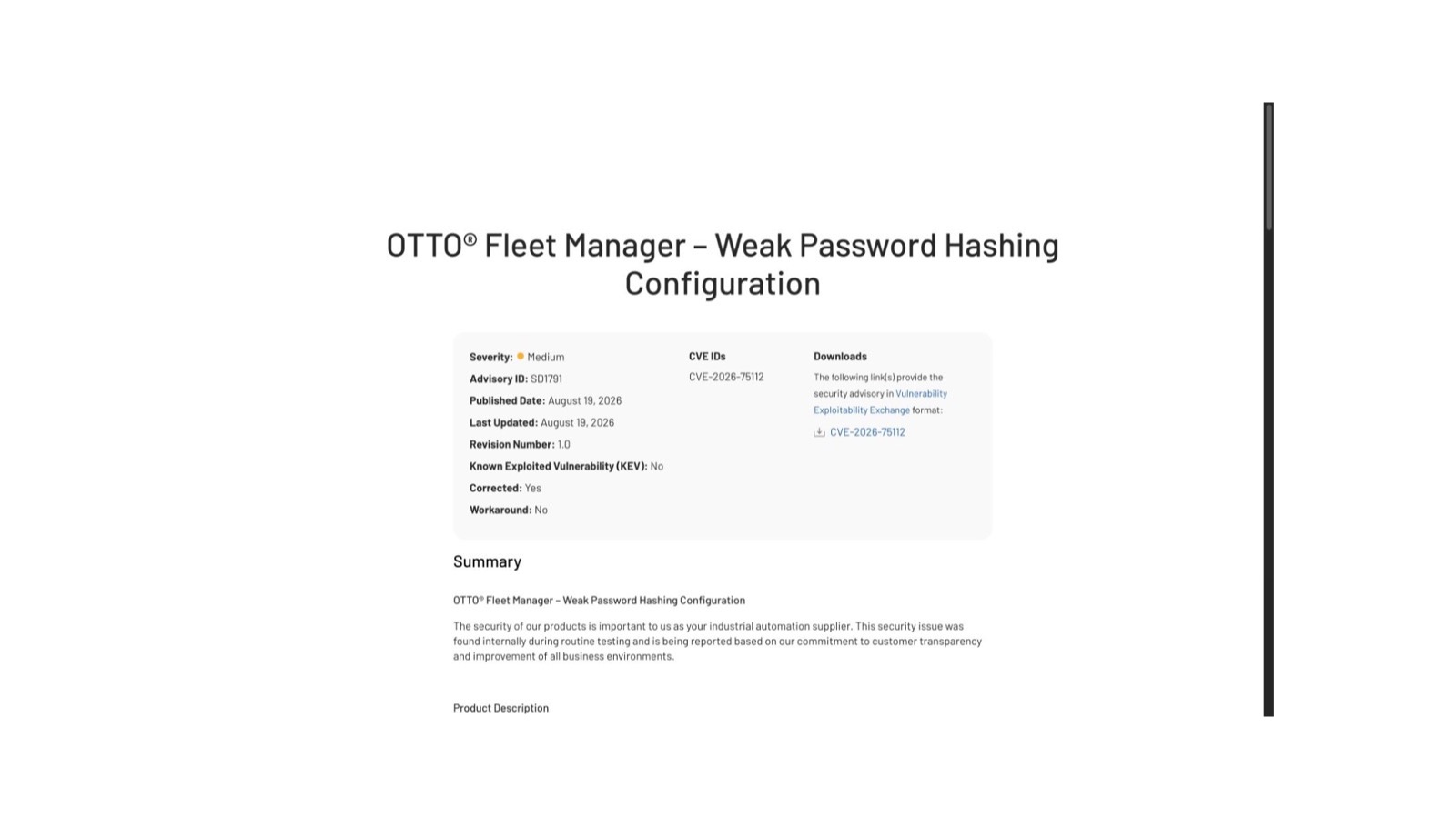
CISA’s Aug. 27 industrial-control-systems advisory gives operators a useful correction to the way this kind of robot-security notice is usually read. The affected product is Rockwell Automation’s OTTO Fleet Manager, the software layer used to coordinate OTTO autonomous mobile robots in industrial environments. Rockwell’s own advisory, SD1791, describes a weak password-hashing configuration in versions 2.36.2 and earlier. Version 2.36.3 is the corrected release. The advisory is therefore about the security boundary around a fleet-management system, not a newly demonstrated failure of autonomous navigation or a reported collision.[1,2]
The date and source split matters. Rockwell published SD1791 on Aug. 19 and marks it Medium severity, Corrected, and not a Known Exploited Vulnerability. CISA republished the issue as ICSA-26-239-03 on Aug. 27, and its record says there is no known public exploitation and that the issue is not remotely exploitable. Independent reporting from ISSSource repeats the same boundary and identifies 2.36.3 as the fixed version. That is enough to treat this as a live operator checkpoint inside the seven-day analysis window, but not enough to describe an active attack or an exposed robot fleet.[1,2,3]
The failure chain
Rockwell’s technical description places the weakness in the handling of stored credentials inside an unencrypted system backup. The password hashes use a bcrypt configuration with a weak work factor, which lowers the computational cost of offline guessing if an attacker first obtains that backup. This is a conditional chain: backup access comes first, and the advisory does not say that credentials were recovered. The important operational point is that a backup file is not just a recovery convenience. For a fleet manager, its storage location, encryption setting, passphrase ownership, and retention become part of the access-control story.[1,2]
The product role raises the consequence of weak custody without changing the evidence. OTTO Fleet Manager supervises work assignments, charging, parking, and traffic for autonomous mobile robots. Losing control of that supervisory layer could affect how a fleet is scheduled or recovered, but the public record does not establish that a cracked password would directly command a robot, bypass a safety controller, or defeat local protective measures. Those are separate technical and site-specific questions. The evidence supports a credential-protection gap around fleet operations; it does not support a robot-motion claim.[1,2,3]
What the evidence does not show
Three negative findings should stay attached to the headline. CISA says the issue is not remotely exploitable. Rockwell says it has no known exploited-vulnerability listing, and CISA records no known public exploitation. Neither primary advisory reports a compromised customer, a recovered credential, a fleet takeover, a safety event, or a robot moving outside its intended workflow. ISSSource also describes the issue as non-remote. These are not reasons to ignore the patch; they are reasons to keep the article inside the actual evidence boundary.[1,2,3]
The Medium rating is similarly not a measurement of physical harm. It reflects the disclosed software weakness and its conditions, while the path from an unencrypted backup to an operational consequence depends on who can reach the backup, which credentials it contains, how the cluster is configured, and what permissions those credentials carry. None of those customer-specific facts are public in the advisory. A responsible reading is therefore neither “only a CVE” nor “the robots are compromised.” It is a security control that can fail before a site has evidence of a live incident.[1,2]
The patch is also a process
Rockwell’s remedy is version 2.36.3 or later. The same advisory says that corrected versions support configurable encrypted system backups, but also that creation and restoration of unencrypted backups remain supported. That detail changes the meaning of “patched.” A version upgrade closes the weak hashing configuration identified by the vendor, but it does not by itself prove that an operator has stopped creating unencrypted copies or that legacy backups have been removed from accessible storage. The software fix and the backup-governance check are separate steps in the same remediation chain.[1,2]
The operator checkpoint is practical and bounded: inventory OTTO Fleet Manager versions across each cluster, identify where system backups are stored, verify whether encryption and a controlled passphrase are actually in use, and document which accounts could restore or administer the manager. Sites should handle credential rotation and legacy-backup retention under their own change-control process, with Rockwell or an integrator consulted where cluster configuration is unclear. This is defensive hygiene, not an instruction for testing a live target. It is also the information missing from the public record today: patch coverage, backup coverage, and evidence that the control is working in customer environments.[1,2]
The decision delta
The usual summary of CVE-2026-75112 would be “upgrade to 2.36.3.” The stronger systems reading is “prove that backup custody is part of the fleet safety case.” OTTO Fleet Manager sits above physical workflows, so credential protection and recovery controls deserve an explicit handoff between cybersecurity, automation engineering, and site operations. The current record supports a medium-severity, non-remote software issue with a clear fixed version and no known exploitation. It does not support claims about robot takeover, customer impact, or field-wide remediation. The next decision-changing evidence would be confirmed exploitation, a CISA KEV change, an updated vendor control, published patch-coverage data, or an operator account of how encrypted backups are handled in production.[1,2,3]