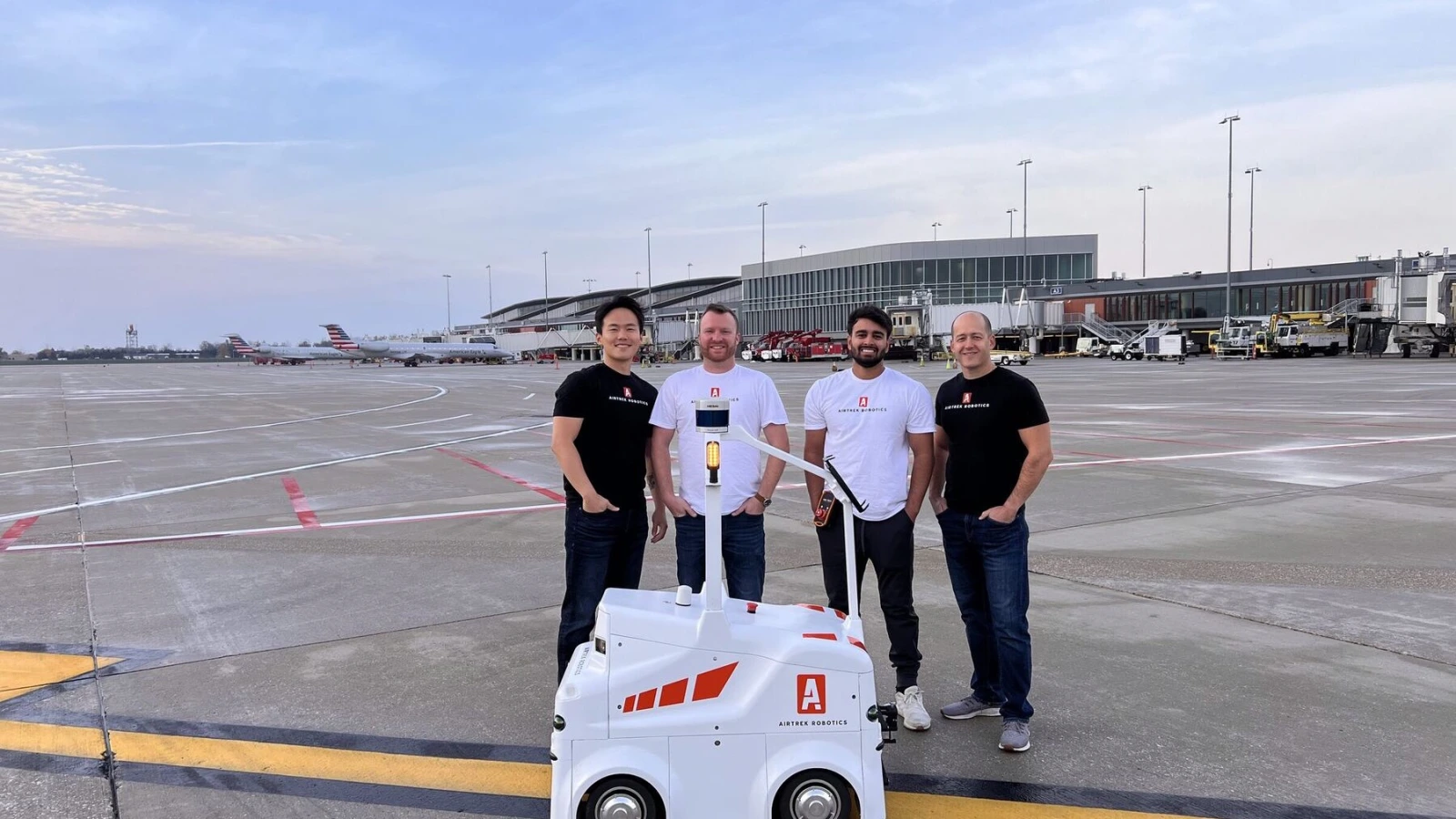
A live aviation task, not a demo
Pentastar Aviation has begun deploying autonomous robots beside aircraft during towing at Oakland County International Airport in Waterford, Michigan, according to an August 24 report by the Association for Advancing Automation. Aviation International News reported on August 19 that Pentastar was the first fixed-base operator to adopt the technology. The move puts a narrow robot task into day-to-day airport work: watching the aircraft’s clearance while a tug moves it.[1,2]
Airtrek’s Groundwatch uses two autonomous mobile robots, typically one near each wingtip. Cameras and LiDAR monitor the aircraft and surrounding obstacles, while alerts reach the operator if a potential conflict is detected. The tug operator still controls the aircraft movement. That distinction matters: this is automated perception and warning around a tow, not an autonomous aircraft tug or a driverless ramp operation.[1,3]
The robot sees; the operator still drives
The underlying patent application describes the operating boundary in more detail: a robot identifies an aircraft part, positions itself beside it, tracks that part as the aircraft moves and issues visual or audible alerts when obstacles are detected. It also describes a mobile interface and charging workflow. Those are design disclosures, not proof that the system achieves its claimed accuracy or reliability in field operations, so the current evidence supports the deployment’s task boundary rather than a performance claim.[3]
The staffing model is narrower than a simple replacement story. A3 reports that a technician initiates the robots and that one technician can initiate multiple units; Pentastar has said affected employees can move to other activities such as customer service. The system therefore shifts work from walking beside an aircraft toward initiating, supervising and reviewing a machine-assisted safety layer. It does not remove the human responsible for the tow.[1]
The commercial test is still ahead
Pentastar and Airtrek have not publicly disclosed enough operating data to calculate labor savings, cost per tow or payback. The company expects full implementation by the fourth quarter of 2026, which creates a measurable checkpoint: how many tows the robots cover, how often they generate alerts or require intervention, how much technician time remains attached to each movement, and whether the same hardware is used for foreign-object-debris detection or aircraft inspection between tows. Until those figures appear, the deployment proves a buyer is testing routine use of a constrained safety robot—not that airport automation economics have been solved.[1,3]