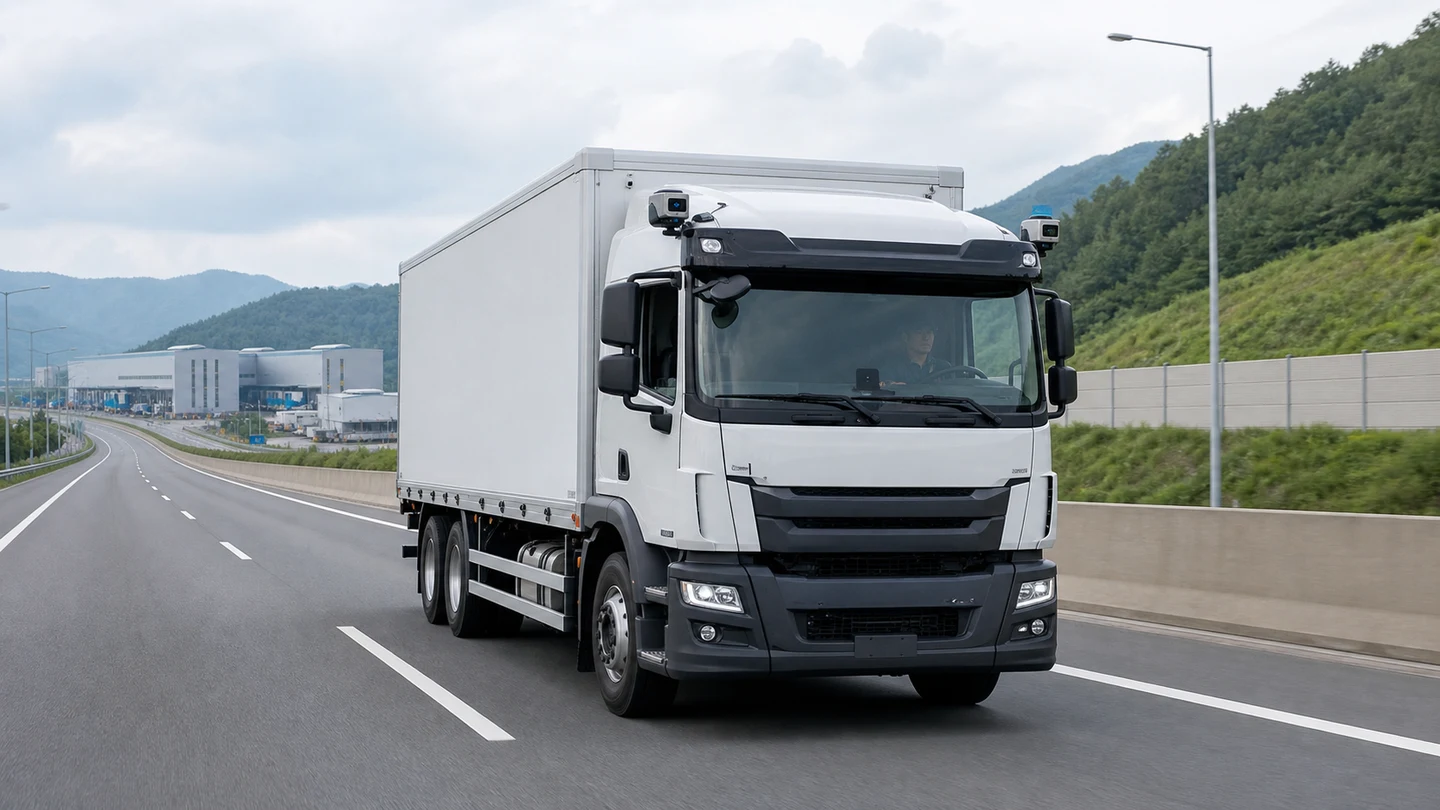
The commercial milestone is paid freight, not an empty cab
RideFlux said it began paid autonomous freight service with Hanjin Parcel on July 1, moving real parcel loads from a special-cargo customs centre in Gunsan through Hanjin's Jeonju parcel centre to the Daejeon Mega Hub. The supplier describes a one-way route of 116 kilometres, operated twice a week in daytime with a Tata Daewoo Maxen 25-ton truck. The vehicle can carry up to 11 tonnes of parcels and travel at up to 90 kilometres per hour. A professional safety operator remains in the driver's seat.[1,2]
Hanjin's July 9 announcement, reported by ZDNet Korea, independently confirms that the programme has moved beyond unpaid testing into commercial parcel transport. That distinction matters: the truck is performing a revenue-linked logistics task on a named operator's network. It does not mean the route is driverless. ZDNet says the safety operator can intervene when required, and none of the reviewed sources quantifies how much of each journey is completed under autonomous control or how often that intervention occurs.[1,2]
Commercialization arrives before labor removal
The operating model is therefore supervised autonomy, not driver-out freight. RideFlux says it will conduct another two to three test runs per week alongside the two paid services, using those journeys for data collection and system refinement. Revenue work and development work are happening on the same corridor at the same time. The immediate product is a truck that can enter a paid Hanjin workflow with a trained human fallback, not a labor-free linehaul service.[1,2]
That sequence is commercially important because it separates two milestones that are often collapsed into one. A supplier can begin billing for autonomous capability while keeping a safety operator aboard, learning the route and proving integration with live terminals. The buyer can accumulate operating data without yet accepting the technical and regulatory burden of an empty cab. The economic benefit at this stage could come from experience, consistency or future option value, but the sources do not show a current labor saving, cost reduction or productivity gain.[1,2,4]
The public operating figures do not yet reconcile
The two launch records differ on basic operating units. RideFlux's July 1 account says the route is 116 kilometres one way and carries two paid services per week, plus two to three separate test runs. Hanjin-derived reporting on July 9 says the route covers 118 kilometres and operates three times weekly. Electronic Times, citing Jeonbuk Province, also reports 118 kilometres and three weekly services. The sources may be using different endpoints or counting a different mix of paid and test journeys, but none explains the difference.[1,2,3]
The discrepancy is small in distance but material for operator analysis. Route length and service cadence are the denominators for utilization, revenue per kilometre, cost per run and safety performance. Until Hanjin or RideFlux publishes a common definition of a paid run, the number of completed journeys and the distance actually driven under autonomous control, the launch supports a commercial-status claim but not a reliable throughput or unit-economics calculation.[1,2,3]
The route sits on a government-backed operating stack
This is not a supplier-only road test. South Korea's Saemangeum autonomous-transport programme lists Hanjin as a beneficiary and describes a support stack that includes commercial-vehicle test infrastructure, road monitoring, a digital twin, vehicle-control systems and data services. ZDNet says Hanjin provides the logistics network and commercial parcel volume, the Jeonbuk Institute of Automotive Convergence Technology supports the vehicle and test infrastructure, LX's Spatial Information Research Institute built monitoring, and the Korea Integrated Logistics Association supports programme operations.[2,4]
The institutional stack helps explain why a paid route can start with human supervision. The programme can validate the vehicle, route and terminal processes while a safety operator remains the final fallback. It also means the deployment should not be treated as proof that a standalone software supplier has already solved every operating layer. Vehicle integration, road infrastructure, remote monitoring, terminal readiness and regulatory approval all sit around the autonomy system.[2,3,4]
The next proof is a route-level operating record
RideFlux says it aims to extend paid freight to other Korean regions and bring driver-out capability to middle-mile trucking in 2027. Those are targets, not achieved operating states. The next useful evidence is narrower: a shared route definition, paid runs completed, tonnes moved, autonomous-driving share, interventions, safety events, uptime, terminal dwell time and the cost of the safety-operator and monitoring layer. Tariff, contract value and operating cost would then show whether paid service is also repeatable business.[1,2,3]
The defensible conclusion today is that supervised autonomous trucking has crossed a commercial threshold on a named Hanjin parcel route. That is stronger evidence than another closed-course demonstration and weaker evidence than a driverless network with published economics. The safety operator is not a footnote to the story; the operator is the boundary that makes the current service possible while the companies continue testing what they hope to remove later.[1,2,3,4]