The gain survives a strict-success check
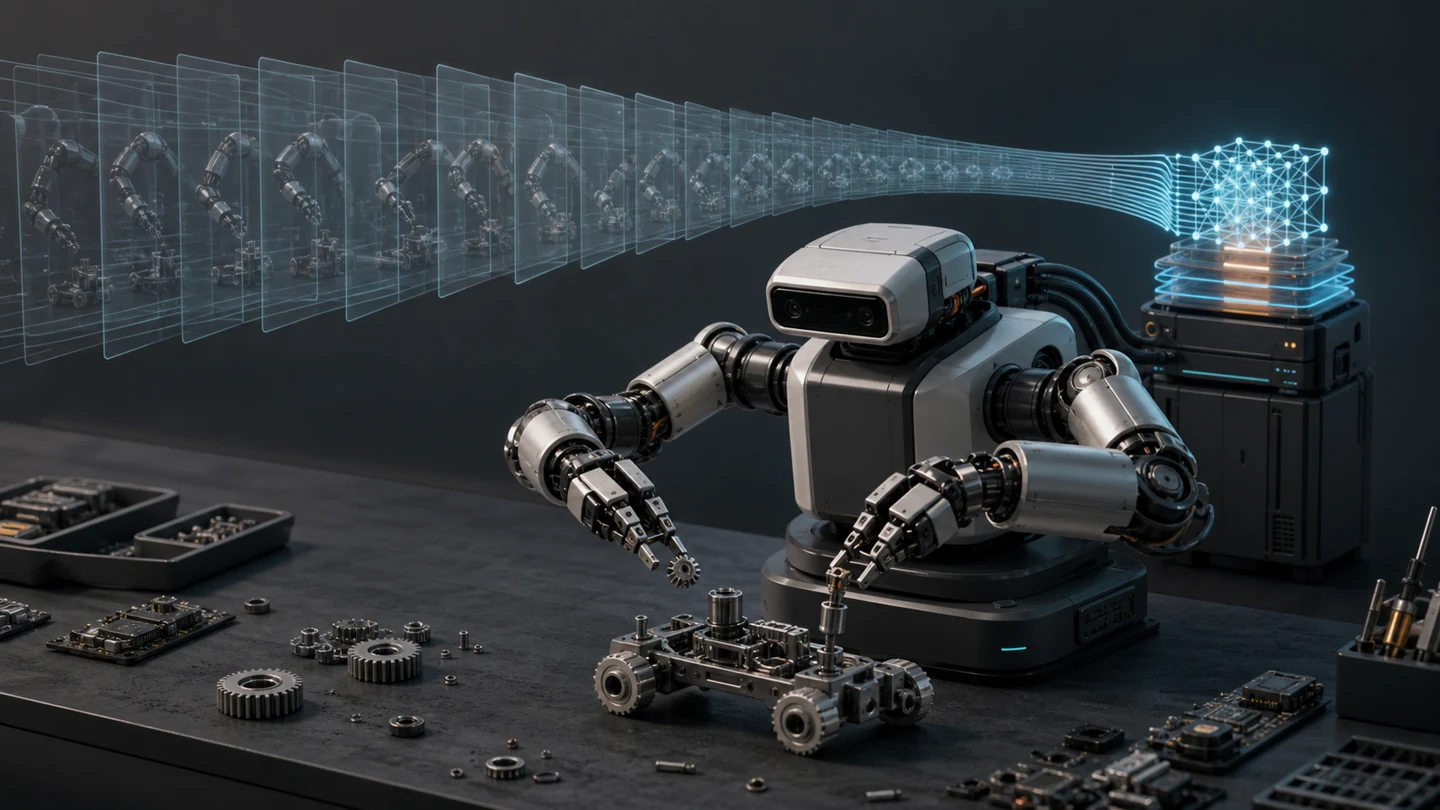
A team from NVIDIA, Stanford University and the University of Texas at Austin has stretched a robot policy's visual-action context to 8,000 timesteps, about five minutes at the reported 30-hertz control rate. RoboTTT was tested on three multi-stage assembly tasks using one YAM bimanual tabletop robot, four RGB cameras and an RTX 5090 workstation. The authors report an average rubric-based task-completion score of 79%, compared with 42% for single-step GR00T N1.7, 49% for a one-history-frame version and 56% for a recurrent-memory baseline.[1,2]
The strict result is smaller but still material. RoboTTT fully completed 9 of 20 Pup Go Car trials, 13 of 20 unseen Circuit trials and 2 of 10 Gear Bot trials: 24 full successes in 50 attempts. The 79% headline is therefore a partial-completion score, not a success rate. Its task rubrics award credit for intermediate stages such as picking up a part, placing a component or completing one step in a ten-stage build.[1,2]
RoboTTT was the only evaluated policy to finish the longest Gear Bot assembly at all, which makes the result more than a demo reel. Yet two completions in ten trials does not establish dependable five-minute autonomy. The useful decision change is narrower: long visual-action history can improve closed-loop manipulation on this setup, but the most demanding task remains failure-prone.[1,2]
History becomes a model inside the model
RoboTTT's mechanism is a set of fast weights. The researchers added a two-layer neural network after the attention blocks in each of GR00T N1.7's 16 diffusion-transformer layers. At every timestep, gradient descent updates those small networks from the incoming stream; their fixed-size parameters then carry selected history forward. That avoids retaining and repeatedly attending over every past frame. The additions increased the action head from 538 million parameters to a 690-million-parameter model.[1,2]
Training long sequences still costs compute. The team used sequence action forcing and truncated backpropagation so fast weights could cross segment boundaries while training memory stayed bounded. It pretrained the added sequence layers for 30,000 steps on 16 GB200 GPUs, then post-trained each task for 20,000 steps on eight GPUs. In the context-scaling experiment, the 8K model reached a 71.5% partial score, versus 43.9% for the same architecture pretrained at 1K and 45.6% for the best short-context baseline. Those scaling evaluations preceded the DAgger correction training used in the main Pup Go Car result, isolating the context-length comparison from that later procedure.[1]
Longer history is not automatically better. An independent Gated Memory Policy study published in April found that simply extending observation histories could degrade manipulation policies through overfitting and distribution shift, and instead learned when to retrieve cached history. RoboTTT takes a different route by compressing the stream into gradient-updated parameters. The studies use different robots, tasks and baselines, so they are not a leaderboard comparison; together they show that the update and retrieval rule matters at least as much as the nominal context length.[1,3]
Context is not autonomous learning
The same fast-weight channel enabled two additional author-reported behaviors. Given one human video of an unseen Circuit configuration, RoboTTT fully succeeded in 6 of 10 trials while the recurrent baseline succeeded in none. Its DAgger Distillation procedure also improved RoboTTT's partial task score by 36% using a shared pool of 100 previously collected trajectories containing human corrections. At evaluation time the policy can react without a person intervening, but the learned correction pattern still comes from human-supervised data; this is not autonomous online exploration or open-ended self-improvement.[1,2]
The evidence boundary is one bimanual platform, three tabletop assembly tasks, 19 total hours of task-specific robot data and 10 to 20 trials per task. The authors acknowledge that training cost rises with context length and that the policy does not handle every deployment failure. At the time of review, neither the paper nor the NVIDIA project page linked RoboTTT code, model weights or the task dataset, preventing an independent rerun. The next measurable catalyst is an artifact release followed by cross-platform tests reporting strict full-task success, interventions, recovery after mistakes and measured per-step compute and latency—not only partial progress scores.[1,2,3]