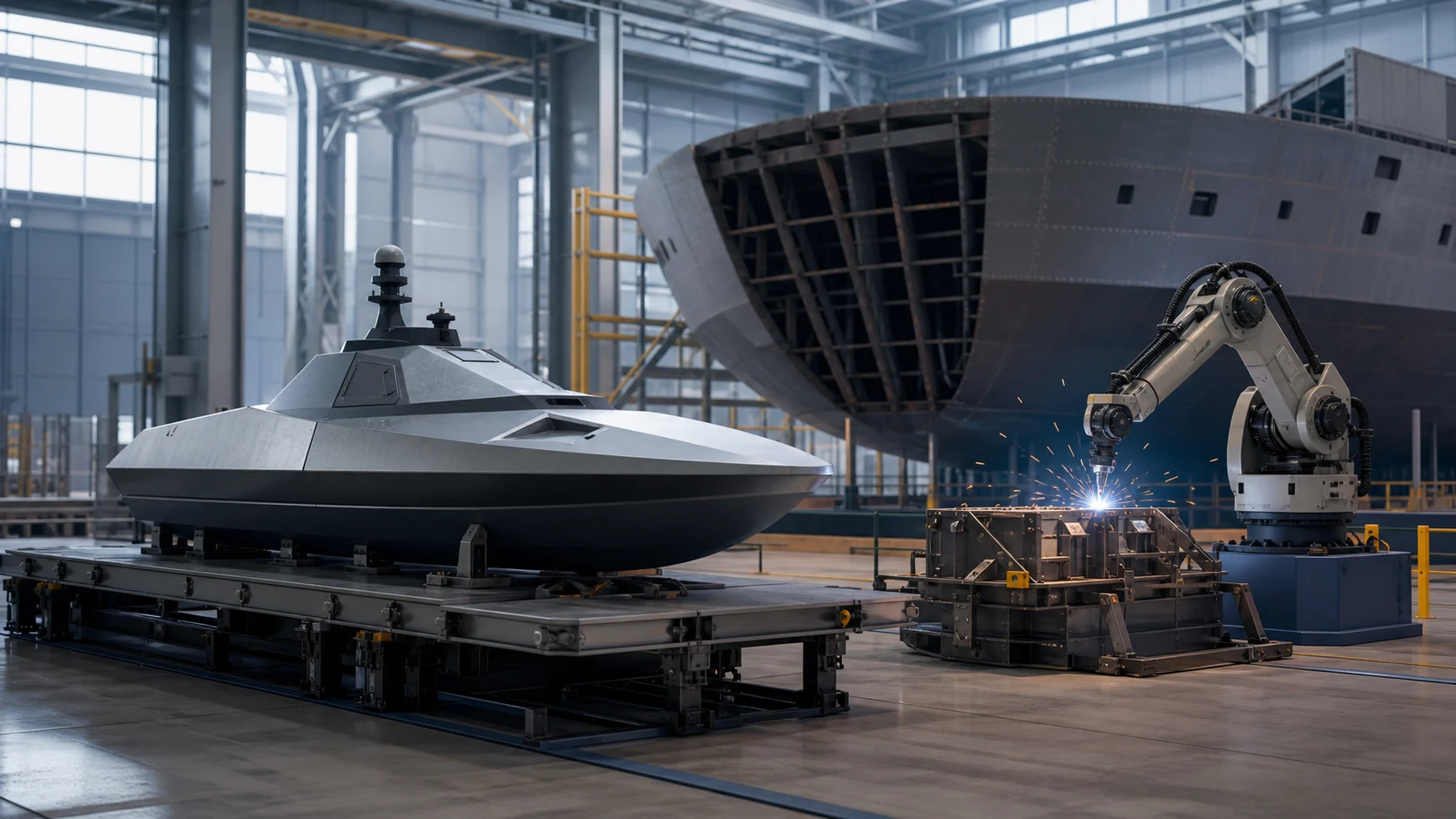
A named production partner changes the capacity question
Saronic Technologies and South Korea’s Samsung Heavy Industries announced a strategic partnership on July 23 to explore autonomy-capable vessels, artificial-intelligence-powered digital shipbuilding and robotics-based process automation at Saronic’s U.S. shipyards. The companies unveiled it at the Korea–U.S. Shipbuilding Partnership Center in Washington. WorkBoat, Inside Defense, Naval Today and ZDNet Korea separately report the agreement and its stated scope.[1,2,3,4]
The pairing links a U.S. autonomy developer with a shipbuilder that says it has production automation and autonomous-ship capabilities. Saronic’s official site describes Port Alpha as a next-generation shipyard and identifies the 180-foot Marauder as a medium unmanned surface vessel. Those are company descriptions and plans, not evidence that Samsung systems are installed or that Port Alpha is operating.[5,6]
The agreement is a capacity option, not a contract
The decision delta is a named Korean industrial partner for production technology and maritime autonomy, alongside Saronic’s existing U.S. yard-expansion story. The mechanism is clear enough to test: pair Saronic’s autonomy and vessel-design work with Samsung’s ship-design and process-automation capabilities to address the production and workforce bottleneck. The exposed parties are the two companies, U.S. shipyards, maritime workers, government and commercial buyers, and allied industrial-base planners.[1,2,3,4,5,6]
The limit is the legal and commercial status: the sources call it a strategic partnership and say the companies will explore; they disclose no purchase order, committed capital, vessel count, customer, installation date, delivered hull, autonomy test or process metric. The next checkpoint is a signed work package, installed automation, a first jointly supported hull, and published throughput, quality or labor data. Until then, this changes the capacity option, not proven output.[1,2,3,4,5,6]