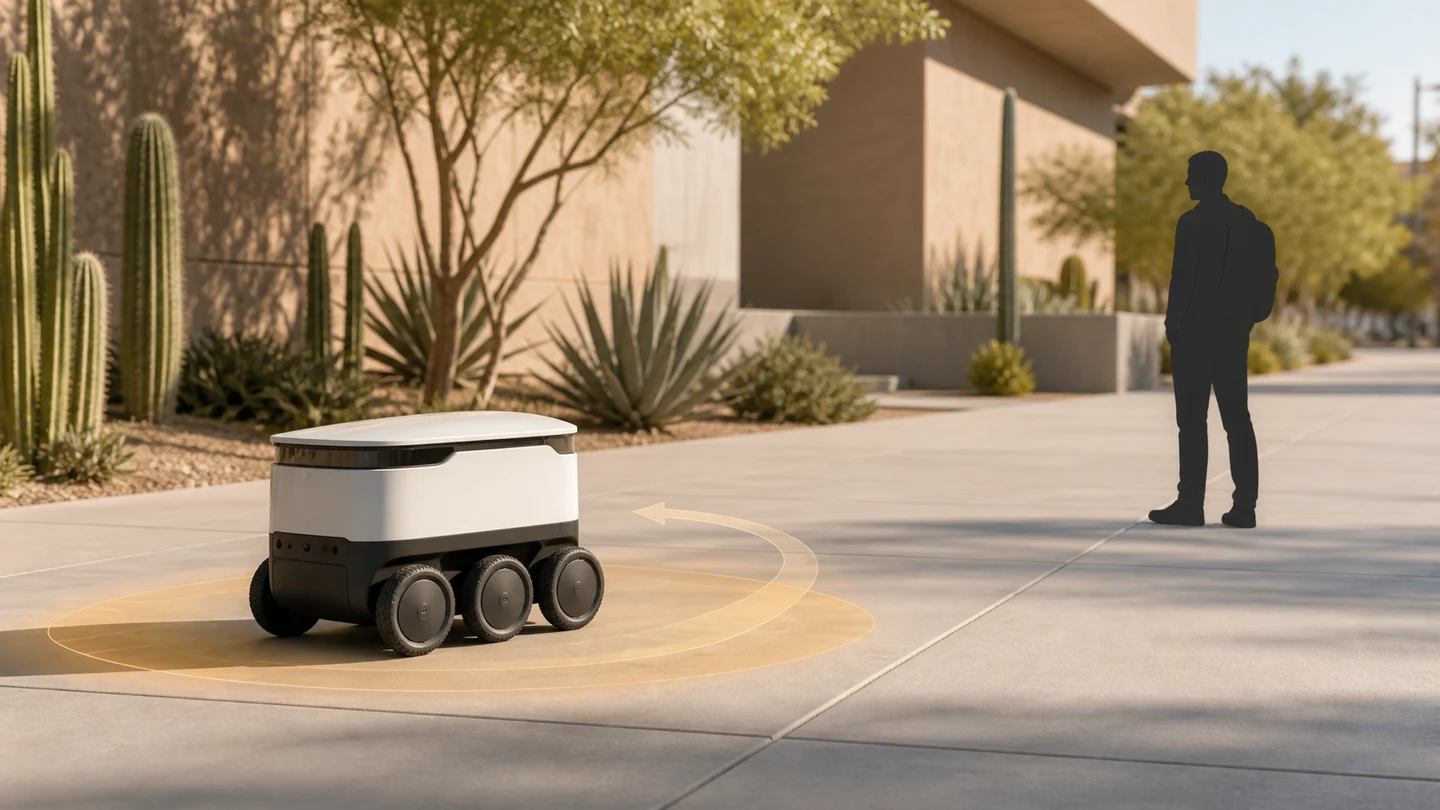
The detailed supplement records one contact
An Arizona State University police report released to KJZZ says campus video captured a Starship delivery robot abruptly reversing into an employee on September 22, 2023, after she crossed behind it. The robot knocked her down, moved forward several feet and reversed toward her again. The report's supplementary video review says it stopped before a second contact. KJZZ reported the incident and the pending civil case on July 14, 2026.[1,2]
The responding officer recorded lower-back pain, trouble walking and a fresh laceration about four inches long near the employee's left elbow. Tempe Fire treated her at the scene; she declined an ambulance and planned to go to ASU Medical Center. Police classified the matter as an information report with no crime. That record supports a collision and injury, not a technical cause or a finding of civil fault.[1,2]
The police release is internally uneven. Its initial narrative includes a sentence that can be read as a second strike, and KJZZ summarizes multiple strikes. The later, event-by-event supplement says the robot stopped before another contact. This article relies on the more specific supplement and describes one confirmed strike. Neither source publishes the robot's command history, perception output, software version, maintenance record or remote-operator timeline.[1,2]
The lawsuit remains unresolved
The Maricopa County public docket identifies case CV2024-026348 as Trudy Perez v. Starship Technologies Inc. It records a complaint filed September 20, 2024 and Starship's answer filed December 31, 2024, but the public page does not publish the pleadings' text. Without those primary documents, this article does not reproduce the parties' specific claims or defenses. The docket lists no judgment and shows the next pretrial conference on October 30, 2026, followed by another on February 19, 2027.[3]
Arizona's operating rules supply a separate accountability layer. A personal delivery device must yield to or not obstruct other traffic, including pedestrians, must not unreasonably interfere with pedestrians and must be monitored or controlled for that requirement. A human agent must be capable of monitoring or physically controlling the device, while the business entity is treated as the operator for assessing traffic-law compliance unless an agent acts outside the scope of employment. The operating business must also carry at least $100,000 in general liability coverage. Those provisions establish traffic-law duties and a coverage floor; they do not resolve the civil case.[4,5,6]
The missing evidence is technical
The useful systems question is why the robot reversed and whether the monitoring layer could detect or stop it. The opened source packet cannot distinguish among a software decision, sensor or localization error, a remote human command, a maintenance condition or another operational input. Assigning any of those causes would be speculation. A meaningful safety record would preserve motion commands, obstacle and intent estimates, intervention timestamps, configuration and maintenance history, and the criteria used to escalate abnormal movement.[1,2,3]
The next measurable catalyst is a dispositive ruling, a technical filing or the October 2026 pretrial conference. Until then, the opened evidence supports a limited conclusion: the detailed video review in the police supplement documents one reverse collision and a second reverse that stopped short, while the court has not determined the technical cause or civil liability.[1,2,3]