What changed
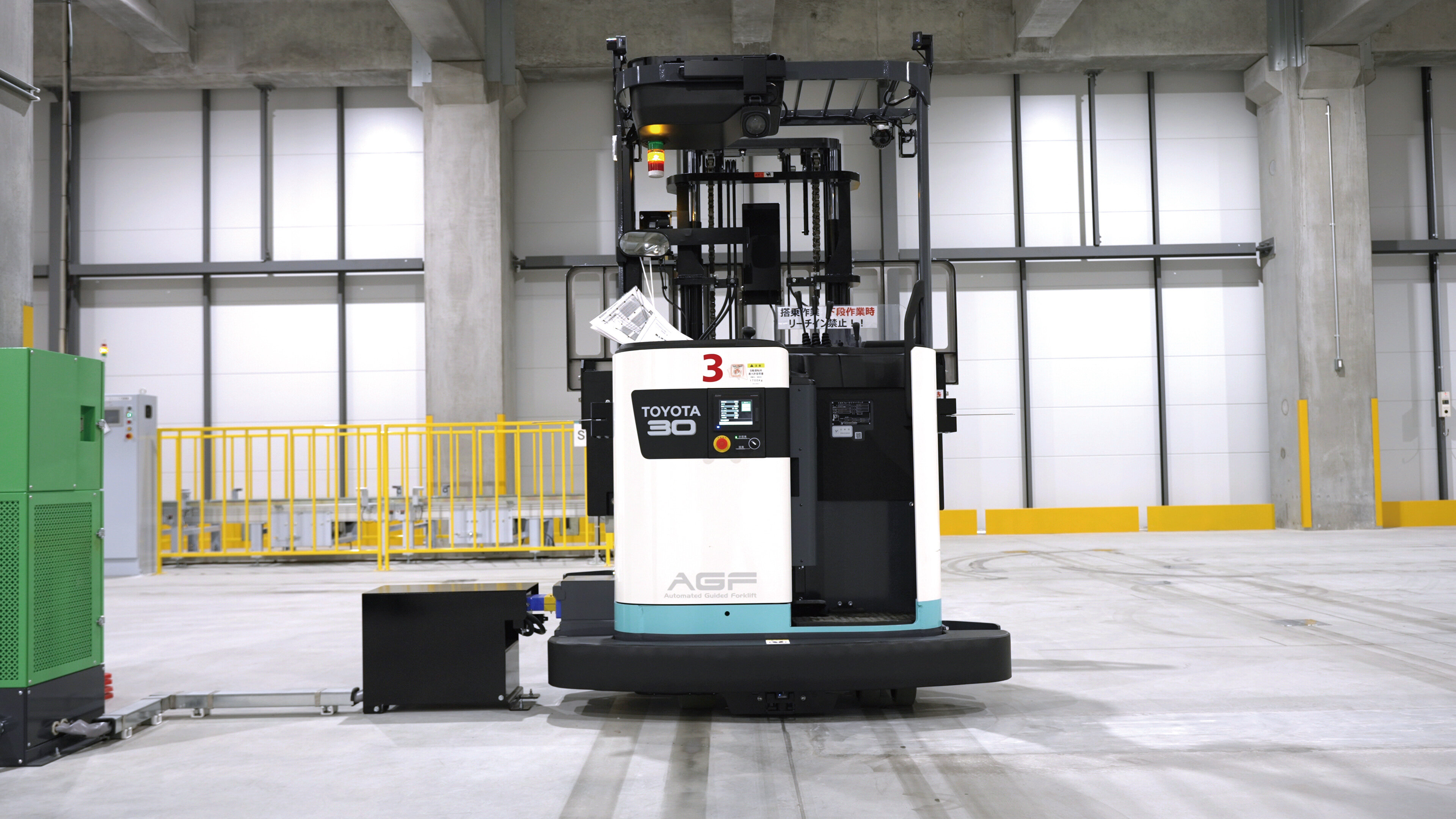
Suntory Logistics and Toyota Industries say they will start a demonstration in November 2026 at Suntory’s Urawa-Misono Distribution Center in Saitama. The test uses Rinova Autonomous, a truck-loading autonomous forklift that can change between two and four forks to handle one or two pallets. Toyota Industries says the practical-operation target is September 2028 onward, with the eventual operating location still undecided. LNEWS separately listed the same planned November demonstration on its September 2026 industry page. This is a planned test, not evidence of a live truck-dock deployment.[1,3]
The hardware is aimed at a specific beverage-logistics mismatch. Four-fork forklifts are useful when two pallets move together, but truck loading, factory inbound work and different equipment layouts can require a single pallet. Toyota’s proposed system uses 3D-LiDAR to detect the truck and loading bed, 3D-SLAM for guide-free navigation, and deep learning to identify pallet position and orientation without markers. It also generates an approach path and changes fork count according to the truck’s planned pallet sequence.[1]
The decision delta
The location matters because Urawa-Misono already exposes the boundary the new test is meant to cross. A 2021 on-site report by LOGI-BIZ described four Toyota AGFs, chain conveyors and a warehouse-management system handling the automated storage side, while human-operated forklifts still placed pallets on the conveyor. LOGI-BIZ also reported that the AGFs moved at about one-third of the speed of human forklifts, so shorter routes and conveyors were used to compensate. The operators estimated roughly 30 percent lower work-hours, but the prior system did not remove the dock interface from the human workflow.[2]
That makes this more than another autonomous-forklift product announcement. The operational question is whether perception and variable pallet handling can extend a bounded, conveyor-assisted warehouse system into the less structured space around a truck. If the test works, the same pallet flow could connect unloading, storage and loading with fewer handoffs. That is Toyota Industries’ stated possibility, not a result yet: the November test is specifically set to measure precision, stability and practical response across different pallet counts.[1,2]
What remains unproven
Neither company discloses a unit count, truck mix, cycle time, manual-intervention rate, safety record, exception policy or measured truck-dwell outcome for the planned test. The 2028 target also has no confirmed operating site. The useful checkpoint is therefore not the trade-show appearance at International Logistics Exhibition 2026, but the November Urawa-Misono demonstration and the data it produces: successful one- and two-pallet moves, fork-change reliability, intervention frequency, loading precision, stability and time per truck. Until those fields are public, the evidence supports a credible deployment path with a clear remaining boundary, not a completed dock automation rollout.[1,2]