What the benchmark adds
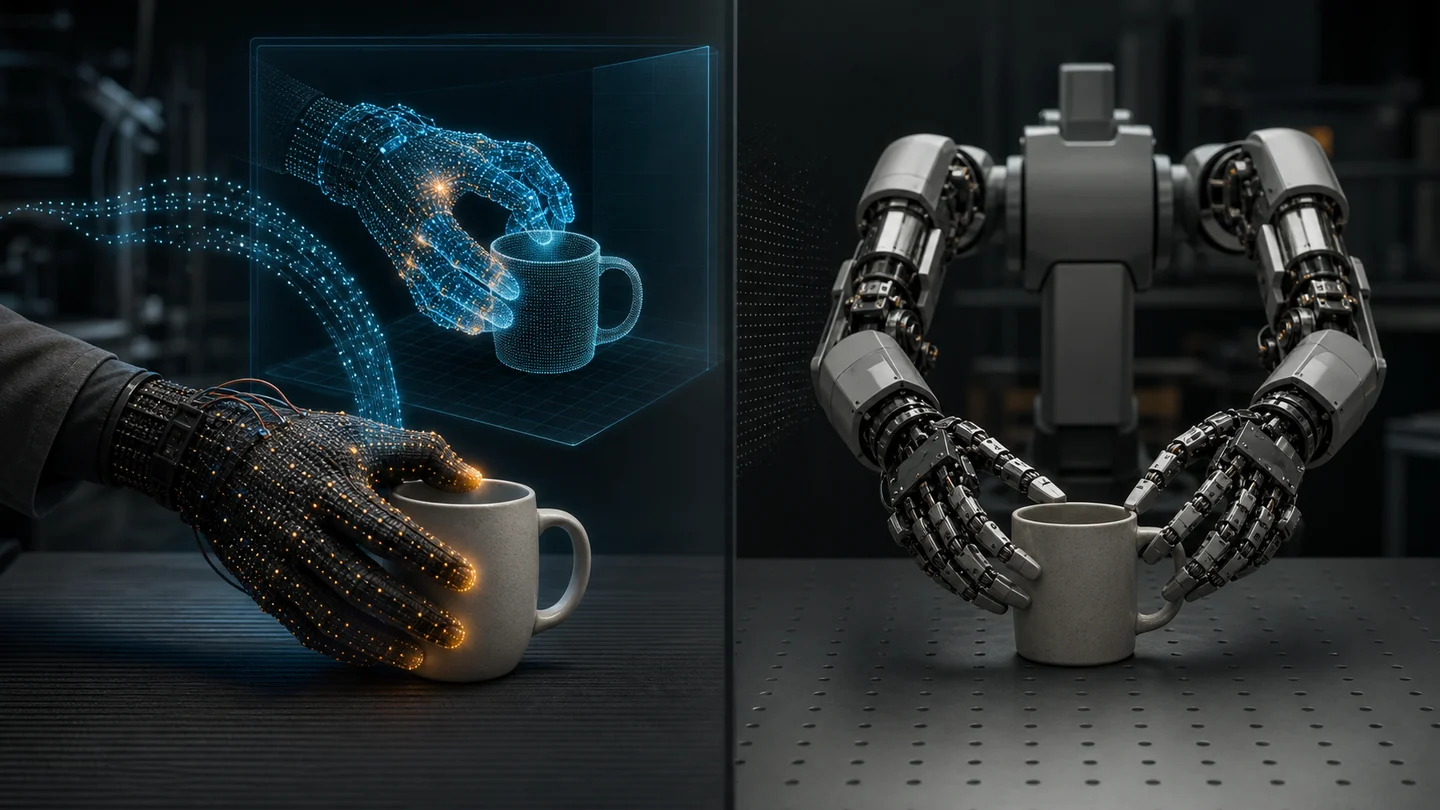
A ShanghaiTech University and InstAdapt team has introduced TactiDex, a human hand-object interaction dataset and simulation benchmark built around synchronized touch and motion. The preprint describes 5.1 million frames collected from 10 people manipulating 49 objects across 757 single-hand and bimanual sequences. Its outer glove has 162 pressure-sensing elements sampled at 17 Hz, while an eight-camera OptiTrack system records hand and object poses at 120 frames per second.[1]
The authors use 73 representative sequences to evaluate TactiSkill, a reinforcement-learning system trained in NVIDIA Isaac Gym with rewards for contact formation, force alignment and force limits. On the paper's strict tactile-aware success metric, the full method scores 64.64%, compared with 39.35% for a kinematic baseline. That is a meaningful benchmark result, but it is a simulation result: the metric compares simulated contacts and forces with the human tactile reference.[1]
The physical robot changes the claim
The paper also shows the learned motion on a physical bimanual platform with two 7-DoF Franka arms and two Inspire dexterous hands. Before execution, the simulated hand trajectory is optimized offline for the Inspire hand's six independent actuators; the arms then track the retargeted wrist pose through inverse kinematics. The critical boundary is explicit in both the main text and appendix: tactile sensors are installed on the Inspire hands, but their signals are not fed back into the policy during deployment. The hand commands run open-loop.[1]
That means the hardware examples demonstrate that tactile-guided training can produce trajectories that transfer to the team's robot. They do not demonstrate a robot using touch online to detect slip, correct force or recover from an unexpected contact. The paper presents representative physical execution snapshots and qualitative results, but it does not report a real-world rollout count, numerical success rate or physical baseline comparison. Its limitations section identifies on-robot fine-tuning with real tactile feedback as future work.[1]
Reproduction is not available yet
The public artifact trail is also incomplete. When The Robot Economy reviewed the TactiDex project page, its Paper and arXiv buttons led to the unrelated Nerfies paper from 2020. Code and Data buttons existed only as disabled, commented-out placeholders marked coming soon, so the page offered no active package for rerunning the 73-sequence benchmark or inspecting the 5.1-million-frame dataset.[1,2]
Other tactile-transfer systems show why the distinction matters. OSMO reports a policy that uses continuous shear and normal tactile signals at deployment time, a 72% success rate on a real wiping task, and released hardware designs, firmware and assembly instructions. The peer-reviewed MimicTouch framework similarly adds online residual reinforcement learning to bridge the human-to-robot tactile gap. These are not head-to-head comparisons with TactiDex, but they separate tactile data used as a training prior from tactile feedback used for closed-loop robot control.[3,4]
TactiDex is therefore best read as a substantial tactile dataset specification and a promising simulated transfer benchmark, not yet as evidence of a closed-loop tactile robot capability. The next proof should be an accessible release, quantified physical rollouts and a deployment in which the policy actually consumes the robot hand's touch signals while the task is running.[1,2,3,4]