The 90% headline rests on 50 high-frequency SKUs
TEPCO Logistics has put a Mujin case-picking system into full operation at its Central Branch in Tokyo. The buyer's official warehouse list confirms that the Central Branch warehouse is in Tokyo. Fresh reporting from Logistics Weekly supplies the operating denominator: 50 of the branch's 860 stock-keeping units, about 6%, generate 90,000 annual units—about one-fifth of its 440,000-unit 2024 workload—and 90% of boxed inbound and outbound flow. The investment was ¥380 million. Other boxed items stay manual because their shapes and weights vary.[1,3,4]
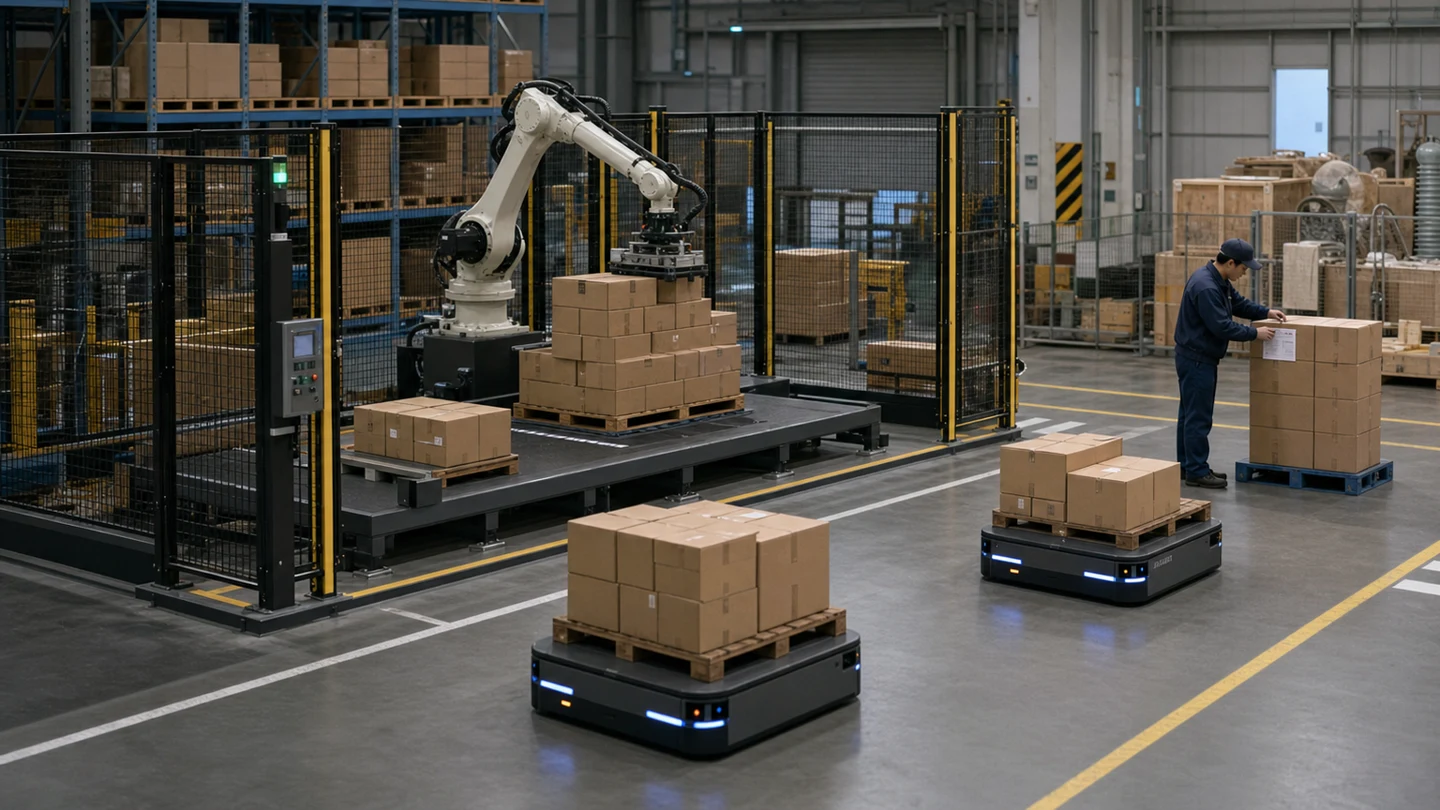
Mujin says its operating stack links an arm robot and 17 automated guided vehicles with 3D vision, warehouse software and a digital twin. The vehicles bring stored pallets to the robot, software plans mixed-case palletizing and completed pallets move to dispatch. A worker still attaches shipping paperwork. Mujin and both trade publications report that picking labor fell from four people to one; that is target-workflow staffing, not evidence of layoffs.[1,2,3]
The selective boundary is the operating lesson
Earlier disclosures had already established that the robot cell was live and reduced target-workflow staffing. The July 14 report changes the analysis by exposing what sits behind the percentage: 50 high-frequency stock-keeping units and 90,000 annual units. That concentration matters because it shows where this automation stops. Selecting repeatable, standardized work can capture a large flow share without solving every item; it also means the published 90% cannot be generalized to the branch's full 860-item catalogue or its irregular materials.[1,2,3]
The useful lesson is not that TEPCO Logistics automated 90% of a warehouse. It automated the repeatable head of one case-flow while leaving the irregular long tail to people. Standardized 120-by-100-centimetre outbound pallets and concentrated volume define the automation boundary. The public record does not disclose throughput, uptime, maintenance cost, wage savings, error baselines or payback, and the company's revenue growth cannot be attributed to this system.[1,2]
The next proof should be post-launch operating data: cases per hour, intervention and error rates, downtime, maintenance spending and payback against the ¥380 million investment. TEPCO Logistics also plans to consolidate Yamanashi and Numazu functions into a Fuji Gotemba hub, but that remains a planned network change, not evidence that this robot design has scaled beyond the Central Branch.[1]