The disclosure
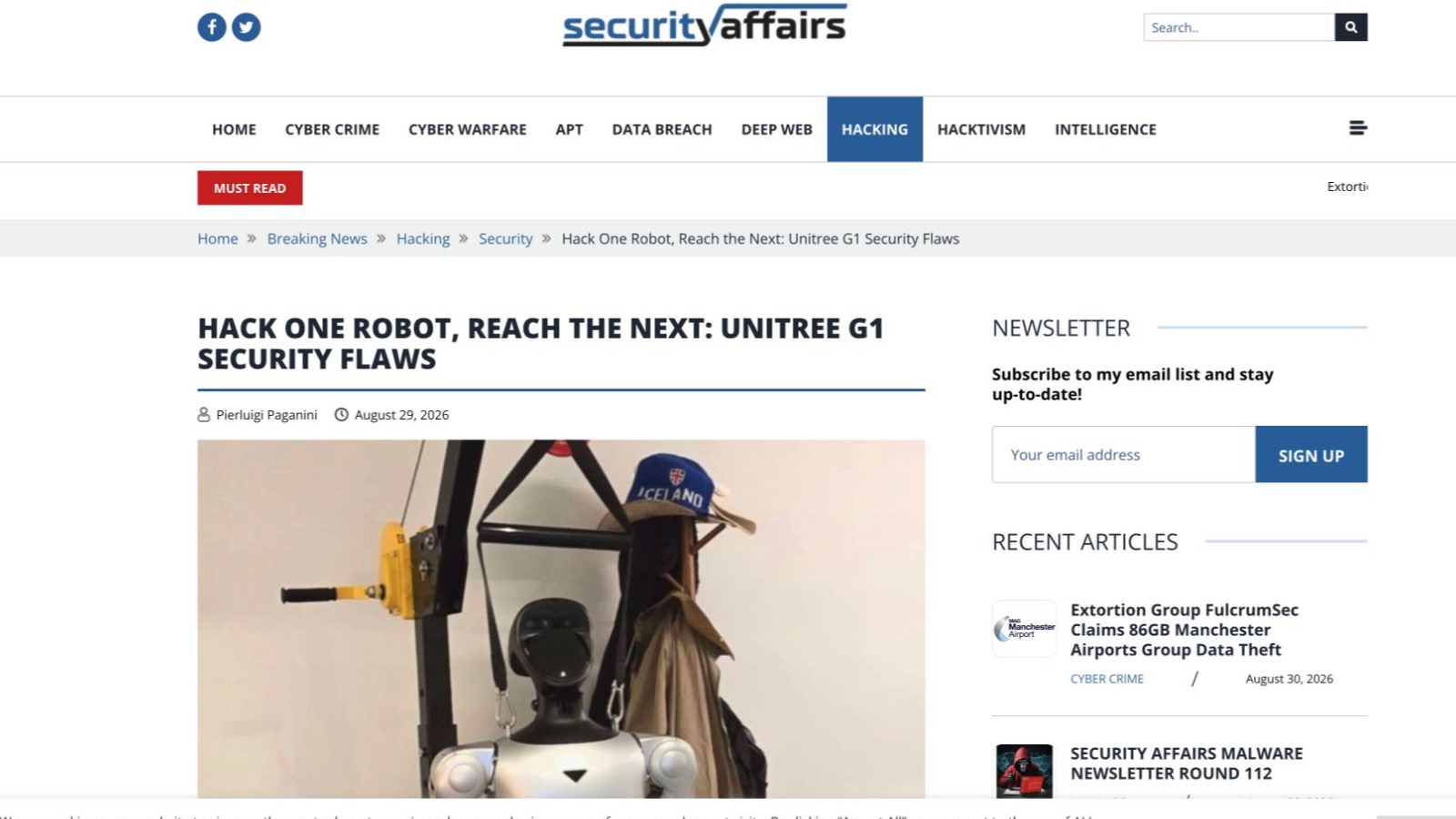
On Aug. 27, security researcher Olivier Laflamme published a technical report describing two CVE-assigned vulnerabilities in the Unitree G1 EDU. The report says the issues can reach root-level access on the tested robot; Security Affairs and The Hacker News independently summarized the disclosure. The public record documents researcher testing and disclosure, not a real-world compromise or confirmed fleet takeover.[1,2,3]
The evidence boundary
The detail that matters for operators is scope. Laflamme says the vulnerabilities were reproduced on four G1 robots, while the propagation test cited by The Hacker News and Security Affairs involved two robots in one room. That is enough to establish a credible model-specific control risk; it is not enough to claim every Unitree product is exposed, that a fleet can be reached at scale, or that an attacker has operated a deployed robot.[1,2,3]
A fix without a target
The disclosure timeline records a Unitree cloud account-to-robot ownership check as a remediation during the reporting period, and the independent reports describe vendor engagement after disclosure. But none of the accessible records gives owners a verified fixed firmware version for G1 EDU. That turns a vulnerability report into a remediation-chain test: a control cannot be considered closed if operators cannot identify the affected build, target update and confirmed product scope.[1,2,3]
The operator checkpoint
Owners should first establish whether a unit is G1 EDU, record the running firmware and obtain the vendor’s current remediation instruction before treating the issue as closed. Where the platform is used around people, the practical control is to confirm the update path and wireless exposure for each robot, preserve relevant logs and keep adjacent models in an unconfirmed bucket until product scope is published. Those are control checks, not evidence that a named operator has completed them.[1,2,3]
Decision delta: this is a supporting Systems & Safety brief, not an incident report about a compromised fleet. The disclosure raises priority because privileged robot access was reported on the tested G1 EDU and the remediation record is not yet operator-complete. The next measurable checkpoint is a vendor record of affected model and build scope, fixed firmware, update steps and verification guidance, followed by operator-reported patch coverage. Until then, vulnerability existence is supported; current fleet exposure is not measured.[1,2,3]