What changed
Yushu Technology, the Chinese robot maker known internationally as Unitree Robotics, closed at 615.03 yuan on Aug. 27, according to market data cited by Sina Finance and Caixin. The price was down 44.1% from the 1,100-yuan intraday high reached on its Aug. 19 Shanghai STAR Market debut, even after a 3.97% rebound on Aug. 27. The company trades under code 688836.[2,3,4]
The market move is larger than the index move
That move is company-specific in scale. STAR50, the Shanghai exchange’s technology-stock index, rose from 1,667.52 on Aug. 19 to 1,693.48 on Aug. 27, a 1.6% gain. Unitree’s Aug. 27 close was still roughly 4.1 times its 150.8-yuan issue price, but the retreat has removed more than two-fifths of the debut-day high. The comparison does not establish why investors sold; it establishes that the repricing was not simply an index move.[3,4,5]
The filing had already named the next test
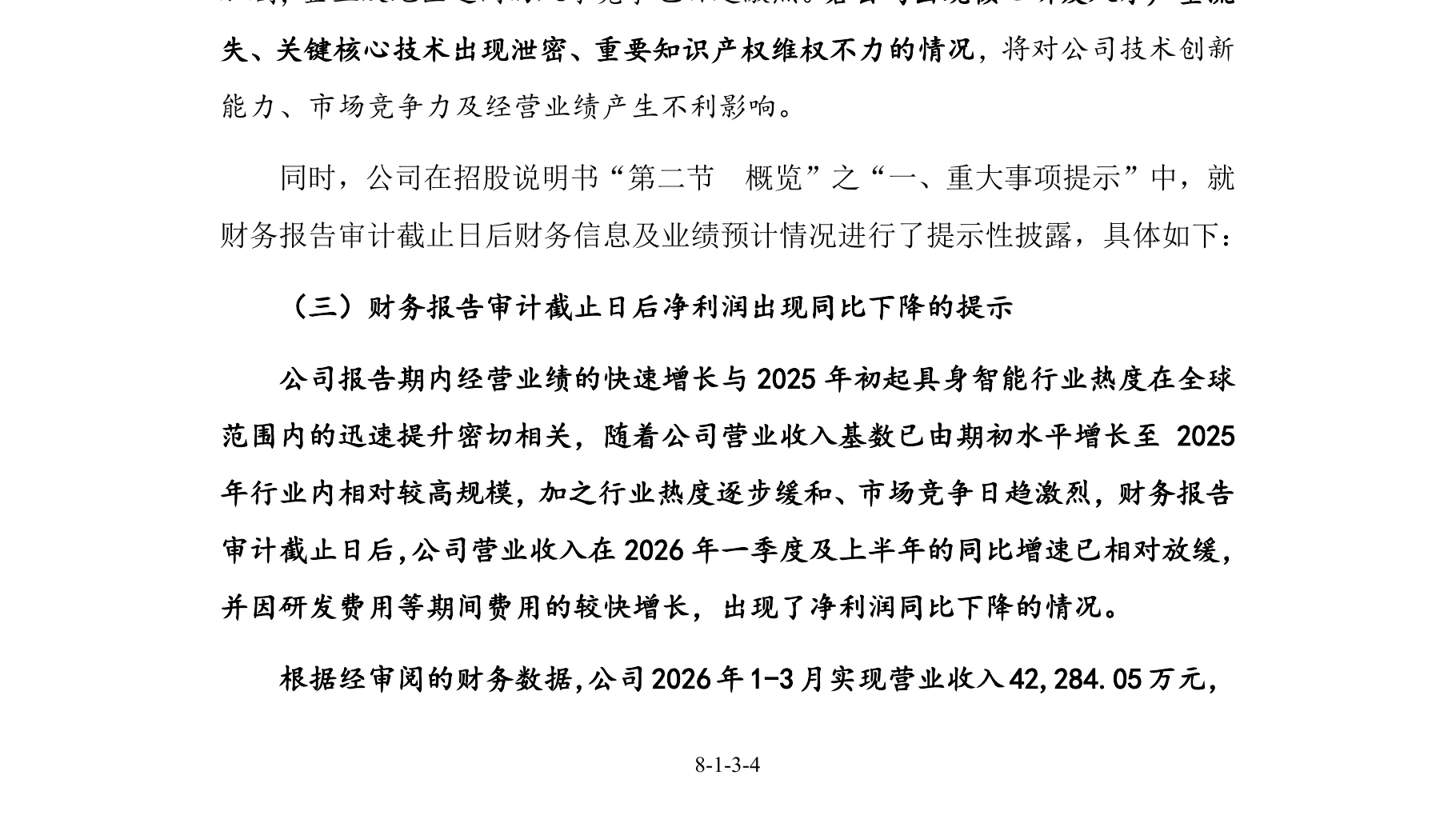
The timing matters because the company’s public filing had already set a harder operating test. Yushu reported first-quarter 2026 revenue of 422.84 million yuan, up 68.49% year over year, while non-GAAP profit fell 52.55% to 40.25 million yuan. Its first-half estimate calls for revenue of 1.052 billion to 1.128 billion yuan, up 35.62% to 45.41%, and non-GAAP profit of 236 million to 283 million yuan, down 21.97% to 6.43%.[1]
What to watch
The decision delta is therefore narrower than either a crash narrative or a commercialization verdict. The filing shows growth and profitability guidance moving in different directions; the price action shows public-market expectations can reset faster than physical-robot revenue can compound. The next checkpoint is the company’s filed first-half results and subsequent disclosure of production, customer mix and repeatable demand. Until then, the IPO gives the sector a public valuation signal, not proof that Unitree’s robots have failed or that the market has found fair value.[1,3,4,5]