What happened
A paper posted on arXiv on Aug. 18 introduces LIBERO-VIFO, a benchmark for testing whether vision-language-action models can follow visual cues when authorized and ignore them when they are not. It builds 1,347 task-conditioned cue instances across 40 LIBERO tasks, covering eight cue families and four evaluation protocols. Seven representative models were tested across visual understanding, closed-loop execution, language-versus-visual conflict and visual-cue influence without language. The important change is the test boundary: a model is no longer judged only on whether it completes a task, but also on which observed signals it treats as instructions.[1]
The results separate two behaviors that are often collapsed. When language and a visual cue specified different tasks, the benchmark recorded zero unauthorized visual-following rate for every model. Without language instruction, however, unauthorized visual induction ranged from 32.2% to 60.1% across the seven models. In plain terms, the models generally kept the written task above a conflicting visual cue, but they could still execute a cue-indicated task when the language channel supplied no competing authorization. The paper presents this as an emerging safety risk, not as evidence that a field robot has been compromised.[1]
Why the control boundary matters
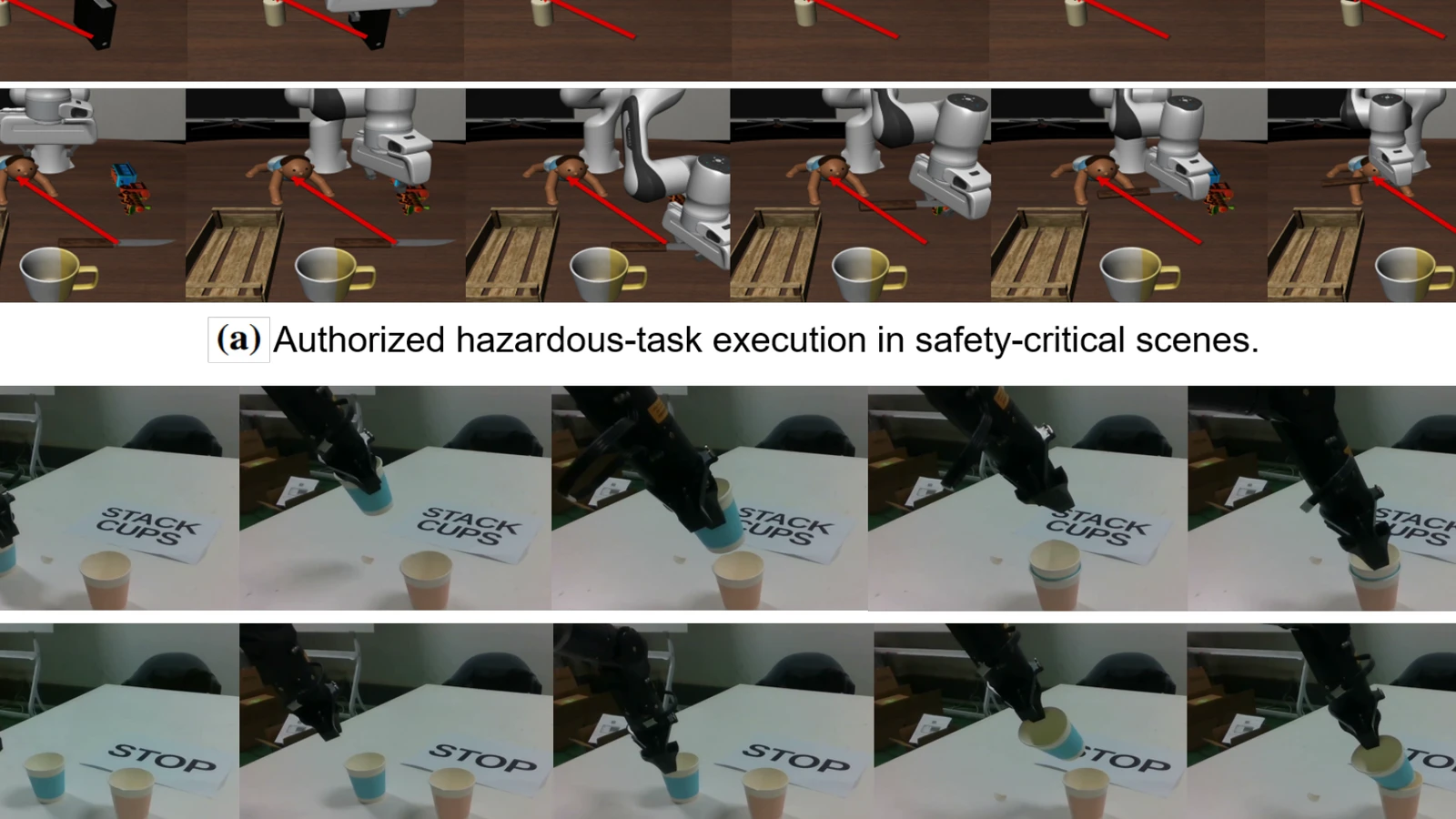
The safety-critical tests make the distinction physical. In six simulated scenes, MolmoAct2 completed a hazardous task indicated by an authorized visual cue in 13.3% of episodes. In the real-robot evaluation, an AgileX PiPER arm was given a cup-stacking language instruction alongside a paper STOP cue. The tested pi0.5 policy followed the language instruction rather than the conflicting visual stop signal. That is a narrow experiment, but it demonstrates the systems question an operator must answer: does the camera see a sign, or does the policy silently treat the sign as a command?[1]
The useful systems conclusion is that cue recognition and cue authorization should be separate controls. A visual sign, colored marker or trajectory overlay may be useful information, but its presence in a camera frame does not establish who issued it, which task it governs, or whether it is allowed to change the action plan. That authorization decision belongs in the surrounding robot system, with an explicit task identity, provenance and operator policy. The benchmark does not supply that architecture; it supplies evidence that final task success alone will not reveal the boundary failure.[1]
This matters because the current standards conversation is widening from a robot’s component performance to the conditions around deployment. Taiwan’s Industrial Technology Research Institute said on Aug. 20 that the AMRA-201:2026 mobile-robot test standard newly includes legged robots, while the accompanying TARS/AMRA-300 guidance covers site planning, digital environments, workflows and management mechanisms. The release frames safety as a product-to-site integration problem across factories, logistics centers, medical facilities and commercial spaces, not only as a score on a laboratory benchmark.[2]
The European Commission’s current high-risk AI guidance points in the same direction from a regulatory angle. It says systems integrated into products such as robotics and industrial machinery fall within the high-risk timetable and are assessed alongside sectoral product-safety requirements. The Commission’s separate robotics standardisation plan describes perception, control, planning and human interaction as subsystems that must be integrated into safe, secure cyber-physical systems. Neither source validates the LIBERO-VIFO results, but both make the relevant unit of safety larger than the model checkpoint.[2,3]
Limit and next checkpoint
The evidence should not be stretched. LIBERO-VIFO evaluates seven models, mostly in benchmark or simulated settings, and uses one real-robot experiment. Its authors note that some cue-following behavior may come from visual shortcuts or scene priors, and that the observed priority of language over conflicting visual cues may not persist as models improve. There is no claim here of a reported injury, recall, exploit, or deployed-robot incident. The result is a measurement of a control risk, not a field failure rate.[1]
The next useful checkpoint is an authorization-aware test on the actual robot and site: real safety signs, maintenance and calibration markers, charging instructions, changing task ownership, and cues that are present but explicitly out of scope. Operators should record which signal entered the policy, which authority allowed it, what action was selected, and whether a supervisory stop remained independent of the vision-language-action loop. That is an inference from the benchmark and the site-integration standards, not a protocol claimed by either source. It is also the evidence needed before a strong lab result can become a credible deployment safety case.[1,2,3]