The headline number changes under the metric
Xiaomi Robotics has released Xiaomi-Robotics-U0, a 38-billion-parameter model that generates robot scenes, transfers recorded trajectories into altered visual settings and predicts embodied video. The July 13 technical report gives the model an operating consequence: synthetic observations were added to π0.5 post-training, and the paper’s abstract says the policy’s out-of-distribution success rate rose from 36.9% to 63.2% on real robot tasks.[1,2]
The experiment reports something narrower. Its methods section says task-completion progress is the sole metric. Each task is divided into ordered milestones, and a rollout receives proportional credit for the milestones reached; only a score of 1 means full completion. The published 63.2% is therefore an average progress score under the held-out condition, not a reported percentage of trials that finished the entire task. The paper provides no separate full-task success rate.[1]
The gain is real but concentrated
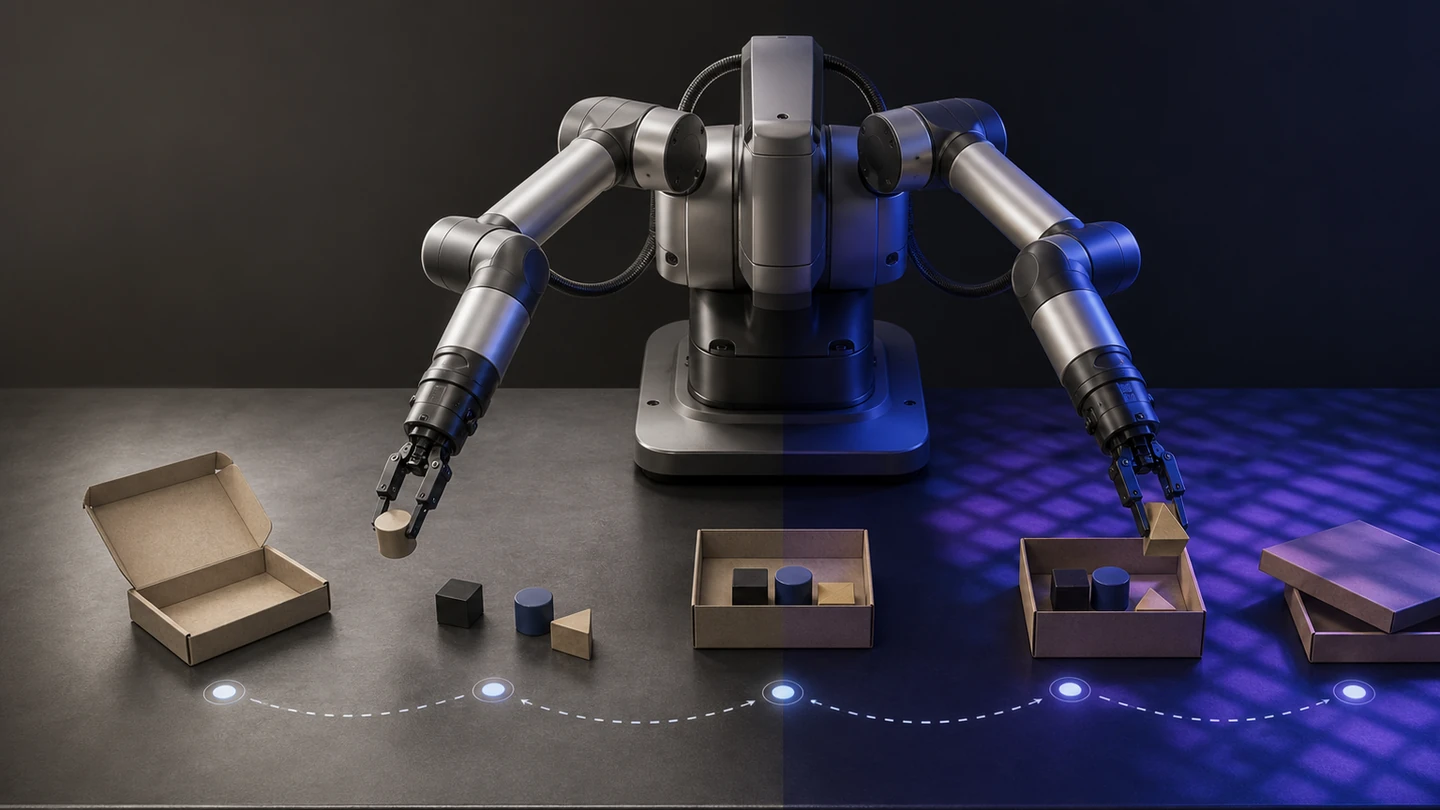
The comparison spans Store Earphones, Fold Towel and Pack Box on a bimanual ARX platform. For each policy and task, Xiaomi ran three layouts in a familiar base condition and three layouts with held-out tablecloths and lighting, with three trials per layout. That is nine trials per task and group, or 18 per policy-task pair. Average progress in the interference group rose from 36.9% to 63.2%; in the familiar base group it moved only from 81.0% to 82.1%.[1]
The mechanism is training-time visual diversification, not a world model controlling the robot. Xiaomi collected about 40 hours of real demonstrations per task, generated roughly another 40 hours of style-transferred episodes that changed backgrounds, lighting and textures while preserving actions, then post-trained separate π0.5 policies on the combined data. U0 was absent at inference. The result supports a specific claim: synthetic views helped the policy make more progress when appearance changed.[1,4]
What remains open
The evidence does not establish broad world-model-driven robot reliability. It covers three lab tabletop tasks, only nine held-out trials per task and no confidence intervals or independent reproduction. The paper’s own failures include missed grasps under saturated light, confusion about earphone-case orientation, losing towel edges against similar fabric and attempts to grasp a projected light spot. Partial progress can still improve when full completions do not, so the missing completion counts matter.[1]
The artifact release is also split. Xiaomi’s repository describes an open inference package and releases weights for scene generation, transfer, text-to-image and image editing. It does not include the augmented π0.5 policy or a training-and-evaluation pipeline for the reported robot result, and it says the separate video-generation checkpoint is coming soon. Those omissions prevent a direct public rerun of the two headline evaluation tracks from the listed package alone.[1,2]
WorldArena explicitly separates video perception quality from functional utility because visually strong world models do not automatically improve robot policies. U0 supplies useful early evidence for the data-engine side of that divide, but the next measurable proof is straightforward: publish per-rollout full-completion counts, the augmented policy or reproducible training recipe, and an independent test across new objects and physical scenes rather than lighting and tablecloth changes alone.[1,2,3]