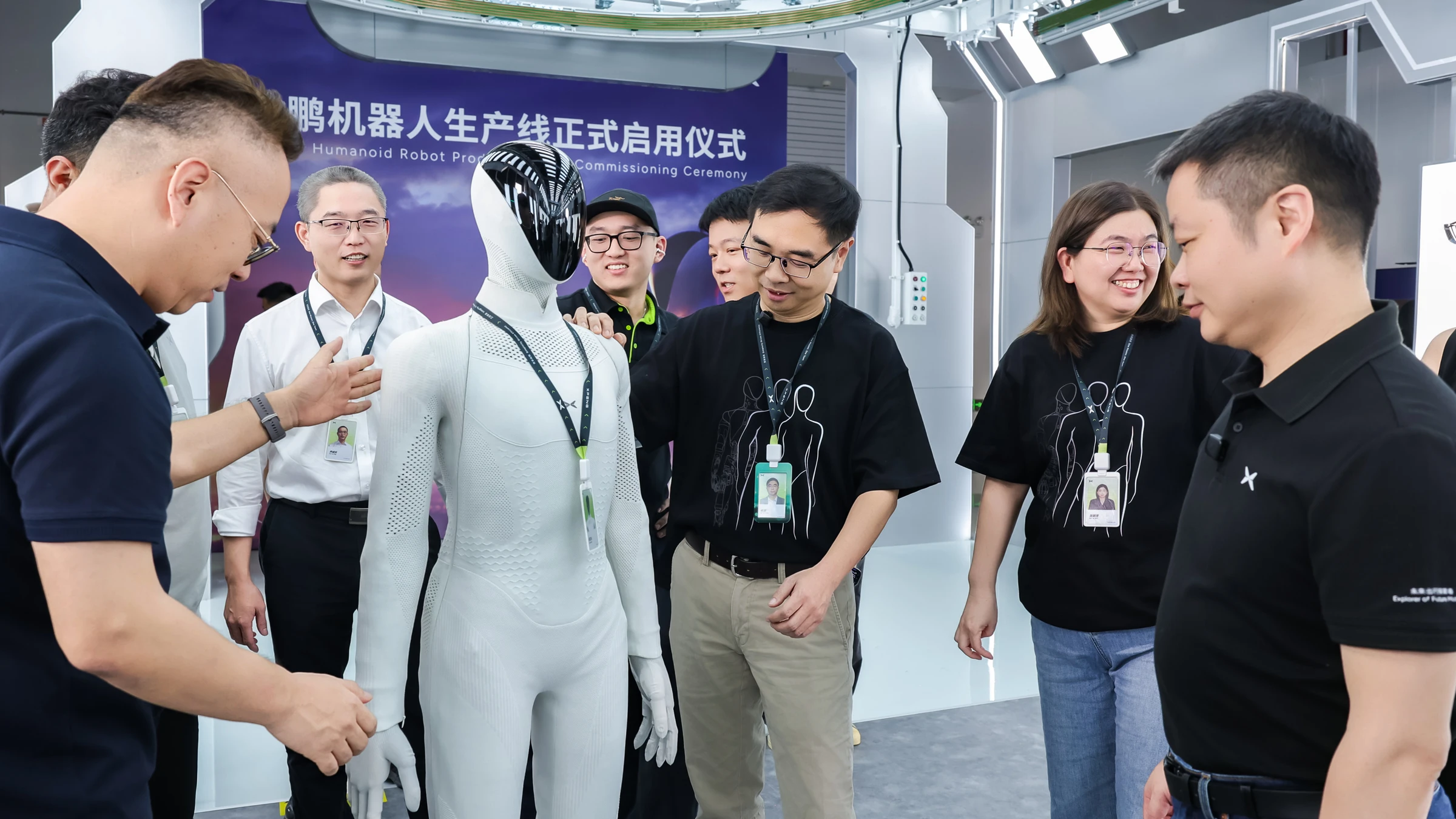
XPENG says it commissioned production lines for its IRON humanoid robot in Guangzhou on September 8, with a completed machine walking off the line under its own control. That advances the project beyond a manufacturing plan. It does not establish sustained volume: the same announcement still puts mass production at the end of 2026 and market launch and deliveries in 2027.[1,2]
Comparing the September announcement with XPENG’s August financing announcement reveals a narrower change than the production headline suggests. The company has reported completion of an intermediate manufacturing milestone, while retaining its broad commercialization timetable. For prospective buyers, the question shifts from whether a line will exist to what that line can repeatedly deliver, and when a supported robot becomes available.[1,3]
The timetable predates the financing round. In a June 3 corporate update, XPENG targeted formal mass production by year-end and shopping-guide work at its retail outlets from the first quarter of 2027. Read alongside the September record, that earlier statement provides a baseline for tracking delivery against the company’s own sequence, without assuming that commissioning brought customer availability forward.[6,1]
The terminology is already inconsistent across coverage. Live Science reported on September 8 that company representatives said IRON had entered mass production. CnEVPost explicitly distinguished commissioning from mass production. XPENG’s dated corporate announcement retains the year-end target. Without a disclosed production rate, the more defensible description is a commissioned line progressing toward volume output; the differing wording does not itself resolve scale.[1,2,5]
XPENG says more than 80% of core manufacturing processes are automated. It describes transferring quality systems from vehicle manufacturing into robot assembly. These are company statements about the production system, rather than independently audited measurements of how many saleable robots the system produces. The announcement does not provide the underlying process inventory or a completed-unit series.[1]
The denominator matters. A share of automated processes does not tell a buyer the share of labor removed, the time needed to assemble each robot, or the proportion passing inspection without repair. Those measures can move differently. The useful manufacturing comparison would pair accepted units per month with staffing, rework and uptime over the same period, rather than treating one automation percentage as a capacity figure.[1,2]
CnEVPost noted that XPENG did not disclose the line’s specific capacity or IRON’s price. XPENG’s Swiss press materials identify its own sales centers and company sites as the initial deployment settings, with guiding visitors, shopping assistance and accompanying patrols among the intended applications. Those are proposed uses and locations, not a published record of completed customer work.[2,4]
Starting within the parent company gives XPENG a place to develop the operating routine before wider deliveries. It also limits what an internal rollout can establish about external demand. A company-controlled site can test maintenance and user interaction; evidence that an unrelated buyer accepts the price, support burden and service terms would answer a different commercial question. Neither result should be substituted for the other.[3,4]
For a retailer considering such a system, an informative pilot would record completed guidance tasks, staff interventions and hours available for service. A robot being present in a store is only the starting point. Buyers need to know which work it completes reliably and what employees must do when the machine cannot proceed. The reviewed announcements do not supply that operating history.[1,4]
The strongest case for progress is still substantial: XPENG reports installed manufacturing capability where its earlier announcement described a future production ambition. Dismissing that step would miss the change. Equally, a commissioning ceremony cannot establish recurring output, customer acceptance or unit economics. The new evidence improves the manufacturing-readiness case while leaving the commercial test ahead.[1,2,3]
The next checkpoint is XPENG’s end-of-2026 mass-production target. A useful update would give monthly completed and accepted units, deployment locations and the work those machines perform. The planned 2027 deliveries then create a separate checkpoint for external customer acceptance and support. Until those records arrive, procurement teams can track a more concrete supplier roadmap, but cannot derive a delivery commitment or operating return from the line-opening announcement.[1,2,4]