The review reaches beyond the autonomy stack
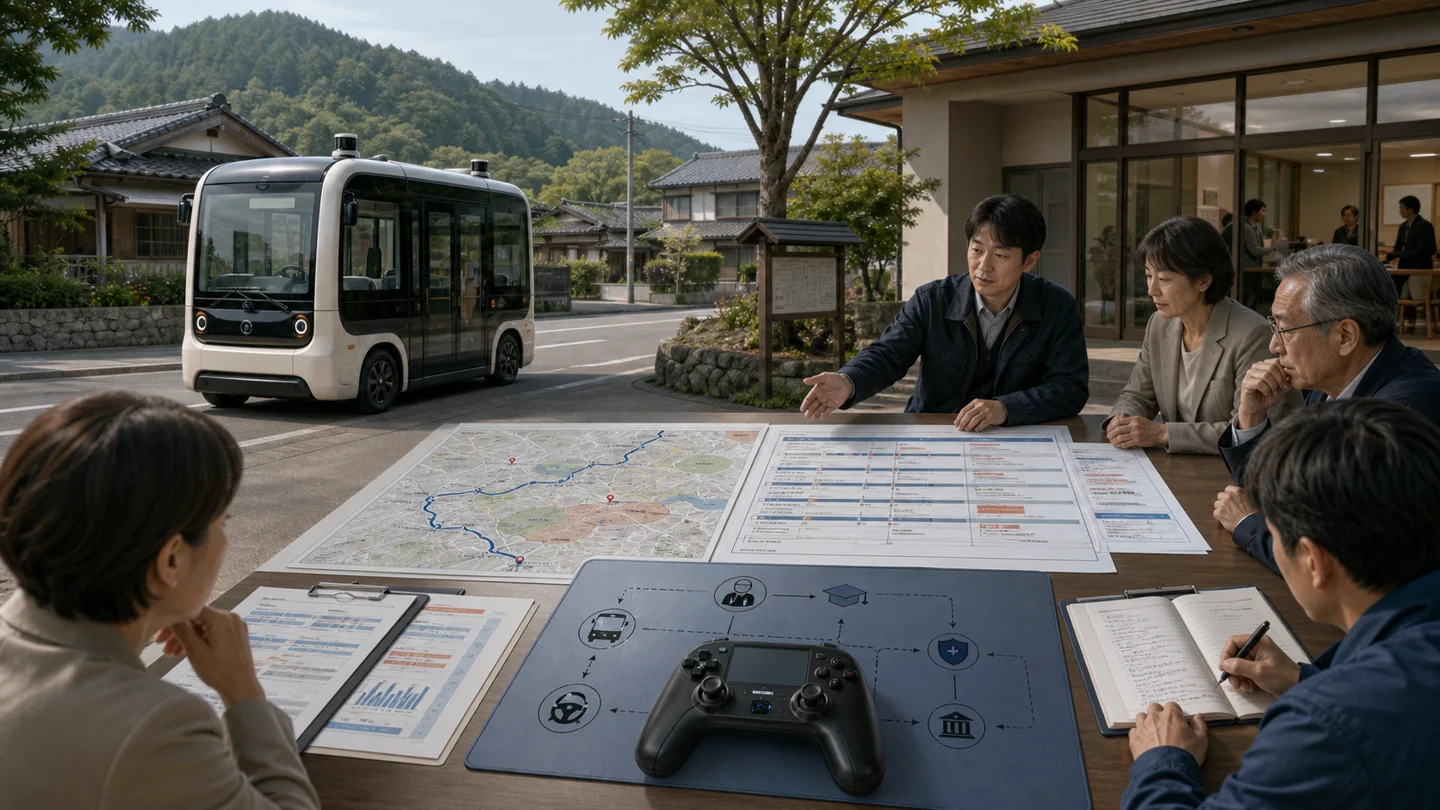
Yahiko Village convened the first meeting of its autonomous-bus accident-verification committee on July 16, three months after its Mikopyon-go shuttle struck and injured two pedestrians near the Omotenashi Plaza tourist area. The village has kept the service suspended since the April 12 collision. The committee's mandate is to establish the facts around the incidents and the way the program was run, then advise the mayor on unresolved issues and measures to prevent recurrence. That is a wider assignment than determining whether a perception or planning algorithm failed.[1,2,3,5]
The village's proposed issue list makes the operating system itself the object of review. It asks whether an autonomous bus was the right vehicle for the new route, whether the Mica vehicle and contractors were selected appropriately, whether operator education and contractor information-sharing were adequate, and whether the responses to two earlier incidents were sufficient. It also puts route-level risk controls, internal reporting and the village's handling of rising manual-intervention frequency on the agenda. The document is a set of questions, not the committee's conclusions, but it defines what a restart decision will have to address.[2,3]
The incidents sit at the automation-human boundary
BSN reported that all three incidents in the program occurred during manual control rather than automated operation. The village's presentation supplies more detail. In June 2024, an operator took manual control to pass a parked vehicle and the shuttle contacted a utility-pole support wire; the presentation attributes the error to the operator's attention shifting to a following vehicle and identifies insufficient training. In August 2024, the same presentation says an accidental touch on the control tablet shifted the vehicle out of automated mode, after which it coasted in neutral and mounted a curb. Four passengers, including a child, were aboard, and no one was injured.[3,4]
For the April 2026 pedestrian collision, FNN reported from the village's emergency briefing that the shuttle detected a pedestrian and stopped about 55 meters before the impact. The operator then changed to manual control to pass the pedestrian. The village's July packet depicts a mode change followed by coasting in neutral before the collision, but it does not resolve why the vehicle approached the road-and-sidewalk boundary. Two pedestrians were taken to hospital; the seven passengers and the onboard operator were not injured. Those records establish a sequence and the control context, not a final cause.[3,5,6]
Manual control does not turn this into a story outside autonomous-vehicle safety. In a Level 2 shuttle service, the conditions that trigger intervention, the interface used to take control, operator practice, route design and supervision are part of the deployed safety case. The evidence currently shifts the question away from an unsupported claim about an autonomous-driving failure and toward whether the program managed that boundary well enough. The committee has not allocated responsibility among the operator, interfaces, training, contractors, municipal oversight or road environment.[2,3,4,6]
A route-level warning signal was not escalated
The village's own operating data identify a measurable change before the April collision. Automated operation accounted for 81.5% of travel on the tourist-oriented Yahiko route, compared with 92.6% on the Kita-Yoshida route. The presentation says manual interventions clustered around bus stops, Yahiko Station and the eventual incident area because pedestrians and other obstacles frequently stopped the automated system. Operators and program staff discussed those interventions in regular meetings, but the packet says the pattern was not shared across the village administration as an organizational risk signal.[3]
That distinction matters because a high intervention burden can be an operating-condition measurement, not merely an inconvenience. The packet says detailed driving and intervention data stopped at the responsible department and that the village conducted little regular, organization-wide review of the program's direction. It also says earlier restart decisions relied on measures negotiated by the operator with police and transport authorities without the village independently evaluating whether residual risks remained. These are the village administration's own preliminary descriptions; the committee still has to test them.[2,3]
Restart now needs a documented gate
The committee's explicit restart question is what operational measures would be required if service resumes, including both system safety controls and public confidence. Its schedule calls for a second meeting in September and a third in November to assemble the report. Those dates are the next measurable catalysts. Useful evidence would include a causal account of the April sequence, intervention-rate thresholds, operator qualification and refresher rules, change-control records, route-specific suspension criteria, and a named authority responsible for accepting residual risk.[2,3]
As of this review, Yahiko's committee page lists the packet but does not publish meeting minutes or a meeting summary. The available evidence therefore supports a bounded conclusion: the village has broadened the safety perimeter from vehicle automation to the human, contractor and municipal layers around it, while causation remains open. A defensible restart decision will be measurable only when the committee converts that scope into findings, controls and acceptance criteria rather than treating the July meeting itself as proof of remediation.[1,2,3,4]