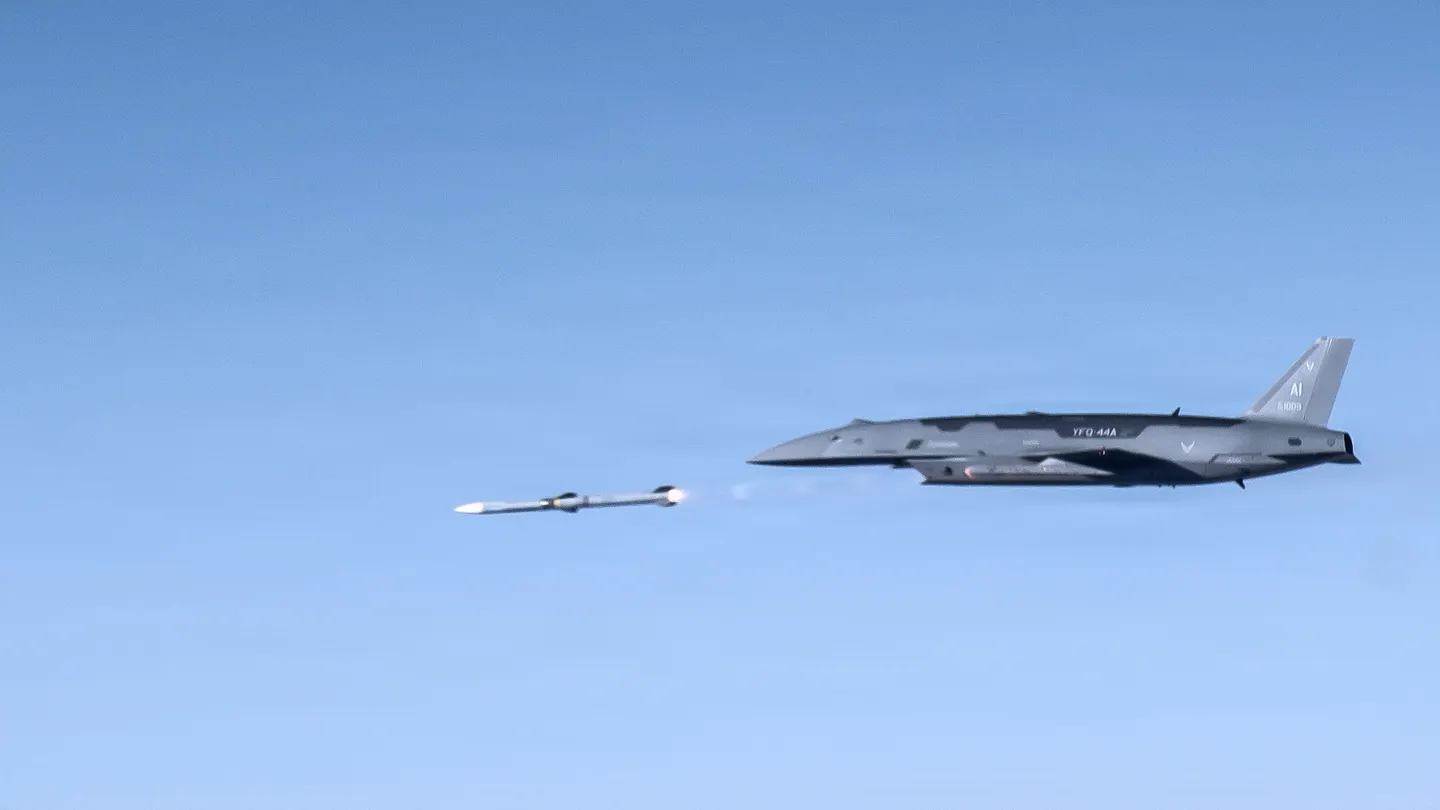
The milestone is separation, not target selection
The U.S. Air Force said on July 15 that Anduril's YFQ-44A Collaborative Combat Aircraft fired an AIM-120 at a digital target over the Mojave Desert. The service described the event as a live-fire test and the next step after captive-carriage and data-link evaluations. Military Times reported, citing an Air Force spokesperson, that the released missile was inert; Air & Space Forces Magazine separately reported the release and operator-command sequence.[1,2,3]
What changed is narrower—and more useful—than the headline label. The program moved from proving that the aircraft could carry a weapon and receive commands to an actual separation event. Air & Space Forces Magazine reported, citing Anduril, that its Lattice software received target information, after which an operator instructed the aircraft to strike. The Air Force says the YFQ-44A then executed the weapon-employment sequence autonomously inside pilot-defined parameters.[1,2,3]
Human command remains the hard boundary
That does not mean autonomous target selection or autonomous weapons release. The Air Force says a human retains command and the release decision at all times. The test used a digital target, and the service did not disclose the number of attempts, separation success criteria, quantitative data-link metrics, operator workload, failure rate, or a measured result beyond the reported sequence. It is developmental evidence, not fielded combat capability.[1,2,3]
The consensus was that CCA weapon integration was advancing through staged tests. The new evidence is the shift from captive carriage to commanded release, with onboard autonomy executing the sequence after human authorization. The parties exposed are the Air Force, Anduril, General Atomics, autonomy-software suppliers, and future operators. The next measurable catalyst is General Atomics' planned YFQ-42A live-fire test later in 2026, followed by comparable results or an Air Force fielding decision.[1,2,3]