The deal is strategic capital, not a customer-site record
On July 20, Sereact announced that Zalando had joined its ongoing Series B as a strategic investor, taking the round to $116 million. Sereact said the additional capital will fund the next generation of Cortex and further international expansion. In the same announcement, the Stuttgart company reported more than 200 systems live across Europe and more than one billion real production picks completed on Cortex. Those are material operating claims. They are not, however, a disclosure that a named Zalando facility has been commissioned, equipped or measured.[1]
That distinction is the story. Sereact’s announcement describes Cortex across single-arm picking cells, dual-arm returns stations and humanoid robots, and lists customers including Daimler Truck, Mercedes-Benz, BMW, MS Direct, Active Ants, DeltiLog, Rohlik Group and Austrian Post. Zalando is described as an investor and operating-scale partner, but it is not named in that customer list or attached to a site, station count, workflow or go-live date. An absence in a public announcement cannot prove that no private evaluation exists; it does establish that the opened record does not yet support a Zalando deployment claim.[1,2]
Tech.eu reports the financing and frames the operating opportunity around packing and returns. Shopifreaks also summarizes the strategic-investor relationship, the $116 million round and Sereact’s live-system and production-pick figures, while linking to the Tech.eu report. Those accounts make the investment current and relevant, but they do not add a customer-side Zalando operating record. The evidence therefore supports a financing-and-deployment-platform analysis, not a funding rewrite that quietly converts strategic alignment into installed equipment.[2,3]
What is actually operating
The strongest operating evidence comes from Sereact’s existing customer base, not from the new investor relationship. The company says more than 200 systems are live in Europe and that Cortex has processed more than one billion production picks. Tech.eu reports the same scale and says the company has deployed more than 200 robots. Sereact also told the publication that its embedded robotics is around 30 percent more cost-effective than manual processing in most regions and offers customers a price guarantee based on per-return cost. These figures are company-reported and are not accompanied in the opened sources by a customer audit, site roster, denominator definition or comparable before-and-after record.[1,2]
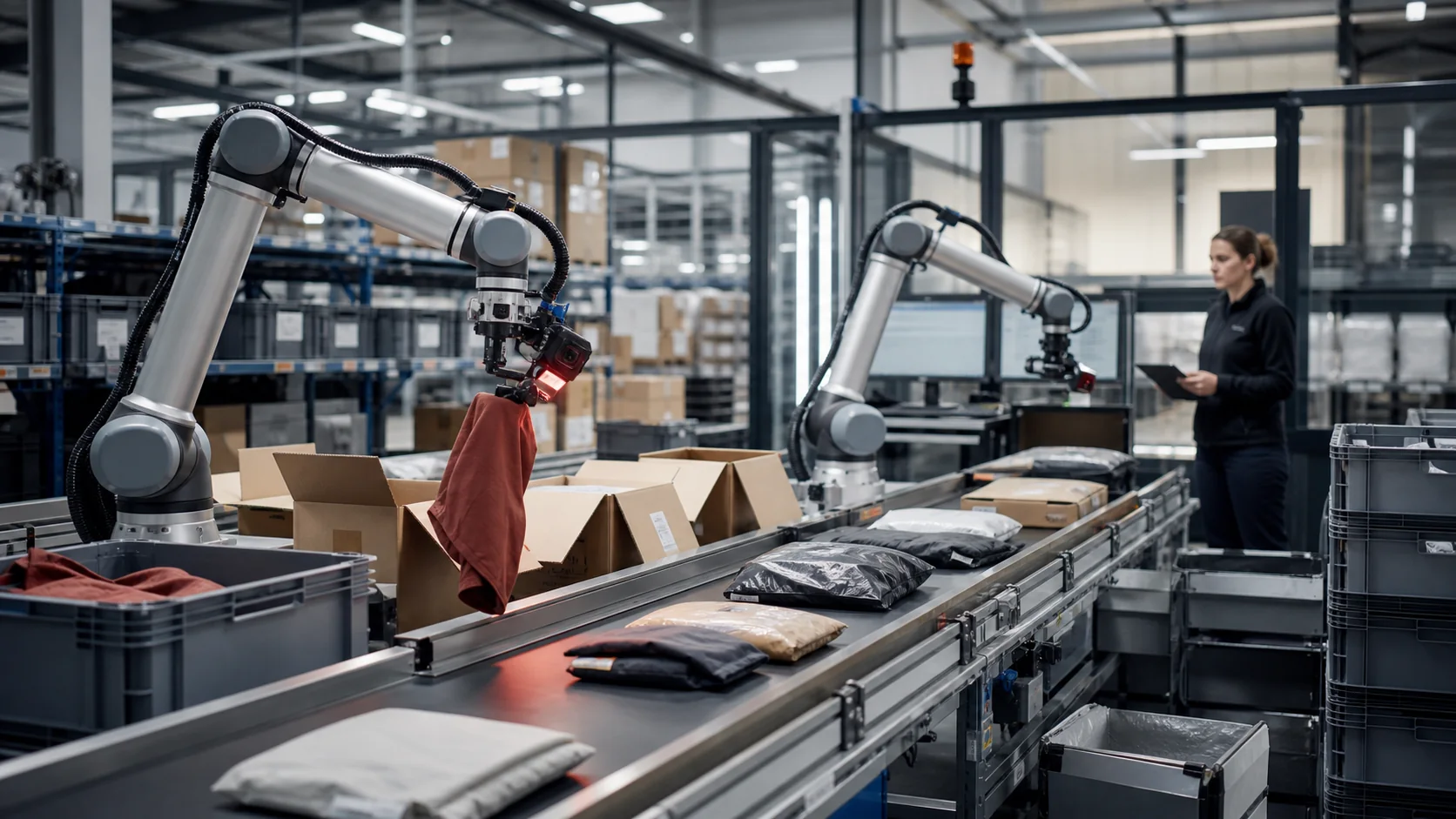
Returns are a credible wedge because they combine high variation with a clear downstream obligation. Tech.eu reports that Zalando says around half of items ordered are returned, and describes the work as unpacking, inspecting, folding and processing goods that is still largely manual. It also reports that Sereact’s dual-arm system can open boxes, remove garments, fold them and process returns automatically. This is a workcell and software-integration problem: the arms must handle changing objects and the operator must decide what happens to goods that cannot be safely or economically classified. The public record gives the task shape, but not the station’s sustained throughput, exception burden or cost per processed return.[2,3]
Cortex is the mechanism connecting those deployments. Sereact presents the platform as a common intelligence layer that can run across different robot forms, with real-world picks feeding a data flywheel. That creates a plausible reason for a large e-commerce operator to invest: the operator brings a difficult, recurring workflow and the vendor brings a deployment base from which to generalize. But the mechanism only becomes an operating result when a customer site publishes what was installed, what the system completed without intervention and what the human or integrator layer still handled.[1,2]
The decision delta is the missing denominator
The consensus view is that a strategic investment is a capital signal. The new evidence adds a sharper operating mechanism: Zalando is placing that signal behind a platform whose vendor says it already has live European systems and a large production-data record. The exposed parties are not only the two companies. Returns workers, warehouse operators, third-party logistics providers, brands and integrators will absorb the consequences if the workcell shifts where inspection, exception handling and resale decisions occur. The decision delta is therefore not that robots have entered fashion returns; it is that an operator has attached capital to the data and deployment layer that could make that transition repeatable.[1,2,3]
The hardware choice also narrows the claim. Tech.eu reports that Sereact’s chief executive is cautious about legged humanoids because of cost, fragility and battery constraints, and views wheeled dual-arm systems as safer and more practical. He also says much more contact-rich work such as assembly is not yet ready for current models. That is useful deployment evidence because it separates a returns workcell with a bounded material flow from the broader humanoid narrative. Sereact’s capital can scale a practical workflow without proving that a general-purpose robot can operate across a warehouse.[2]
What would turn the signal into a deployment
The opened sources do not disclose a Zalando site, installed robot or station count, commissioning date, return throughput, uptime, intervention rate, rework rate, labor-hour change, capital cost or achieved per-return economics. They also do not identify the integrator responsible for site acceptance or say whether Zalando has committed to a production rollout. Those omissions matter because a strategic investment can purchase learning, option value and influence without being a purchase order. Calling it a deployment would erase the boundary the evidence currently leaves intact.[1,2,3]
The next credible catalyst is a named Zalando commissioning or operating record. It should identify the facility and workflow, the number and form factor of stations, the start date, sustained returns per hour, autonomous-completion and exception rates, human support minutes, downtime, rework or resale yield, and cost per return against the manual baseline. If those measures appear and hold across more than one site, this signal can move from platform financing to repeatable deployment. Until then, the most defensible reading is narrower and more useful: Zalando is funding Sereact’s live-deployment data flywheel, while the customer-side proof of returns automation remains pending.[1,2]