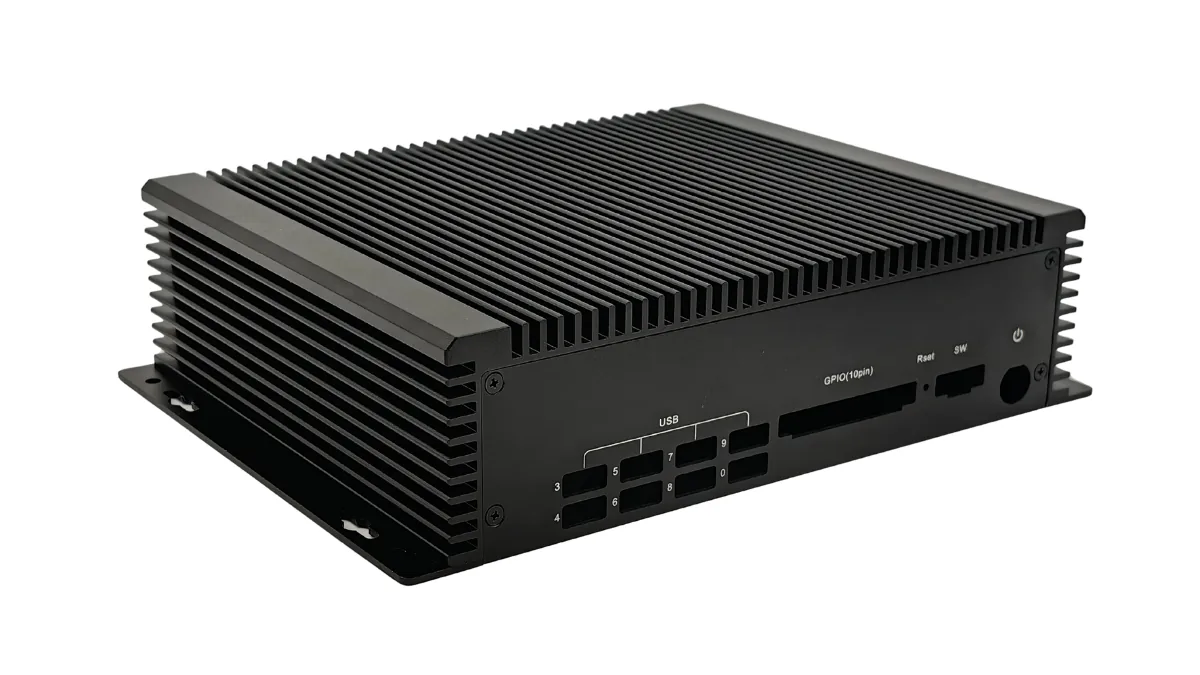
An industrial computer enclosure has to accommodate more than a motherboard. Connected plugs, expansion cards, cooling structures and the tools needed for assembly all occupy space. Domify's public product and engineering material follows that larger envelope, from the machined panels of its DM11 enclosure to a Mini-ITX integration account and a separate review of repeat-production consistency. Together, they show how the housing becomes part of the system design.[1,2,3,4]
The connector changes the enclosure
DM11 is an extruded aluminum enclosure with an external finned profile, customizable CNC-machined front and rear panels, internal mounting and a heat-transfer structure. Domify presents the photographed panel openings as examples to review against a customer's board and cables. Its reference drawing shows an extrusion cross section; it does not settle product length or every dimension a project will need.[1]
A separate Domify engineering note explains why that review matters. Panel thickness and the distance between a connector and the board edge affect how an opening can be machined. Space may also be needed behind the panel for the connector housing, mating plug or locking hardware. A bare-board outline can therefore fit while the connected assembly remains difficult to use. The note calls for actual cable and plug envelopes, insertion and removal space, and tool access to be checked before prototype release.[2]
Cooling and service access compete for the same space
Domify's Mini-ITX account describes those interactions in a compact system requiring PCIe expansion, fanless cooling and side access to a 2.5-inch drive. According to the company, a PCIe cable separated the expansion card's mounting position from the motherboard slot. A heat-pipe path then connected the CPU to the outer cooling structure, while the drive mounting was arranged for side access. These were linked packaging decisions, rather than three independent additions.[3]
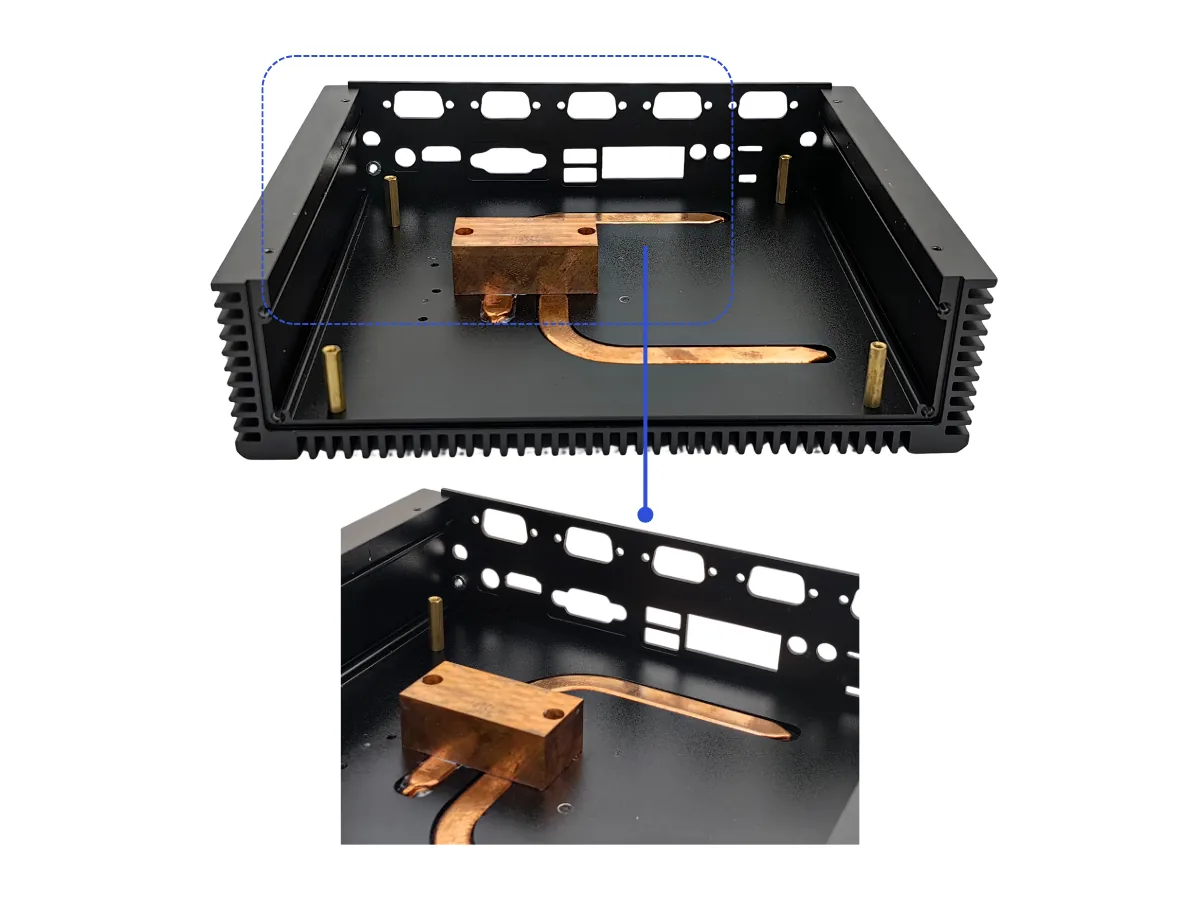
The company describes that case as a completed engineering project, but does not identify the customer or publish measured thermal results. It also says the illustrations were simplified and recreated as non-dimensional concepts to protect project information. They explain the design approach without providing a manufacturing drawing or proving the performance of another enclosure. The DM11 photographs in this story are a separate product example, not photographs of that customer project.[1,3]
A working sample is only the first checkpoint
In its separate production-consistency account, Domify describes attention shifting after repeat batches from initial fit to the relationship between the enclosure body, end panels and bottom cover. The review covered machining features, thread depth, standoff retention, extrusion straightness, finish and matching accessories. The reported response included assembling the first article before batch packing and checking the complete enclosure, rather than relying on individual parts alone.[4]
Domify reports clearer inspection controls and earlier identification of assembly risks. It publishes no batch size, defect-rate series, cost saving or independently audited result with the account. The useful engineering lesson is the inspection boundary: a hole, panel or cover can pass a separate check while the relationship between the parts still needs attention in the assembled product.[4]
Specify the assembly, then validate it
For an equipment team, the common thread is a complete assembly review. Board layout, connector and cable space, the heat path, fasteners and service sequence belong in the same design conversation. Domify's OEM and ODM offering links that work with prototypes and small-batch planning. The next meaningful proof is a representative assembly checked against agreed requirements, followed by controls that can be applied to repeat orders. The public material describes that approach; project-specific fit and production acceptance remain to be confirmed.[2,5]