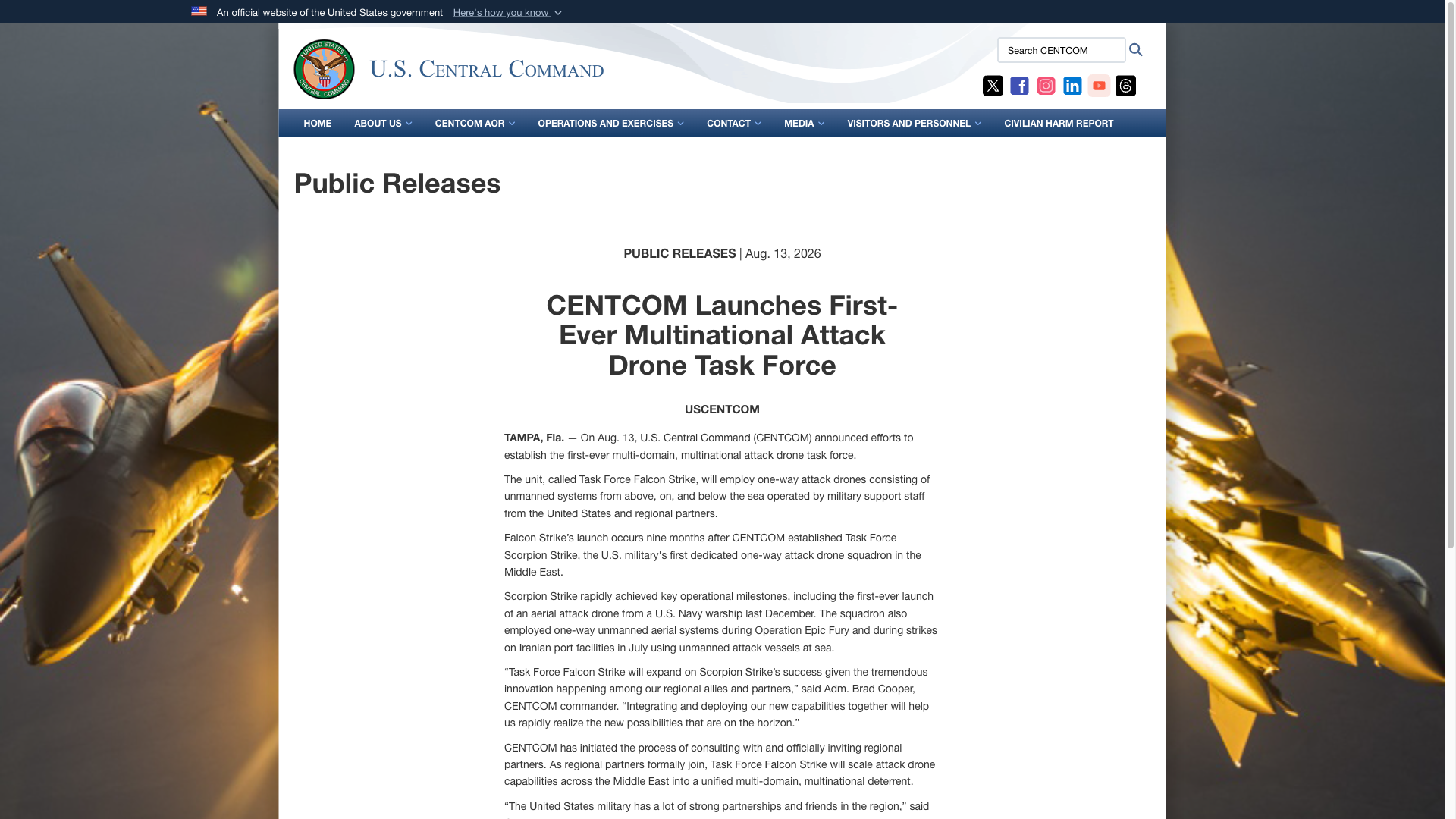
The announcement begins a formation process
U.S. Central Command said on August 13 that it had begun efforts to establish Task Force Falcon Strike, which it describes as a multinational, multi-domain force for one-way attack drones. The announcement matters because it moves the command's drone strategy from a U.S.-run task-force model toward regional integration across air, sea-surface and undersea systems. But the operative verbs in the primary release are prospective: CENTCOM says the force will employ those systems and will scale capabilities as regional partners formally join. It does not say that a unified multinational force is already operational.[1,2,3]
That distinction is more than semantic. CENTCOM says it has started consulting with and formally inviting regional partners, while U.S. Special Operations Command Central will lead a staff of U.S. and regional representatives. The release does not identify a country that has accepted, a force contribution, a host location, a platform supplier, a unit count, a command arrangement or an activation date. The Italian public broadcaster Rai and Lebanon's An-Nahar each reported the development as an intention to create the force and retained the consultation-and-invitation status in their accounts.[1,2,3]
What the record supports, and what it does not
The evidence supports a policy and force-formation change: CENTCOM has publicly created a vehicle for bringing regional personnel and attack-drone systems into one proposed structure. It does not support a claim that allied assets are already integrated, that a partner has committed a specific system, or that the task force has a measured operational capacity. The command's own condition is explicit: scaling follows formal partner entry. That makes the announced consultation process the current operational boundary, rather than a minor caveat to a completed coalition deployment.[1,2,3]
The public record also leaves control and accountability questions open. The release says the systems will be operated by military support staff from the United States and regional partners, but it does not describe whether any platform is remotely piloted, how targeting authority would be assigned, how operators would be integrated, or what rules would govern cross-border use. Those are not proof that such arrangements are absent; they are disclosure gaps. No conclusion about autonomy, readiness, inventory or deterrent effect can fairly be drawn from the announcement alone.[1,2,3]
The multi-domain label should be read with the same discipline. CENTCOM says Falcon Strike is intended to use systems from above, on and below the sea. That identifies the environments the command wants the structure to span, not a disclosed inventory or an integrated operational network. The release contains no named aerial, surface or undersea platform, no training event, no logistics arrangement and no evidence that systems from multiple countries have operated under a common command. Treating the architecture as already fielded would turn a stated objective into a deployed capability claim.[1,2,3]
Independent coverage is useful here chiefly as a check on the announcement's status, not as a substitute for implementation evidence. Rai and An-Nahar each describe CENTCOM's move as an intention or an effort to create the force, and neither identifies a state that has formally joined. Their matching treatment reduces the risk of misreading the release as a completed coalition activation. It does not independently verify the effectiveness, scale or use of any drone system. That boundary matters in a military story, where official statements can establish a policy decision while leaving performance and operational consequences unproven.[1,2,3]
The next evidence should be concrete
Falcon Strike becomes a different kind of story when the institutions publish material implementation evidence: a named partner, a signed participation arrangement, a command-and-control framework, assigned platforms, a location, an activation order or an exercise with disclosed participants and tasks. Any one of those records would show a move from institutional intent into an accountable operating system. Until then, the decision delta is narrower but useful: CENTCOM has opened a regional integration channel for attack drones, not yet demonstrated a functioning multinational drone force.[1,2,3]