A useful separation of model and runtime
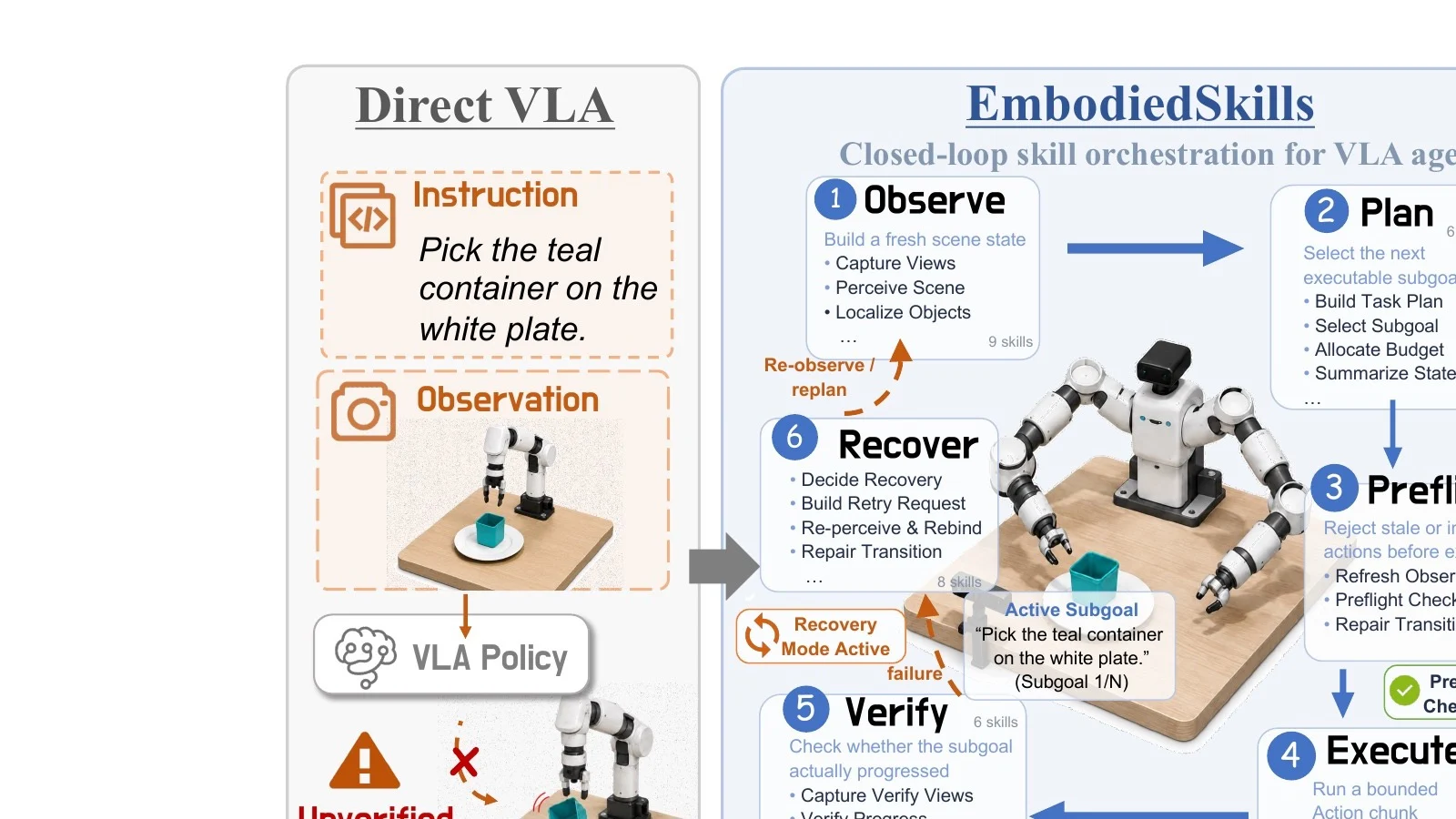
EmbodiedSkills, a September 1 preprint led by Zhejiang University researchers, proposes a way to put a guarded runtime around a vision-language-action policy. Instead of letting a model issue actions as one opaque stream, the authors divide an episode into observation, planning, preflight validation, bounded execution, verification and recovery. The practical claim is not that this loop makes a robot safe by itself. It is that invalid or stale actions can be rejected before execution and that the reason for a failed step can remain visible in a structured trace.[1]
That is a sensible systems direction. A robot policy that predicts a plausible next move still needs to know whether the scene has changed, whether the move is allowed and whether the intended subgoal actually happened. The paper instantiates the low-level controller with OpenPI's pi0.5 model, while a high-level vision-language model proposes the next structured skill. Physical Intelligence's public OpenPI repository separately shows that pi0.5 can be fine-tuned and evaluated through a LIBERO benchmark workflow, making the base-policy comparison inspectable even though it does not reproduce this new agent loop.[1,2]
The 86.20% result is a specialist score
The headline number is an 86.20% macro-average across 50 RoboTwin 2.0 manipulation tasks. The paper compares that with an 82.74% pi0.5 reference reported in the separate LingBot-VA study, a 3.46-point difference. But the evaluation protocol matters: the authors say they fine-tune a separate pi0.5 policy for each task using subtask-level demonstrations, then test each task for 100 episodes. That supports a bounded claim about task-adapted execution in this benchmark. It is not evidence that one unchanged general-purpose agent has acquired the same capability across 50 jobs.[1,3]
The separate LIBERO comparison is tighter but smaller. EmbodiedSkills reports a 97.40% average across the four suites, versus the 96.85% official OpenPI reference; the largest stated gain is 1.2 points on LIBERO-Long. Those near-saturated results are useful evidence that the adapted policies work in more than one benchmark setup. They do not identify a hardware reliability margin, intervention rate, recovery time or field failure mode. The paper's own protocol describes benchmark terminal success, not a customer or workplace operating test.[1,2]
Memory is the harder boundary
The more decision-changing result is in the four memory-dependent tasks from RMBench. There, the same task-adapted approach reaches a 12.5% macro-average: 19% on Battery Try, 9% on Blocks Ranking Try, 6% on Cover Blocks and 16% on Press Button. Those results exceed the published RMBench columns for pi0.5 at 5.5% and X-VLA at 7.3%, so the preprint does not show a simple failure. But 12.5% remains a low absolute rate for a task family where the next correct action depends on earlier interaction history.[1,4]
That number should not be read as a fall from 86.20%; it is a different four-task test with a different difficulty profile. It does show why a benchmark average alone is an incomplete buying or deployment signal. A system can improve a controlled action loop and still be weak when it must retain what happened earlier in the episode. RMBench's public repository identifies the suite as a memory-dependent manipulation benchmark built on RoboTwin 2.0, and publishes task-specific evaluation resources. It is therefore a meaningful but still simulated boundary, not a field replication of EmbodiedSkills.[3,4]
What the architecture has and has not proved
The paper's controlled ablation is the strongest evidence for the runtime design itself. Across 5,000 RoboTwin episodes, the authors report 86.2% for the full loop, 48.2% without intermediate verification, 34.4% without semantic subtasks and 19.5% with one action chunk per subtask. That makes a credible narrow case that, in this setup, repeatedly checking progress and retaining a subgoal can improve terminal success. It does not establish that a similar loop will correctly recognize an occluded object, a slippery grasp, a person entering the scene or a faulty sensor in the physical world.[1]
The authors name several of those costs themselves. Maintaining per-task specialists raises training, storage and deployment costs relative to a single generalist policy. Extra vision-language calls and post-action observations add latency. And even a decision that passes the runtime's schema can still be wrong if grounding or verification is visually ambiguous. The arXiv record currently provides the paper, HTML and TeX source, but no associated EmbodiedSkills code, weights, data package or physical-evaluation artifact. That is an artifact boundary, not a claim that the work cannot be released later.[1]
The next test is a physical one
For robot teams, the result is useful as an engineering pattern: give a policy explicit state, checks and a recovery path rather than treating every failure as an unexplained action-model error. The evidence does not yet support a claim of general robot reliability. The next measurable test is an independently runnable release with task-balanced physical trials, disclosed resets and interventions, end-to-end latency, and memory-dependent failures recorded alongside successes. Until then, EmbodiedSkills is a promising benchmark architecture with a clear limitation, not proof that a guarded VLA loop is ready to operate unattended.[1,2,4]