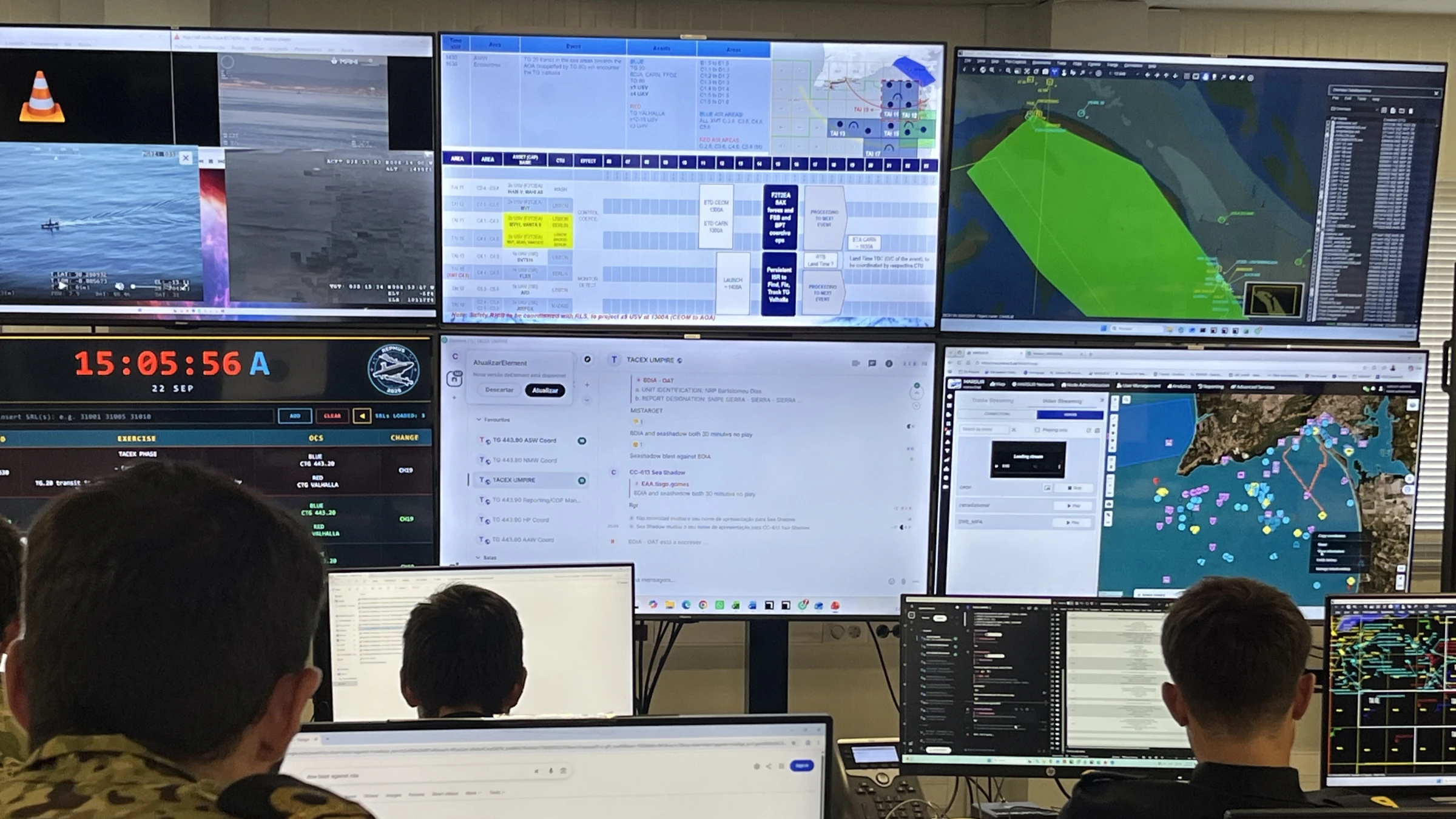
The European Defence Agency said on September 23 that its MARSUR maritime surveillance network exchanged information with national and NATO systems during testing off Portugal. Data from unmanned systems entered that exchange. The result concerns connecting information to operators, rather than proving that robots can perform an entire mission autonomously.[1]
The Portuguese Navy places the trial within REPMUS, an experimentation exercise running from August 31 to September 25 around Troia and Sesimbra. Its opening notice describes testing across surface, underwater, aerial and land systems, with military, academic and industrial participants. That setting matters: it brings different equipment into an operational environment, but participation does not establish that every platform passed an acceptance test.[3]
This was a planned integration milestone. EDA’s January MARSUR III factsheet listed REPMUS 2026 as a test to expand exchanges with underwater and unmanned systems. It described a decentralized network connecting maritime operations centres through encrypted connections, with either integration into national systems or a separate user interface. The same document presented an EU Secret information layer as work ahead, alongside exchanges with civilian authorities at lower classifications.[2]
The September account makes that boundary explicit: MARSUR remains protected but unclassified. EDA describes a proposed upgrade of 18 nodes and connection to the European External Action Service’s secure network. Its timetable depends on approval: work in 2027 and classified operation in 2028. The report does not establish that this upgrade has been funded or completed.[1]
Comparing the two EDA records yields a practical distinction for naval integrators. An interface can demonstrate data exchange while the wider information environment still awaits a different authorization and infrastructure path. Buyers should therefore separate acceptance of robot-derived information from acceptance of the network that will carry sensitive operational data. One milestone cannot substitute for the other.[1,2]
The Navy’s independently published exercise notice confirms the experimental setting, not the specific MARSUR result. EDA provides no measured latency, loss rate or failure breakdown in its announcement. The next useful evidence is repeatable exchange performance under disrupted communications, followed by documented approval and delivery of the classified upgrade. Those checkpoints would show how far a successful exercise connection travels into routine service.[1,3]