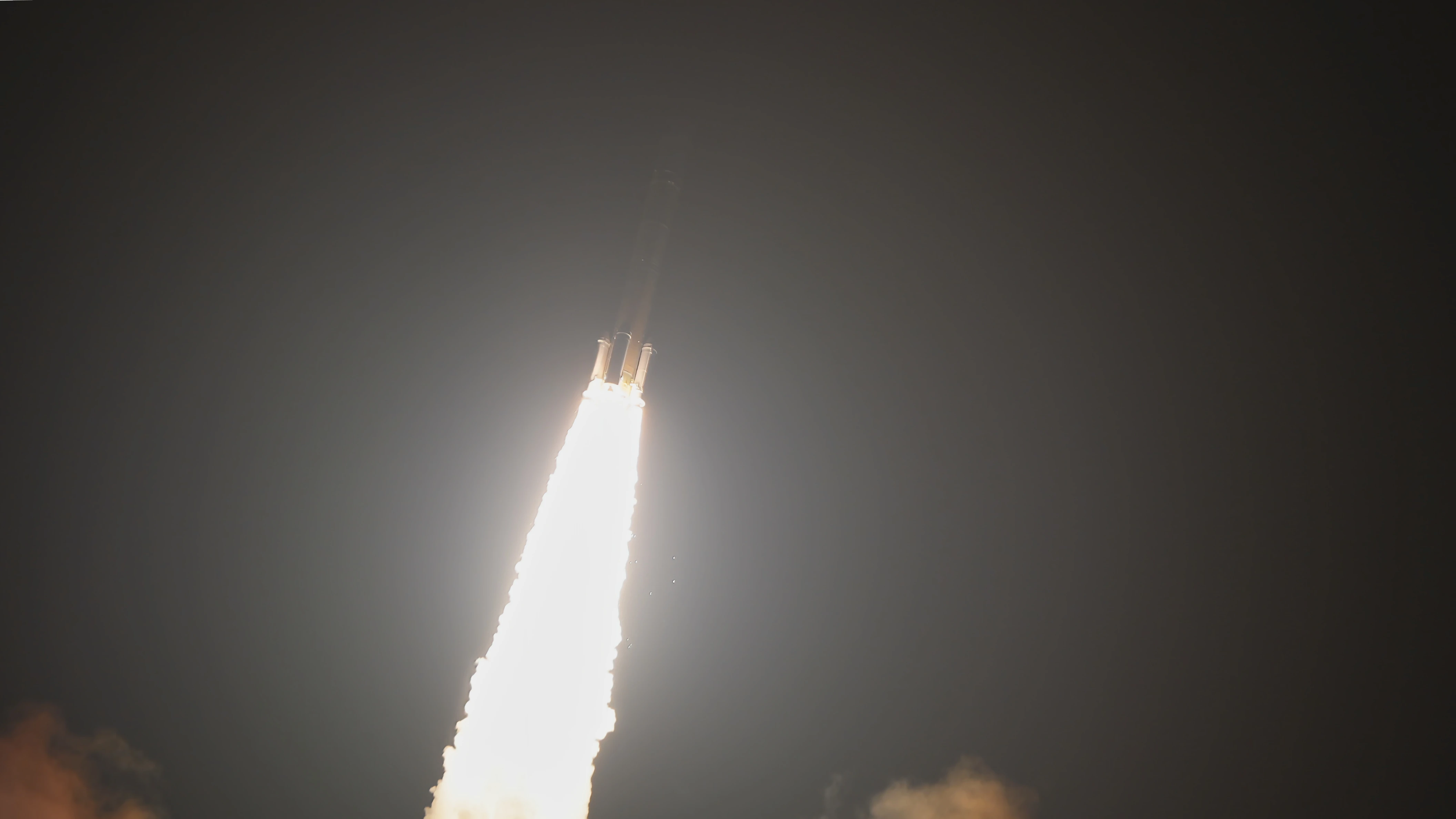
The launch is complete; surface operations remain ahead
Japan’s Martian Moons eXploration mission, MMX, launched from Tanegashima at 04:41:03 Japan Standard Time on October 20. JAXA confirmed spacecraft separation about 71 minutes later. On board is Idefix, the rover developed jointly by Germany’s DLR and France’s CNES. The launch removes one major mission dependency, but it does not establish that the rover can work on Phobos.[1,2]
DLR’s launch update puts the next robotics milestones in a different category from a conventional touchdown. Around the turn of 2028/2029, the spacecraft is intended to release Idefix roughly 40 to 100 metres above Phobos. The rover is expected to hit the surface without braking, bounce and settle, then recover its working orientation and deploy its solar panels. These are planned operations, not outcomes demonstrated by launch.[1]
Recovery is part of the job
The operating problem begins before the first drive. DLR describes surface gravity below one thousandth of Earth’s and temperature changes exceeding 200 degrees Celsius during a roughly seven-hour day-night cycle. It identifies self-righting from an unknown resting position as the first real test. That makes recovery a prerequisite for useful work, rather than a maintenance procedure to call after a failed task.[1]
For robotics operators, the distinction is consequential. A successful journey can deliver a machine to the right destination while leaving its first useful action unresolved. Idefix’s evidence chain therefore has separate steps: survival after release, successful self-righting, solar deployment, controlled movement and useful measurements. Treating launch as proof of that complete chain would hide the very field conditions the mission is designed to investigate.[1,2]
The rover informs the next landing
DLR plans about 100 days of surface exploration. Idefix’s measurements of the ground are intended to help the mission choose a suitable landing site and prepare the MMX spacecraft’s later sample collection. JAXA’s mission outline separately targets returning material from Phobos to Earth in 2031. Rover exploration and spacecraft sampling are linked tasks performed by different parts of the mission.[1,3]
During cruise, the rover remains attached to the spacecraft. DLR says the Cologne and Toulouse control centres will prepare health checks, instrument calibration, battery maintenance and a software update. This is the immediate operating change created by launch: a built system now has to be maintained during its journey while its teams rehearse the surface sequence. It is not yet a rover traversing a Martian moon.[1]
The next useful evidence will be mission health and commissioning updates, followed by confirmation of arrival, rover release and successful recovery on Phobos. Until those events occur, the strongest conclusion is bounded: the launch has carried a demanding robotics experiment into flight, and the experiment’s hardest physical tests are still ahead.[1,2,3]