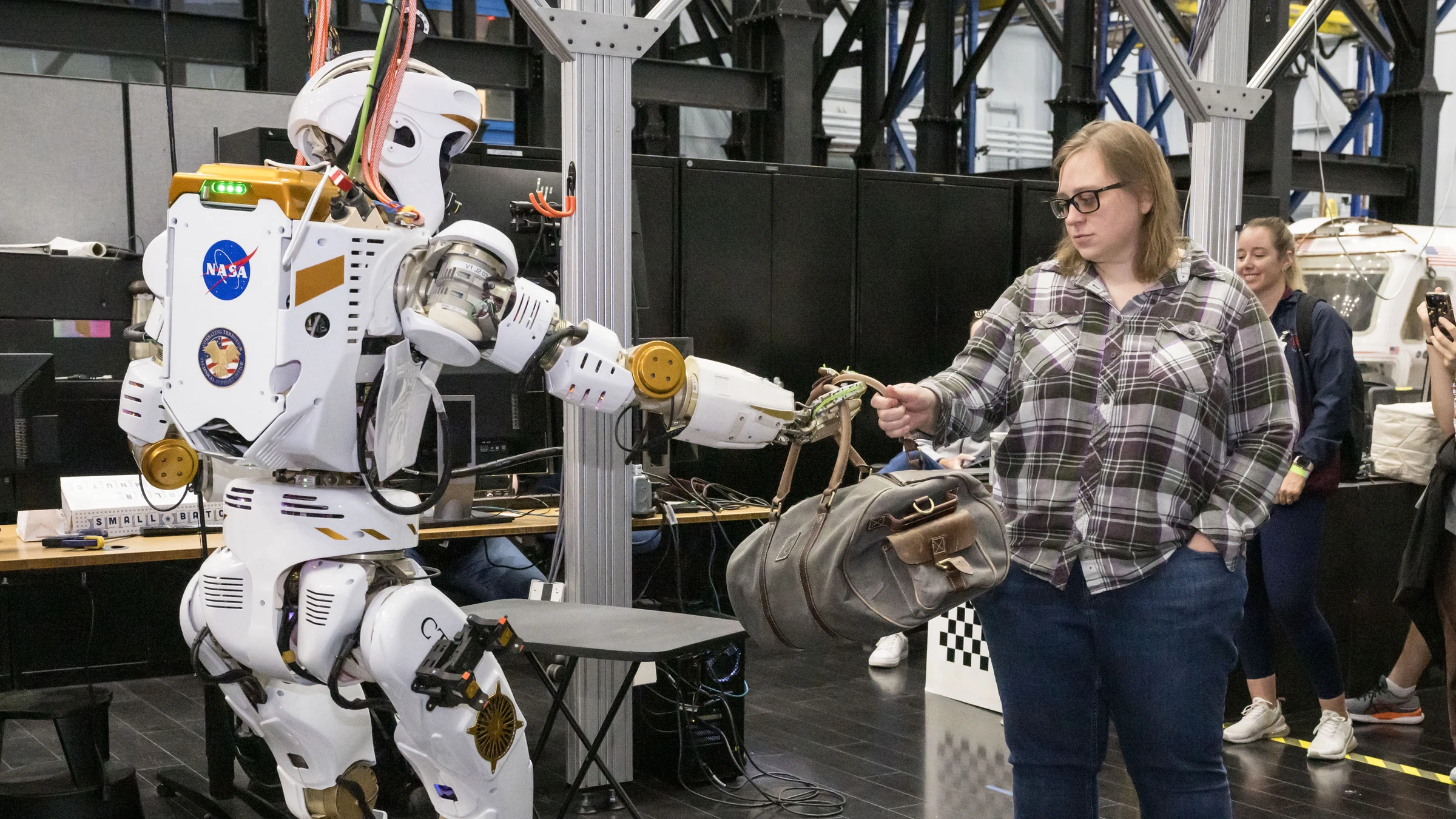
NASA’s September 28 account of its Dexterous Robotics Team offers a practical way to judge space robots: test the work together with the spacecraft that shapes it. At Johnson Space Center, the Integrated Mobile Evaluation Testbed for Robotics Operations, or iMETRO, combines physical mockups and simulation for logistics, maintenance and science tasks. NASA describes the intended applications as human-supervised exploration, not autonomous robots already working on the Moon.[1]
The useful change in understanding is the unit of evaluation. A robot’s ability to move a bag is only one part of a cargo workflow. The hatch, storage space, camera view and operator interface also matter. Comparing NASA’s account with the facility repository and PickNik’s supplier case study shows a concrete integration route, while retaining the boundary between a controlled demonstration and a mission-ready system.[1,2,3]
There is a history boundary here as well. NASA’s technical-report catalog lists an iMETRO pressurized-rover logistics demonstration published in June 2024. The catalog describes laboratory hardware and software, rather than an off-Earth operation. That earlier record makes the September profile a current explanation of an established research effort, not evidence that the facility or its tasks first appeared this week. The recording itself was not evaluated for this article, and its catalog entry provides no completion rate, intervention count or mission qualification result.[5]
The hardware around the robot
NASA says the facility lets technology providers work alongside people designing habitats and rovers. Its account notes that a larger handle or better lighting can make a task easier for robots and people. That is an engineering implication: spacecraft design can influence how difficult the robot’s job becomes, rather than leaving all adaptation to a more capable machine.[1]
The repository makes that approach tangible. It lists a robot arm mounted on a two-metre rail, a mobile platform carrying two arms, remote operator stations and models of a crew-access hatch and logistics stowage trainer. It also permits researchers to bring their own sensors, end effectors or entire robot. These are documented evaluation configurations, not a purchase order for a single humanoid design.[2]
The distinction matters for buyers and mission planners. Matching a machine to a specified hatch-and-stowage sequence gives an integrator something concrete to commission. It also gives the spacecraft designer a way to examine reach, access and object presentation. Neither document provides a comparative cost calculation establishing that this architecture is cheaper than a humanoid or a human crew.[1,2]
A demonstrated sequence, with human involvement
NASA reports a PickNik test in which an arm recognized a hatch, operated its latch and handle, opened it, then moved cargo bags between the hatch and a bin. PickNik’s case study describes the setting as a controlled laboratory on Earth. It calls hatch-door operation semi-autonomous and describes a rail-mounted arm using its MoveIt Pro software.[1,3]
PickNik says its team and NASA combined programmed robot behaviors, and that NASA engineers received training to create further behaviors and configurations. That supports a bounded conclusion: the project demonstrated an integrated task sequence and transferred some application-building capability. The supplier account is an interested-party source; its broad efficiency language supplies neither a trial denominator nor measured crew-time savings.[3]
The next test is the operating envelope
The facility documentation provides a further limit. It discusses remote control under realistic communication constraints, but separately marks an isolated network with configurable latency and bandwidth restrictions as a future planned capability. It also warns that referenced core content is still moving through NASA’s release process. The repository therefore should not be read as proof that every described test condition or software package is already available.[2]
The next useful evidence would specify repeated task completion, interventions and recovery when a hatch is misaligned, cargo shifts or communications degrade. Those are proposed evaluation checkpoints, not results claimed by this article. Until task-level records establish that operating envelope, iMETRO is best understood as a place to reduce integration uncertainty. Its value is making the work and its interfaces testable before committing them to a mission.[2,3]