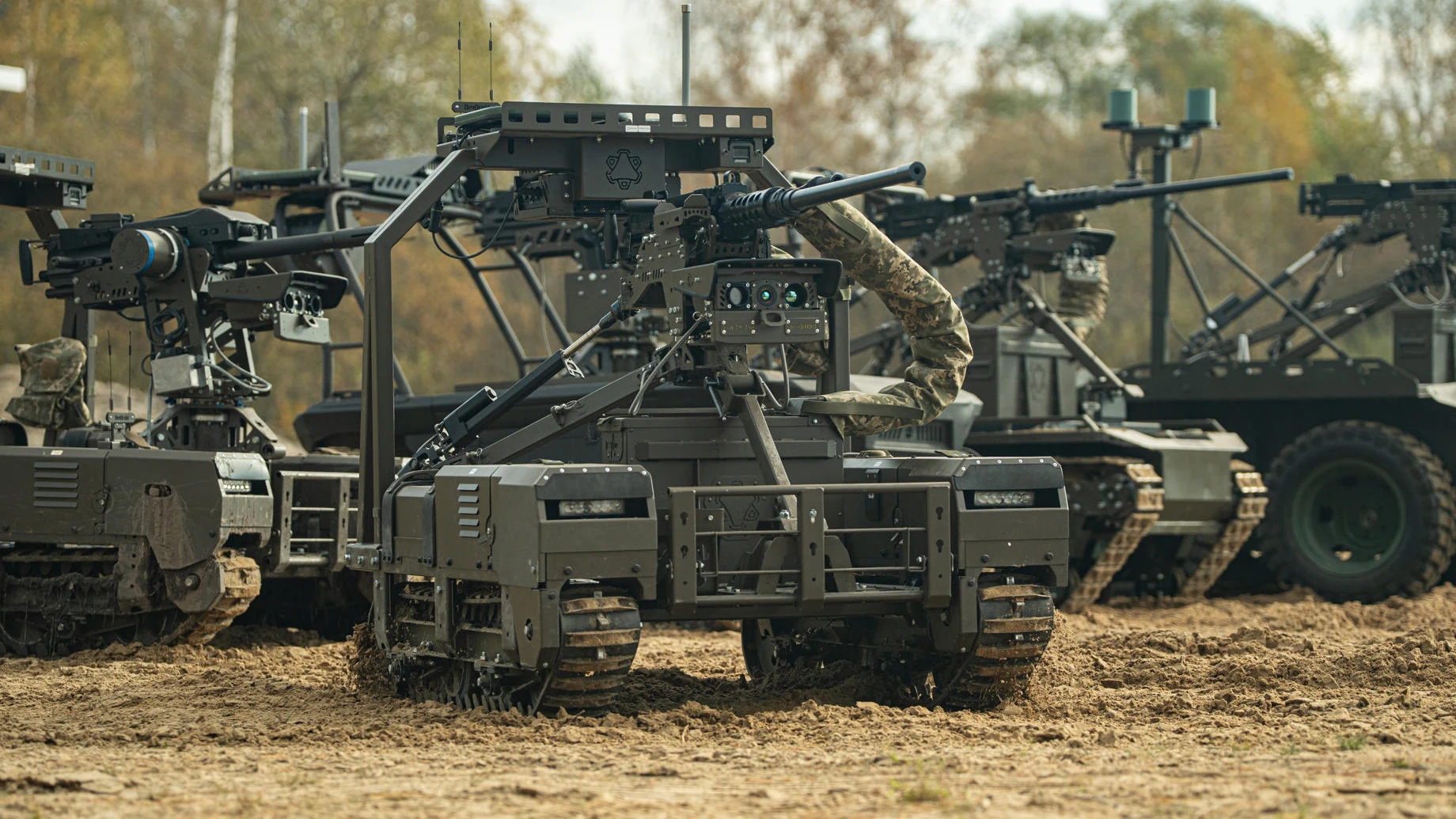
Ukraine’s Third Army Corps sent ground robots to do the work of an assault team, according to accounts from both sides. Russian sources placed the attack near Lyman, in Ukraine’s Donetsk region. Deputy corps commander Maksym Zhorin said the assault itself was carried out entirely by ground robots and that some reached Russian positions and engaged them, Ukrainian broadcaster Espreso reported on November 6. The accounts leave questions about the scale and outcome. They also point to a practical shift: Ukrainian units are finding more ways to send a machine where they would once have had to send a person.[1,2]
The stronger measure of that shift came the same day. Ukraine’s Ministry of Defence reported 31,398 logistics and evacuation missions in October, up from 7,511 in January. Each figure counts missions in the military’s reporting system. It does not count attack robots, distinct vehicles or the number of people saved. It does show how quickly a capability associated with experimental assaults is becoming part of ordinary frontline work.[3]
What the Lyman accounts establish
The earliest public trail we could trace runs through footage circulated by pro-Russian war blogger Yuri Podolyaka on November 1. On November 3, the Conflict Intelligence Team, an independent open-source research group, described the footage as showing a large ground-robot assault. Its Lyman attribution was tentative and based on the Russian formation named in the source, rather than a precise geolocation. The researchers attributed the claim that 28 machines were destroyed to pro-Russian sources.[4,5,2]
On November 5, Russian military Telegram channel Voyennyy Osvedomitel gave a breakdown: 18 vehicles reportedly carried paired AT4 launchers, two carried Mk 19 automatic grenade launchers, and eight carried explosive charges for one-way missions. Ukraine’s In Factum channel dated the assault to October 28, and Tymofiy Mylovanov cited that channel in his November 7 X thread. These accounts explain how the date and number travelled; their repetition is no independent count.[6,7,8]
Zhorin’s response adds something different: a Ukrainian officer acknowledging the robot-led assault and disputing the implication that the machines were stopped before they could engage. His statement gives no fleet count, loss total or territory outcome. Both accounts could be partly true: a machine can reach a position and be destroyed later. The available evidence cannot establish how many arrived, how many were lost, whether there were casualties among supporting personnel, or whether the attack was intended as a diversion. It also cannot establish a world record.[1,9,2]
The innovation is in how people use the machines
Lyman did not come out of nowhere. In an October 7 interview with Ukrainska Pravda, Ukrainian commander Mykola Zinkevych described how his unit worked out a way to use aerial drones to deliver small ground robots during a separate operation. The airborne vehicle did the carrying; the ground vehicle took over after delivery. In a September interview with public broadcaster Suspilne, he also estimated that ground robots handled about 80% of logistics and 90% of casualty evacuation during the phases of Operation Vivaldi he was discussing. Those figures are his account of one operation, with no published mission logs to check the percentages against. Neither interview establishes what happened on October 28.[10,11,5]
An uncrewed vehicle has no one aboard. How it steers and who decides when to use force are separate questions. Under the International Committee of the Red Cross’s definition, an autonomous weapon selects and engages targets without further human intervention once activated. Nothing in the public Lyman accounts establishes that the robots did that, that they coordinated as a swarm, or that one person controlled them all. People can still plan, operate and support an assault even when there is no infantry in the advancing group.[12,9]
The machines also face physical limits. The Conflict Intelligence Team notes that ground vehicles have a shorter line of sight for radio signals than aircraft. Field interviews by the French Institute of International Relations and Eastern Circles describe rough terrain and detection as constraints. The researchers found that many machines still rely on manual or partly automated control. Those are reasons to ask how often a robot completes its task and how much human work goes into each run. A dramatic clip rarely answers either question.[2,13]
The clearest gains are in supply and evacuation
Ukraine’s November release puts October’s mission count at 4.18 times January’s and 10.2% above September’s. The ten monthly figures add to 171,253 recorded logistics and evacuation missions from January through October. These are calculations from one release. The programme records missions in the military’s DELTA system, has them checked by Brave1 specialists and lets units exchange points earned on verified missions for equipment. More units joining the reporting system can also raise the count. The published figures give no count of all attempts, unique machines, losses or trips people would otherwise have made.[3,14]
One mission shows what an entry can mean. In May 2025, Ukraine’s National Guard said the Khartiia Brigade used a ground robot to move a wounded soldier along a 12-kilometre route to an evacuation team. The team took him to doctors. The robot handled one leg of a job that still depended on people at both ends.[15]
Ukraine has also made the machines easier for units to obtain. In February, its Defence Procurement Agency opened direct ordering of ground robots to military units through its DOT-Chain Defence marketplace, with seven models from six Ukrainian manufacturers listed at the time. By July 20, the ministry said the agency had contracted more than 22,000 domestically made ground vehicles through its procurement channels, overwhelmingly for logistics. Contracts measure what the agency has ordered. The ministry separately reported thousands of deliveries, without giving an exact total. That mix shows where demand is concentrated, without telling us who made the robots used at Lyman.[16,17]
Allied supply is a separate channel. Estonian manufacturer Milrem Robotics said it had delivered THeMIS ground vehicles configured for cargo, casualty evacuation and route clearance to Ukraine. In June 2026, the company said it had handed the first vehicles from a new Dutch assembly line to the Netherlands for onward delivery to Ukraine. That handover is a production milestone; it does not establish Ukrainian receipt of the Dutch batch or connect the THeMIS to the Lyman assault.[18,19]
For a commander, the useful measure of a supply robot is whether the load arrives and the crew stays out of danger. For an evacuation, it is whether the wounded person reaches care. For an assault, it is whether the unit achieved its objective while reducing human exposure. Lyman offers a glimpse of Ukraine trying that last, harder task. The supply and evacuation record shows the same idea already being put to work, day after day.[3,1]