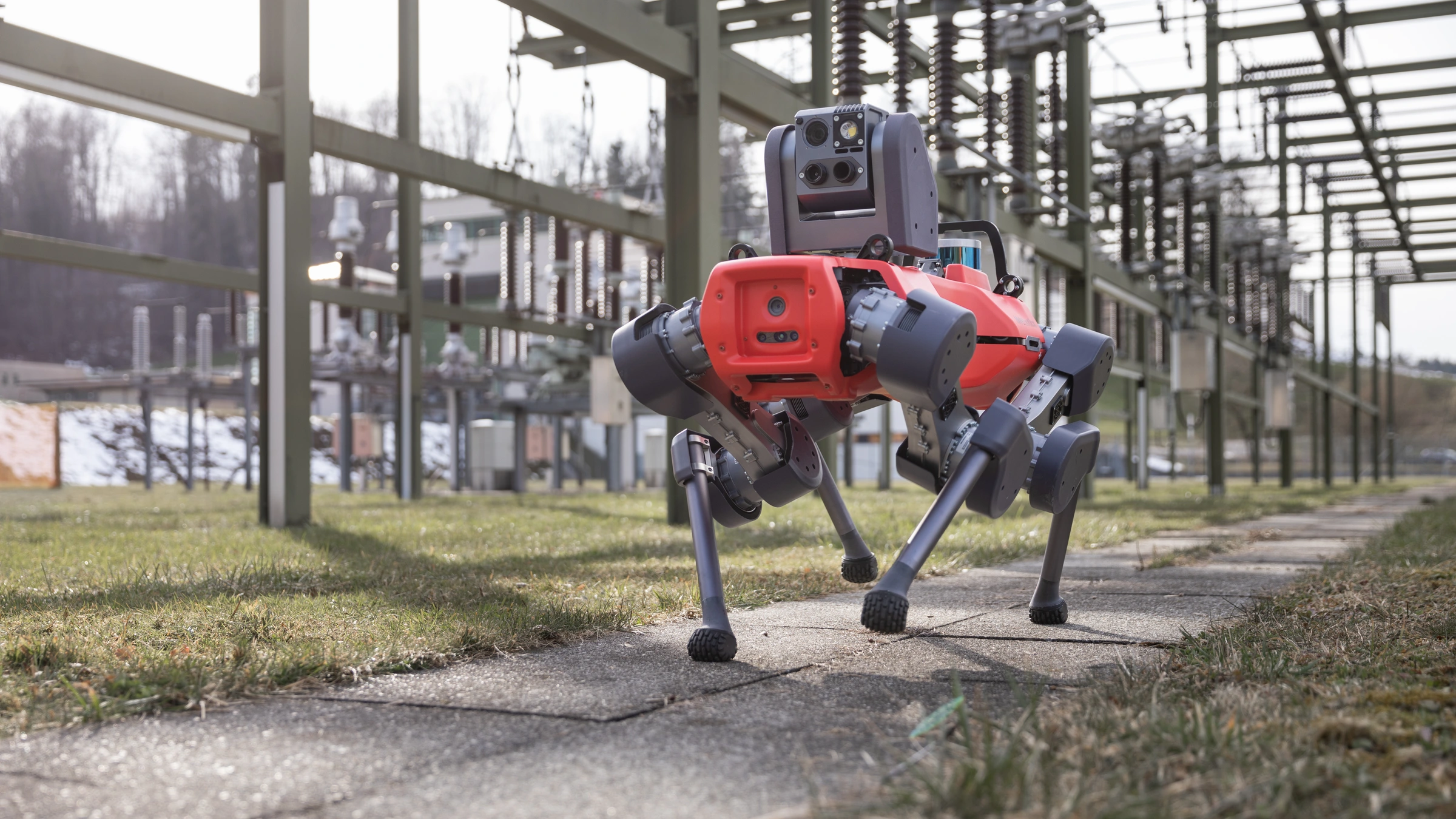
ANYbotics has clarified how customers can obtain door access for its ANYmal inspection robot. Its September 24 guidance says passage through doors without access control is deployable now. A configuration for controlled doors is available on request, with full rollout planned for 2027. For plant operators, the distinction matters: extending a robot’s route requires a working door installation and an agreed access policy, as well as the robot.[1]
The underlying trial is older. Dormakaba announced the joint pilot with ANYbotics and credential specialist LEGIC on September 17, at GE Vernova’s Whitegate power station in Ireland. The partners reported several weeks of operation. ANYbotics now specifies that two doors were automated, including an electrical-room entrance with access management. Those are participant reports of a bounded installation, rather than independent measurements of performance across many plants.[1,2]
The door does the opening
This integration does not give the quadruped a hand that turns an arbitrary handle. The robot requests entry, while a motorized door operator supplies the physical movement. For restricted areas, the access system checks a digital credential carried by the robot before admitting it. The separation is useful: navigation determines where the robot wants to go, while site permissions determine where it is allowed to go.[2]
That makes the door inventory a commissioning input. Dormakaba’s current product documentation gives the ED 100 a door-width limit of 1,100 millimeters, versus 1,600 millimeters for the ED 250. It also distinguishes their supported door weights and describes both assisted and fully automatic operation. These are hardware-selection constraints, not a guarantee that every door within a width limit is suitable for a particular installation.[4]
The Robot Report’s September 24 reporting identifies ED 100 and ED 250 operators for uncontrolled doors and says local dormakaba teams handle surveys, quotations and installation. Its interview with ANYbotics also describes remote assistance for exceptions. Reusing an existing door therefore should not be read as eliminating installation work or human support. It changes the work from replacing the doorway to equipping and integrating it.[3]
Availability is narrower than the headline
There is a timing discrepancy worth preserving. The Robot Report says the controlled-access add-on would reach existing deployments and future hardware later in 2026. The current ANYbotics page instead distinguishes access on request from a full rollout planned for 2027. That is the more specific current purchasing guidance. The records do not establish why the wording differs, so they do not by themselves prove a delay.[1,3]
The pilot’s significance is practical even within that limited scope. A single closed doorway can divide an inspection route into separate areas. Giving an existing robot authorized passage can connect those areas without buying a machine for each one. But the relevant unit of expansion becomes the commissioned route: every doorway on it needs compatible equipment and an access arrangement, rather than merely a destination marked on a robot map.[2,4]
For an operator comparing proposals, this suggests separating the robot price from door equipment, installation and ongoing support. The published specification can help identify candidate door operators; it cannot price a site or establish how many inspections will finish without intervention. A useful acceptance test would count completed routes, refused entries, door faults and human assistance over a stated operating period.[3,4]
What would establish repeatability
The September 17 announcement describes a successful pilot and work toward commercialization. It does not publish a passage-count denominator, a failure-rate distribution or installed cost. Successful operation at the named plant therefore supports testing the integration elsewhere, while leaving reliability and economics to be measured. It cannot establish how the same arrangement performs across a different collection of doors, maintenance conditions and inspection schedules.[2]
The next useful evidence is a customer’s measured route completion before and after installation, alongside the number of equipped doors and the cost of keeping them working. Until then, the strongest conclusion is that the partners have described a concrete way to extend inspection routes through controlled infrastructure. The procurement question is how much usable coverage a commissioned installation adds, and on what support terms.[2,4]
