What the 62 percent result measures
Researchers affiliated with Astribot, Tsinghua University, Juxi Tech, IntelliFusion and The Chinese University of Hong Kong have posted ART, a system that adds callable tools to a vision-language-action robot model. The paper reports that ART-FAST averaged 62 percent across three author-defined tests on Astribot’s S1 dual-arm robot: 70 percent in a vision condition, 55 percent in an affordance condition and 70 percent in an embodiment condition. Its chosen pi0-FAST baseline reports 40, 30 and 60 percent, for a 43 percent average. Those are useful author-reported comparisons, but they are not yet a measured rate over a disclosed physical test denominator.[1]
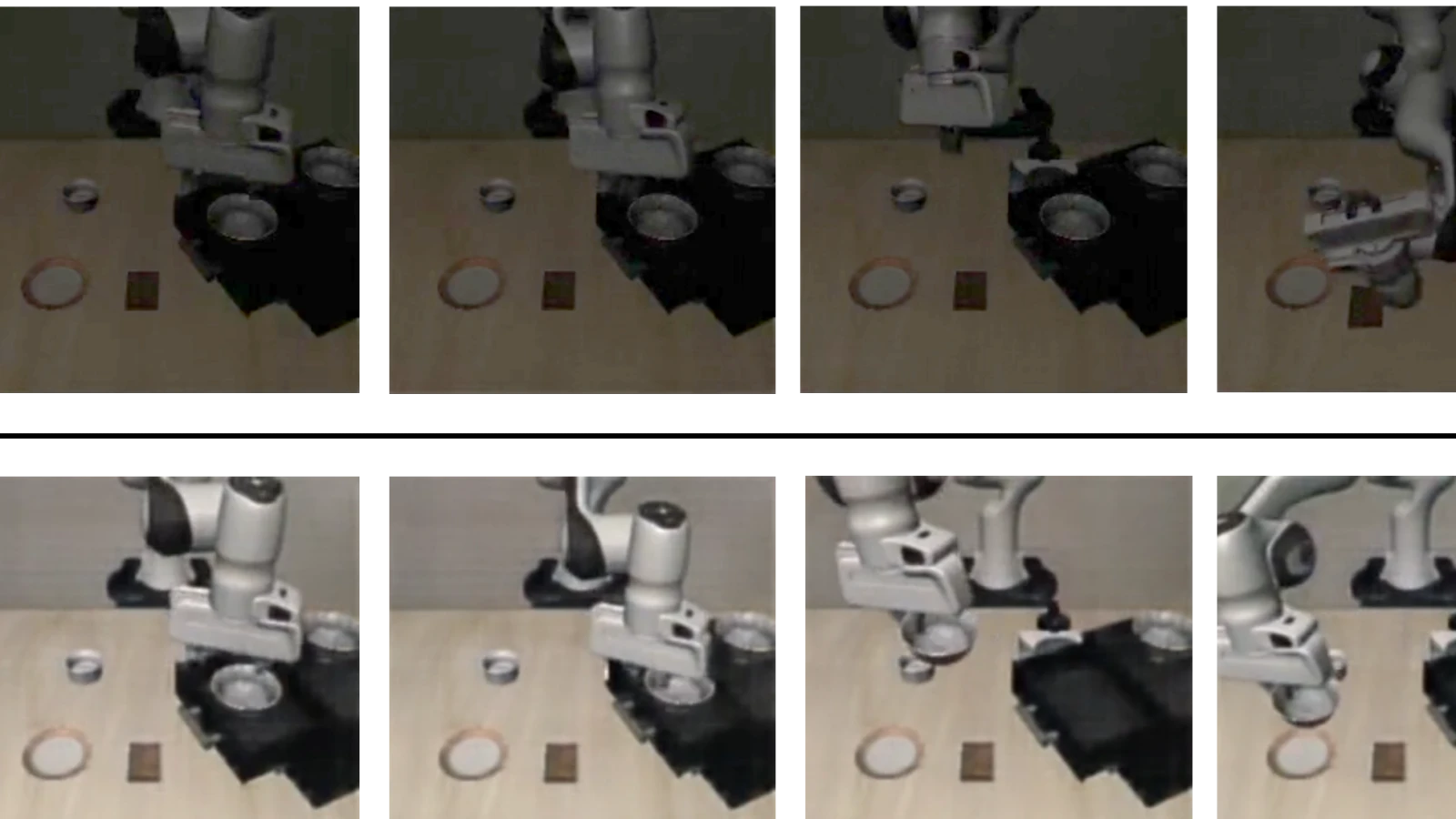
The distinction matters because the paper’s score spans three different stresses. In simulation, ART is evaluated on altered camera quality, more precise language and shifted robot or camera starting states. On the physical Astribot setup, the paper labels its conditions vision, affordance and embodiment. The starting pi0-FAST policy is described as trained on 16,000 pick-and-place trajectories covering 80 objects and 10 containers. ART then receives one epoch of fine-tuning on 30,000 tool-use trajectories. The paper calls the result a closed-loop real-world scenario, but it does not say how many physical attempts produced each percentage or how outcomes were sampled.[1]
The tools are part of the result
ART is not simply a policy asked to act through worse pixels. It can invoke a tool pool that includes low-light enhancement, denoising, jitter correction and deblurring; it also has depth estimation, object detection, camera rotation and zoom, plus a function to reset robot body state. That is a legitimate systems design: a robot can hand a difficult subproblem to a specialized function instead of expecting one learned policy to absorb every condition. It also means the reported number measures the combined policy-and-tools stack. A practical evaluation needs to expose which tools were called, whether each call succeeded, the latency it introduced and whether the handoff caused recovery work. The published paper does not provide those operating measures.[1]
The training data reinforces that boundary. The authors say they generated tool-use trajectories from existing vision-language-action data by applying random visual degradations, transforming simple instructions into tasks that require an affordance tool, composing tool chains and using a language model to create reasoning trajectories. This is a targeted way to teach a model when to request available capabilities. It is not evidence that the system acquired those capabilities from a newly released corpus of physical robot work. The paper reports an eight-A800 graphics-processing-unit training run, but no released data package makes the generation procedure or its filtering available for outside inspection.[1]
The missing denominator changes the claim
A percentage without its physical episode count cannot be read as a comparable reliability claim. The paper’s tables give the three Astribot percentages, but the public version does not state the number of real-world episodes in each class, the number of failed or interrupted attempts, the reset time, or the rule used to count a tool-assisted recovery. LeRobot’s public guidance for the LIBERO benchmark specifies 10 evaluation episodes per task by default. That does not prove ART should have used 10 episodes; it provides a concrete example of the denominator a reproducible benchmark normally makes visible. Without ART’s number, readers cannot translate 62 percent into completed trials, confidence intervals or operator time.[1,4]
The public artifact boundary is equally important. The paper links a project page, while the corresponding ART entry on the lead author’s publication list exposes a paper link but no code or data link. This does not establish that artifacts do not exist elsewhere, and the article makes no such broader claim. It does mean that a reader using the records opened for this report cannot rerun the training mix, tool interface, task setup or reported test comparison. Astribot’s product page describes the S1 as a research robot with seven degrees of freedom per arm, which identifies the hardware class but does not add an independent performance check.[2,3]
What would turn this into deployment evidence
ART narrows a real technical question: whether a robot policy can select specialized visual, geometric and embodiment tools when a normal control path is insufficient. The controlled result is therefore more informative than a generic claim that a vision-language-action model is robust. It does not establish a hands-off workcell, factory or general-purpose household robot. A buyer or lab evaluating the approach would still need the cost, timing and failure behavior of the supporting tool stack, as well as evidence that the same result survives unfamiliar objects, lighting and operators. The paper supplies a promising architecture and a bounded author test, not that operating proof.[1,3]
The decisive next release is straightforward: versioned code and data, the number of physical episodes per task, task-level successes and failures, every reset or human intervention, and tool-call latency and recovery rates. An independent run across new scenes would then show whether the 62 percent result is a reproducible gain from tool use or a narrow advantage inside the authors’ constructed test conditions. Until then, the proper reading is precise but limited: ART has a reported result worth following, and an evidence gap large enough to prevent it becoming a reliability benchmark.[1,2,4]