Three entries, not three blanket permits
On August 20, Beijing’s Economic-Technological Development Area held a ceremony at the World Robot Conference to give three companies certificates to enter its embodied-robot performance sandbox. The district also put a dedicated approval-management system online. The immediate policy change is narrow but real: Shouxing Technology, Beijing Zhongke Huiling Embodied Intelligence Technology and Akapani Robotics now have a named route into a supervised trial for public robot performances. The certificates are not evidence that robot performances have obtained an unrestricted operating permit across Beijing, or that the three systems have met a common commercial safety standard.[1,3]
The fresh district record identifies three distinct formats: Shouxing’s humanoid performance robot, Zhongke Huiling’s four-robot CASBOT BAND, and Akapani’s Unitree G1-U2 choreography system. That matters because the approval experiment is aimed at a particular operating environment—public performances involving machines, audiences, venues and event organisers—rather than at robot manufacturing or general autonomy. The record also says the initial system has registered three companies, seven robots and 14 dedicated safety staff, with 16 remote-monitoring cameras able to support 16 performance sites at once. Those are supervision inputs, not a record of uptime, incident rates or audience-facing operating quality.[1,3]
Why the formal sequence matters
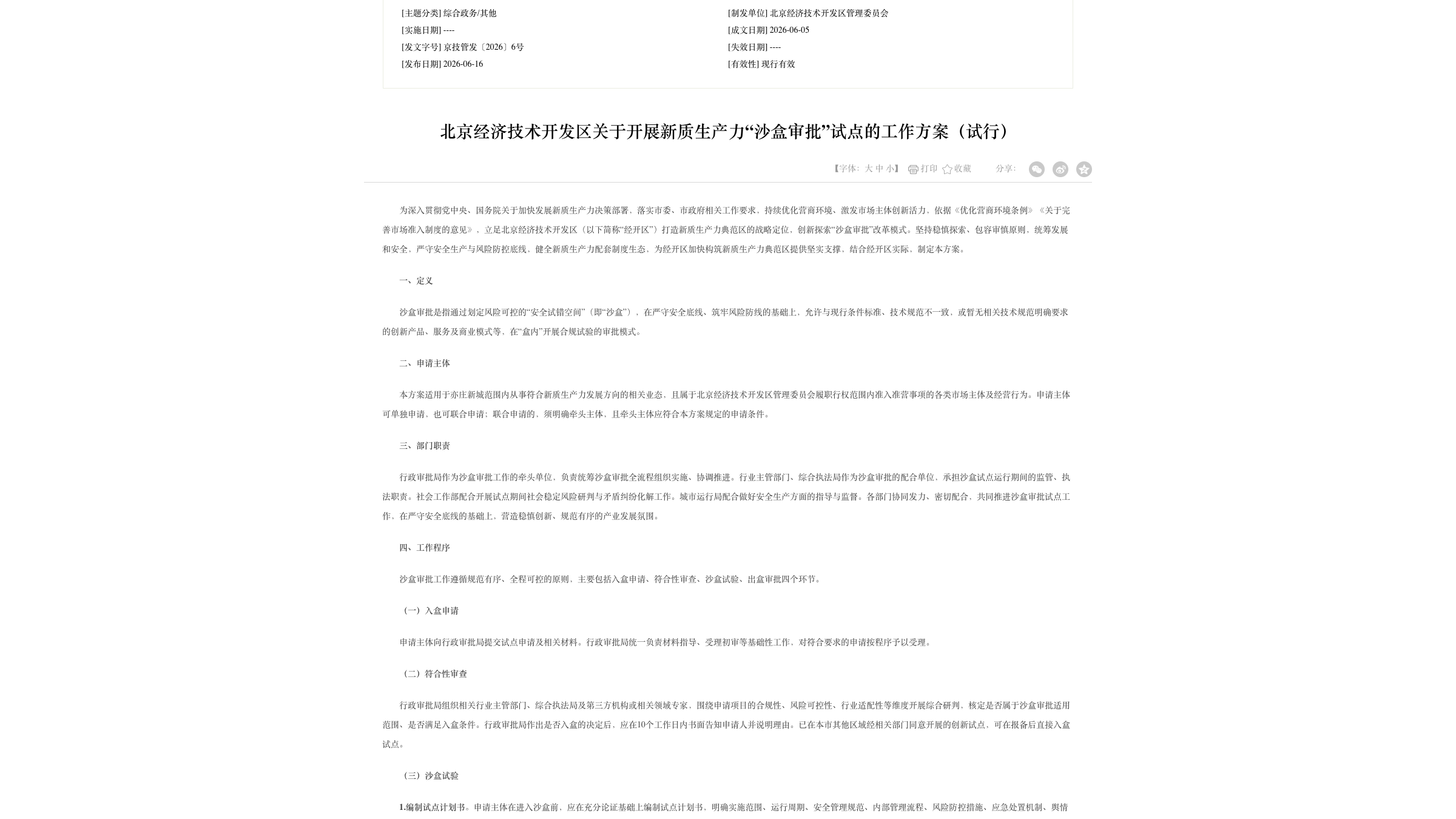
The governing plan, effective since June, makes the boundary explicit. It defines sandbox approval as a controlled space for innovative products, services or business models that may not fit existing conditions, standards or technical specifications. Its process has four separate steps: application to enter, conformity review, sandbox testing, then exit approval. An entry decision therefore opens a path; it does not complete the path. The plan applies only to eligible market-access and operating matters within the district committee’s authority, another limit on treating the ceremony as a general Beijing or national rule for robot performances.[2]
Before trial operations, an entrant must prepare a plan covering scope, operating period, safety rules, internal controls, risk controls, emergency response and exit conditions. The administrative authority can then review whether the trial plan is scientifically and operationally acceptable before allowing experimental production or operations. During the trial, the participant must keep a complete data record and follow the approved plan; the authority can stop a project for a major safety hazard, a failure to follow the plan or a failure to achieve the expected result. After the trial, a separate exit review assesses execution, results, risk control, complaints and legal compliance before subsequent approval or termination.[2]
The decision delta is regulatory, not robotic
The ordinary reading of an entry certificate is that a robot is now approved to perform. The more consequential reading is that Beijing Yizhuang is testing an operating-control stack around a small, named set of machines: company identity, robot identity, a responsible safety worker, location signals, video feeds and operating data. That can reduce uncertainty for venues and builders who need a route to trial a public-facing robot service. It can also make supervision requirements visible early, before a company frames a stage demo as repeatable commercial deployment. Neither the policy nor the event record proves that this control stack works in practice yet.[1,2,3]
The strongest caveat is the absence of outcome data. The opened public records name entry certificates, the process, connected machines and monitoring capacity, but do not provide a trial duration, individual trial plans, intervention counts, faults, audience incidents, insurance coverage, compliance findings, ticket sales or exit decisions. They also do not show whether the rules will transfer to another class of robot or another local authority. The August event is therefore a useful marker of a new regulatory path for a narrow service use, not proof that robot performance is commercially mature or broadly cleared.[1,2,3]
The next measurable checkpoint is not another certificate ceremony. It is a published trial plan or exit decision showing which performance setting was approved, how long it ran, what the supervision system recorded, whether an entrant was halted or amended, and whether any robot gained subsequent operating approval. Until then, the most defensible conclusion is that Beijing has moved from an abstract sandbox framework to its first visible robot-performance entries, while keeping the burden of trial design, traceability and later review squarely inside the sandbox.[1,2,3]