The U.S. Food and Drug Administration's Center for Devices and Radiological Health has scheduled a hybrid public workshop for Dec. 2–3 to discuss benefit and risk in medical robots with autonomous or remote-teleoperation capabilities. The agency issued a discussion paper on Nov. 6; feedback on that paper is due Jan. 5, 2027, under docket FDA-2026-N-13135.[1,2]
The paper is not a new rule
FDA says the paper is for discussion only. It is not draft or final guidance, does not propose policy changes, and does not communicate the agency's proposed or final regulatory expectations. The distinction matters for product teams: the document invites input on possible evaluation considerations; it does not announce a new compliance checklist.[1,3,4]
A separate FDA draft guidance covers premarket submissions for certain robotically assisted surgical devices. FDA lists Nov. 24 as the comment deadline for that guidance, docket FDA-2026-N-9505; it addresses nonclinical testing, clinical data and labeling. It is a different document and docket from the autonomy and remote-operation discussion paper, whose feedback deadline is Jan. 5, 2027, under FDA-2026-N-13135.[7,1]
Autonomy and remote control create different failure paths
The FDA paper treats autonomy and remote teleoperation as separate capabilities. For its discussion, autonomy means a device performs tasks and makes decisions using its current state and sensing without user intervention. Remote teleoperation means a user remotely accesses and controls the device. A system could combine both, but its safety case depends on which tasks are delegated, what the clinician can observe, and how quickly control can be interrupted.[1,3,4]
The paper weighs potential benefits such as access to specialized care and more repeatable workflows against risks including incorrect execution, automation bias, delayed override, and limited adaptability when a procedure departs from expectations. Remote operation adds signal delay or loss, reduced sensory information for the remote user, and dependence on people and equipment at the patient site. FDA asks how quickly a procedure could shift to local manual care when urgent intervention is needed.[1,3,4]
The care environment is part of the test
The two-day agenda reaches beyond a robot's task performance. Dec. 2 sessions cover patient perspectives, preparing health systems, and coverage and reimbursement. On Dec. 3, the program turns to autonomous-system benefits and risks, remote care, cybersecurity and infrastructure, and risk mitigation. That scope puts the operating environment—clinicians, local staff, communications and recovery capacity—inside the discussion.[2]
Three questions for teams preparing input
First, map task-level authority: what the device senses, decides and executes, what the clinician directs, and which conditions trigger a handoff. A single label such as autonomous can hide important differences between systems and intended uses.[1,2]
Second, describe failure and recovery paths, not just normal performance. Teams can show what happens when signals are delayed or lost, an action cannot be interrupted as expected, sensing is incomplete, or the procedure changes. For remote use, the response needs to identify who can take control locally and how care continues if remote control is no longer safe.[1,2,3]
Third, tie evidence to the whole clinical workflow: the intended tasks, likely variation, user training, on-site expertise, and the ability to convert to manual care or escalate. This is an editorial synthesis of the paper and workshop agenda, not an FDA checklist or announced requirement.[1,2,4]
The decision delta is that medical-robot readiness cannot be reduced to whether a system completes its nominal task. The next question is how device actions, human oversight, connectivity and local recovery fit together in a defined use. The December workshop is an opportunity to test those boundaries in public; the paper itself does not settle them.[1,2]
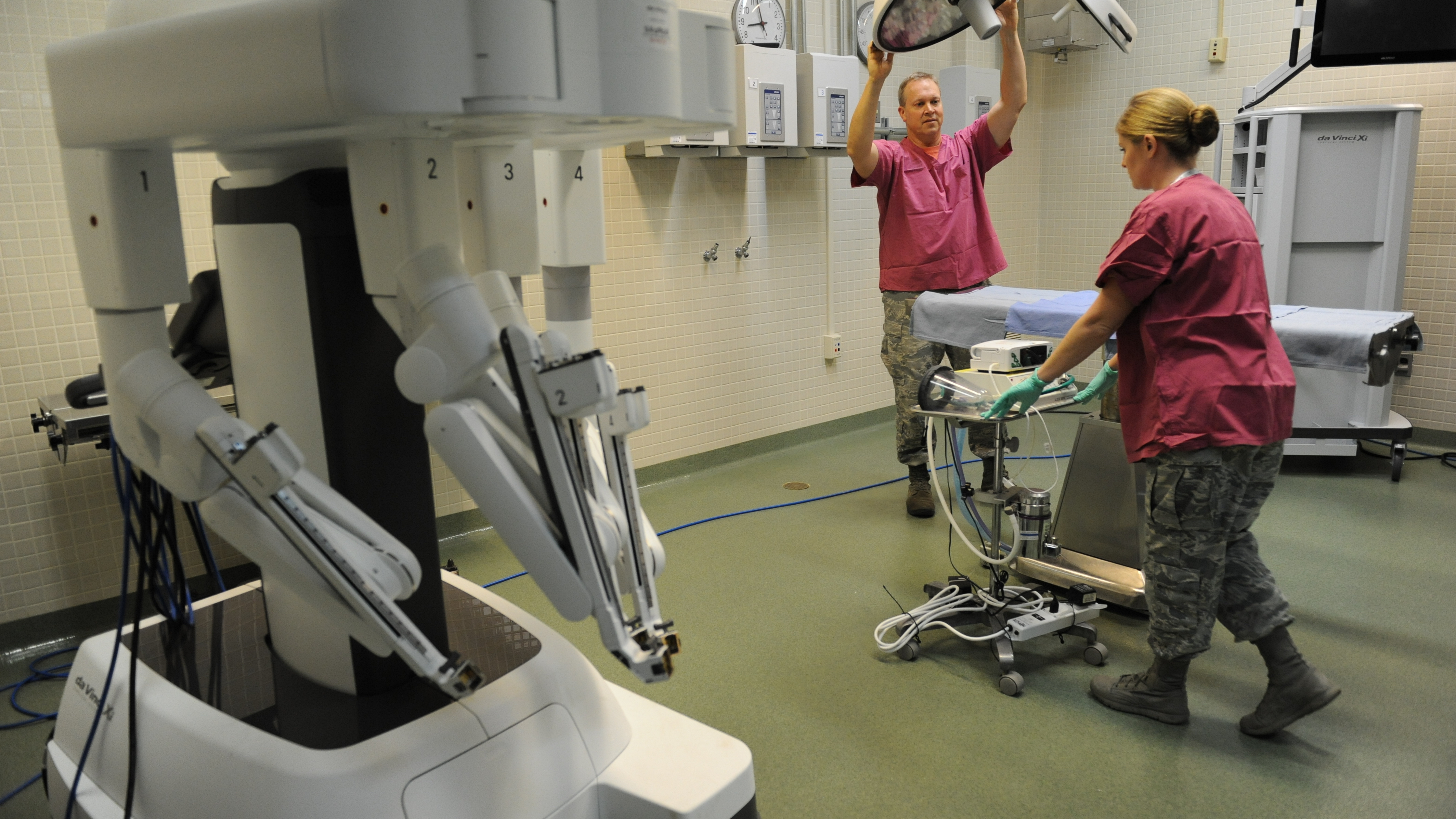
Image note: This 2016 U.S. Air Force photo shows staff setting up a robotic surgical system for training at Keesler Air Force Base. It predates the FDA discussion and is not an image of current agency activity. The appearance of U.S. Department of War (DoW) visual information does not imply or constitute DoW endorsement.[5]