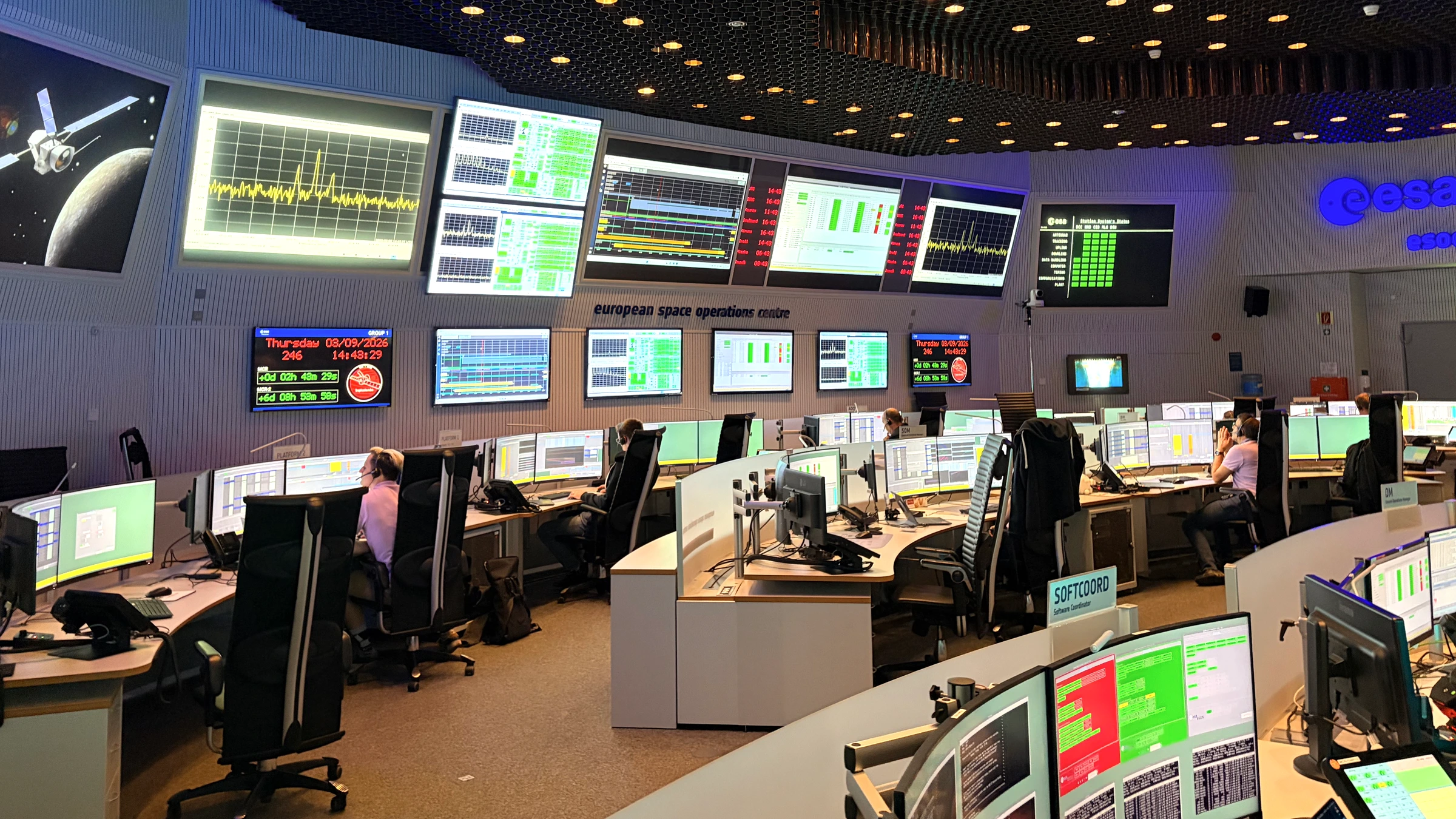
BepiColombo's European science orbiter has taken over power and propulsion for the next stage of its journey to Mercury. The European-Japanese robotic mission released its Mercury Transfer Module on September 3. ESA's September 7 operational account and a September 8 update from instrument laboratory LIRA set out what follows: two science orbiters travelling together, then a sequence of manoeuvres into different working orbits.[1,2]
A new power and propulsion configuration
ESA's operational log says the Mercury Planetary Orbiter's solar panels are charging the spacecraft batteries and that it will power the stack until Japan's Mio orbiter separates. The remaining approach will use the European orbiter's chemical propulsion system. That changes the propulsion regime: the cruise system expelled electrically accelerated xenon ions for sustained low thrust, while chemical propulsion delivers shorter, more powerful bursts. The discarded transfer module has no independent onboard computer or antenna and will remain in orbit around the Sun.[1,4]
The operation took place more than 200 million kilometres from Earth, without real-time human intervention. ESA reports that the remaining stack entered safe mode, adjusted its orientation and reconfigured before transmitting its status. A preliminary radio-frequency shift indicated separation before full confirmation arrived. For the operators, detecting that hardware had moved and confirming that the surviving system was powered and communicating were separate checks.[1,4]
The instruments still depend on the arrival sequence
LIRA's new account makes the payload consequence concrete. Its visible-and-infrared imager channel on the European orbiter is intended to map surface minerals, while its high-frequency radio receiver aboard Mio will study Mercury's magnetic environment. The instruments need different orbital positions to perform those complementary jobs. Their presence aboard the spacecraft is not evidence that the planned orbital observing programme has begun.[2]
The operator's next checkpoints are explicit: Mercury orbit insertion on November 21, separation of the science orbiters on December 9-10, then completion of the European orbiter's final science orbit in March 2027. Full science operations are planned for April. Universe Today's September 9 report also describes those remaining stages. For the instrument teams, the next test is getting each spacecraft into the position its measurements require.[1,2,3,4]