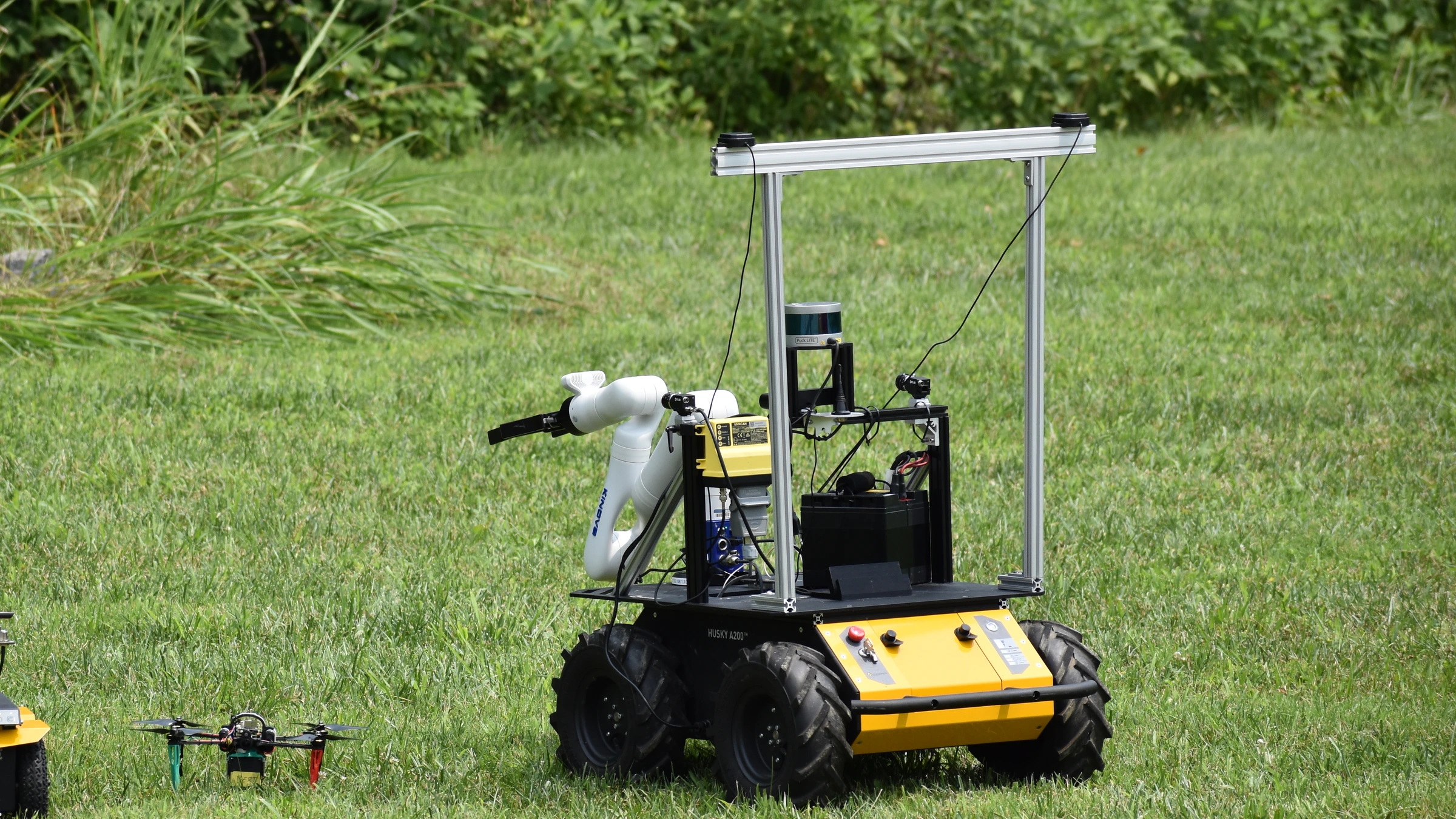
NASA has published results from a July field campaign in which a drone and two rovers shared scientific work at the Virginia Tech Transportation Institute in Blacksburg. The September 15 account describes a useful autonomy step: responding to a new target without dropping the original assignment.[1]
The project, Adaptive Sensing Technology for Responsive Autonomy, or ASTRA, starts with science priorities supplied by people. A drone scouts, one rover maps obstacles using laser-based sensing, and another carries a sampling arm. NASA says the lead drone paused to assess an additional area of interest and brought in another robot to investigate while retaining its initial objective.[1]
Noblis, which supplied the two ground robots, describes a broader coordination problem in its autonomy documentation: nearby machines need shared obstacle information and compatible action plans. Its separate Robot Derby demonstration uses robots following conflicting routes to illustrate collective navigation. That document explains the coordination concept; it does not independently validate the July science test.[1,2]
The research also has an established public trail. The IEEE Conference on Artificial Intelligence 2026 program lists Bethany Theiling and colleagues presenting work on science-objective-based artificial intelligence for spaceflight. A conference listing confirms the research topic and authors, not the performance of this three-robot campaign.[3]
The distinction matters for mission planners. Coordinating motion answers whether machines can share an environment. Allocating a newly discovered investigation asks which machine should do useful work next, considering its capabilities and the value of the result. Comparing the two records places ASTRA at that second decision layer, while leaving the underlying navigation and communication requirements in view. For integrators, this separates two acceptance tests: reaching an assigned location and choosing an appropriate assignment when new information changes priorities.[1,2]
The evidence remains a project account of a terrestrial test. NASA does not publish a trial denominator, intervention rate, failure breakdown or measured gain in science returned. Neither the Noblis concept paper nor the IEEE program supplies those missing results. The next useful checkpoint is repeated end-to-end trials reporting completed assignments, human assistance and responses to communication loss. Those measurements would let operators distinguish a successful handoff from a dependable mission workflow.[1,2,3]