Boston Dynamics has appointed Rohit Prasad chief executive, effective 7 October 2026, after announcing the move a day earlier. The former Amazon leader worked on Alexa and artificial general intelligence and led development of the Amazon Nova model family. The appointment gives the robot maker a leader with experience turning AI research into widely used products.[1]
The company assigns him an explicit commercialization mandate: combining AI with robotic systems for industrial and commercial environments. His expected board appointment remains subject to approval. Neither the leadership change nor that remit establishes a new robot order, completed factory rollout or productivity result.[1]
Atlas is further along than the appointment release’s broad development description suggests. In January, Boston Dynamics announced the product version and reported a completed Hyundai deployment in 2025. Its March account said product-version manufacturing was underway, with deployments at Hyundai and Google DeepMind scheduled for 2026. These are company-reported commercialization milestones; they should not be reduced to laboratory demonstrations.[4,5]
Task training remains part of the operating picture. On 21 September, Boston Dynamics said the initial Robotics Metaplant Application Center on Hyundai Motor Group’s Georgia manufacturing campus was operational. It trains Atlas on preparing and sequencing parts for assembly. A larger facility and broader training in 2027 remain plans.[2]
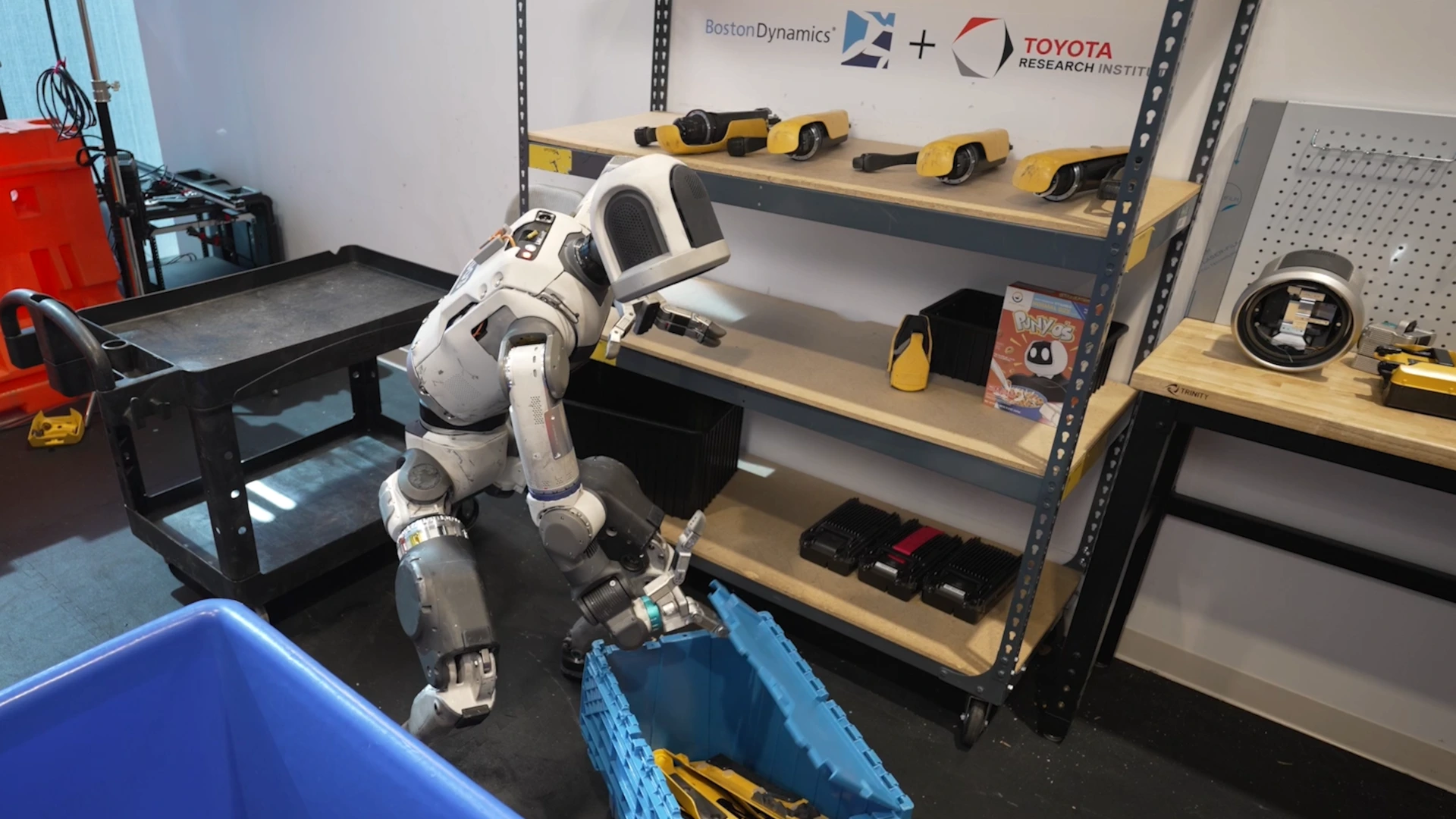
There is already research evidence behind the AI ambition. Toyota’s August 2025 account described Atlas using a large behavior model, an AI system for controlling physical actions, to unpack and sort parts while dealing with a moved or partly closed crate. That demonstration combined movement and manipulation. It did not, by itself, establish sustained factory throughput or a commercial return.[3]
The management change assigns responsibility for the next commercial phase. Product manufacturing, a vendor-reported deployment, an operating training center and a research demonstration each show a different kind of progress. None is interchangeable with a measured buyer return. The cited accounts do not supply a task-level comparison of completion rates, interventions and integration cost that would establish that return.[1,2,3,4,5]
The next meaningful checkpoint is a named task with repeated completion rates, human interventions, cycle times and time unavailable under stated factory conditions, followed by the cost of integrating and maintaining it. Those are tests to watch, not results reported in the appointment. Prasad’s commercial mandate becomes more informative when it is tied to that operating record.[1,2,3]