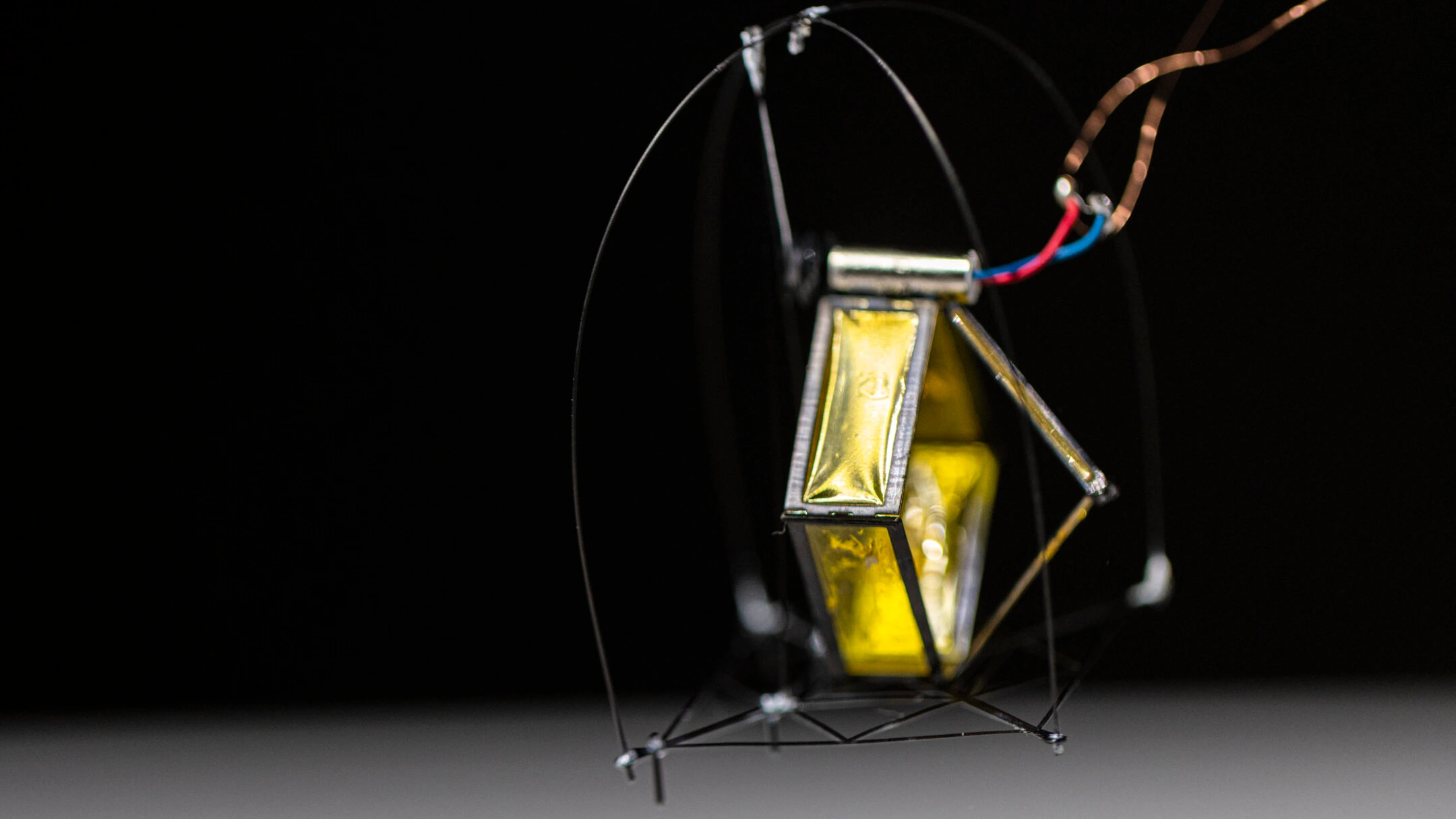
The University of Washington has described a one-gram hopping robot that varies its jump height and rolls itself upright for another attempt. The September 23 research account presents DirectHop as a compact locomotion experiment. Power still arrives through wires, and the machine cannot yet steer itself toward a chosen destination.[1]
Instead of loading and releasing a spring, a small motor pulls a line against a supporting tower. Folding legs guide the movement. Changing the motor current changes the jump; reversing the motor helps the surrounding cage roll the robot back onto its foot. This combines propulsion and recovery in the same actuator.[1,2]
The paper gives the recovery headline a useful denominator: nine successes in ten trials on a flat, rigid surface. Researchers manually placed the robot in stable fallen positions for the isolated recovery test. Its height measurements used five jumps per current setting. A sequence reached four consecutive jumps before tangled power wires impeded performance. Clearing a 17-centimeter step also used a ramp beneath the foot to set the launch angle.[2]
Controlled hopping itself is established. Berkeley’s account of SALTO describes a motor-and-spring mechanism whose controller regulated hopping height, speed and body orientation. Later versions improved foot placement and operated without laboratory tracking equipment. That history narrows the new result: DirectHop explores a much smaller direct-drive mechanism, rather than establishing that robots can regulate jumps for the first time. The two platforms are not a matched performance comparison.[2,3]
For researchers choosing how to move a tiny machine over obstacles, the interesting trade is mechanical simplicity against the work still needed around it. A repeatable launch and recovery mechanism could be useful even without a record leap. But an externally powered tabletop result does not show a robot selecting a route, carrying its own energy supply or completing an inspection.[1,2,3]
The next meaningful demonstration would combine onboard power, deliberate steering and repeated recovery across different surfaces, reporting completed routes and human interventions. Those measurements would connect the mechanism to a usable mobile system. Until then, the evidence supports a controllable hopping prototype; the suggested applications in farms, industrial sites and exploration remain research possibilities.[1,2]