The service is on sale, not yet at airport scale
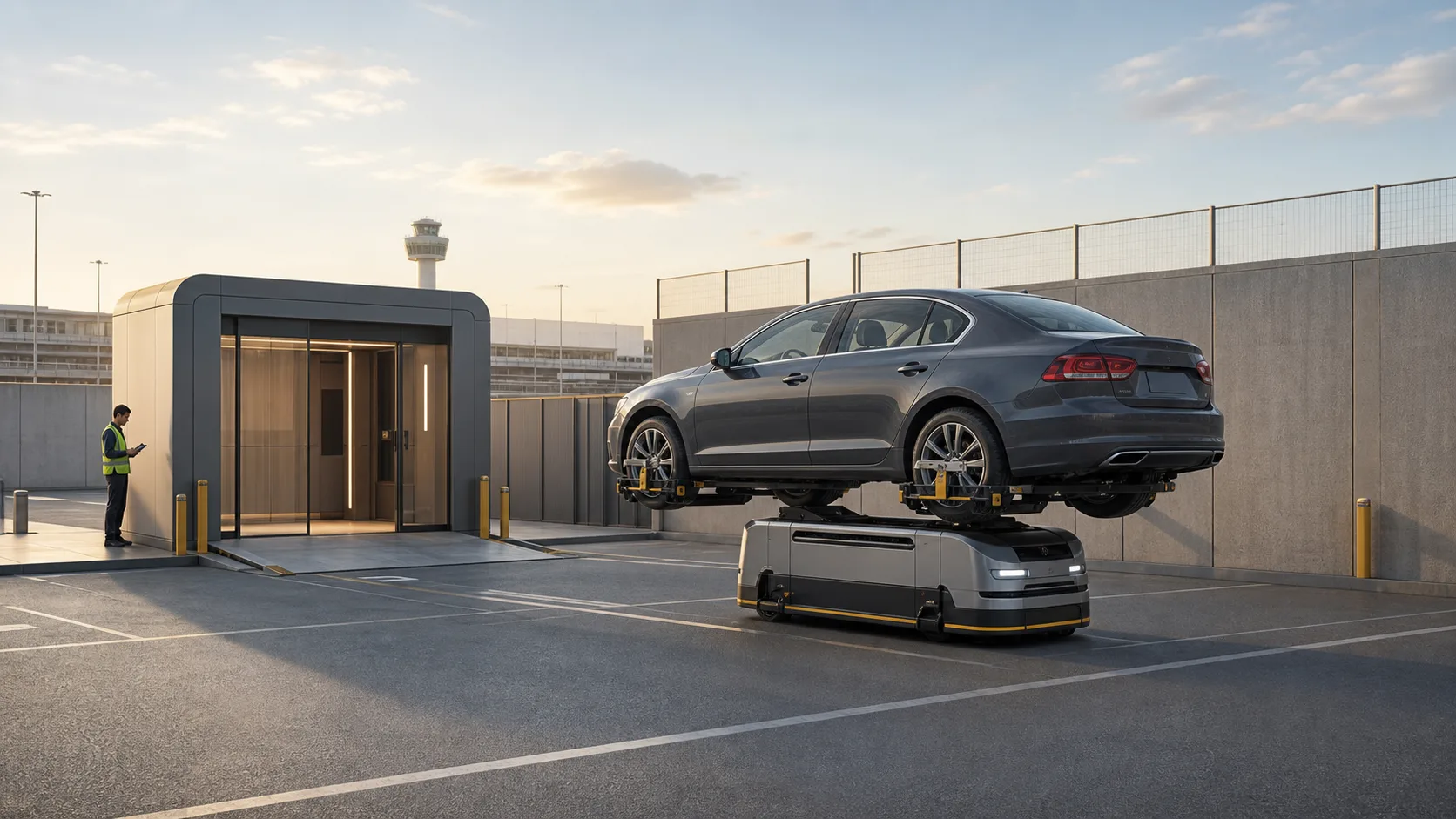
London Gatwick and Stanley Robotics have put a robotic valet-parking service on sale ahead of its first passengers in August. Customers will drive into an enclosed cabin near the South Terminal, leave the car and keep the keys; an autonomous vehicle then lifts the car by its tyres and stores it until the return journey. That is a real commercial handoff, but the public record still describes a launch boundary rather than a proven airport-scale fleet.[1,2]
Gatwick's live parking page fills in the operational detail that a launch headline leaves out. The site is restricted to the South Terminal, uses private garages and automatic number-plate recognition at entry, and requires customers to scan a booking before a robot collects the car. On return, the customer walks or takes a shuttle back to the parking area, scans a code and waits for the car to be brought to a cabin.[2]
The useful novelty is the workflow
The robot is only one part of the product. The operator must accept a compatible vehicle, close the handoff safely, assign a storage position, connect the booking to the passenger's return flight and retrieve the right car at the right time. Gatwick says the system tracks landing information and that on-site teams are available when something goes wrong. The software and exception process are therefore part of the deployment, not support work around it.[1,2]
Independent aviation coverage confirms the bounded design. Aviation Week reports a six-minute walk or a seven-to-15-minute shuttle to the South Terminal, while describing the same tyre-lifting robot and human assistance if there is an issue. CAPA reports an August start and identifies the earlier Gatwick framework contract for a robot-valet trial that ran from the second half of 2019 into early 2020. The current service is a re-entry into a known operating problem, not evidence that the airport has solved general autonomous driving.[3,4]
The constraints are the story
The initial rules expose the system's real capacity model. Customers must book in advance, leave the car for at least five days, enter and exit on weekdays and use the service only during stated booking hours. Gatwick also caps the supported vehicle at a 3.3-metre wheelbase, 2.3-metre height, 21-inch wheel diameter and 2.6-tonne weight. The airport says those limits may ease as the service scales, which makes the first operating period a controlled demand slice rather than a drop-in replacement for ordinary parking.[1,2]
That is not a weakness by itself. A constrained workflow can be a sensible way to commission a safety-critical material-handling system: narrow the vehicle envelope, smooth the storage duration, keep passengers out of the robot area and retain people for exceptions. But it shifts the buyer's question from whether a robot can move a car to whether the whole service can sustain predictable intake, storage density, retrieval timing and recovery without creating a new queue at the airport.[1,2,3]
What Gatwick must prove next
The launch material does not disclose the number of robots or bays, storage capacity, peak intake, average retrieval time, failed handoffs, vehicle-damage rate, intervention rate, staffing, maintenance burden, price, capex or payback. It proves that the airport has defined a customer-facing service and exposed its compatibility rules; it does not yet prove throughput or economics. The 2019 trial history also matters because the public sources do not explain what changed between that earlier attempt and the service now being sold.[1,2,3,4]
The next decision-changing evidence should arrive with the first August passenger trips: the installed robot and bay count, cars accepted and retrieved, retrieval-time distribution, human interventions, damage or exception records, labour hours and the economics of the parking offer. Those are the numbers that convert a controlled commissioning test into a dependable service. Until those measures are public, Gatwick's robot valet is best understood as a commercial commissioning test with a clearly visible human fallback—not as proof that autonomous airport parking has become a solved category.[1,2,3,4]