What changed
A preprint posted August 6 introduces GAUGE, a diagnostic benchmark for the physical fidelity of robotics simulators and video world models. The authors recorded real trajectories and calibrated properties across 22 task families—including rigid contact, cables, textiles and deformable objects—then tested whether software reproduces them rather than merely rendering a convincing clip.[1]
The engine track compares Isaac Sim 6.0.0, Genesis 1.12.0 and Newton 1.3.0 on 14 task families, preserving default non-task settings after parameter calibration. It uses 20 independent real-world trials per evaluation task. Official documentation confirms Isaac Sim's PhysX and Newton back ends and Newton's public 1.3 release, but the accuracy results are the paper authors' own measurements.[1,2,3]
The decision delta
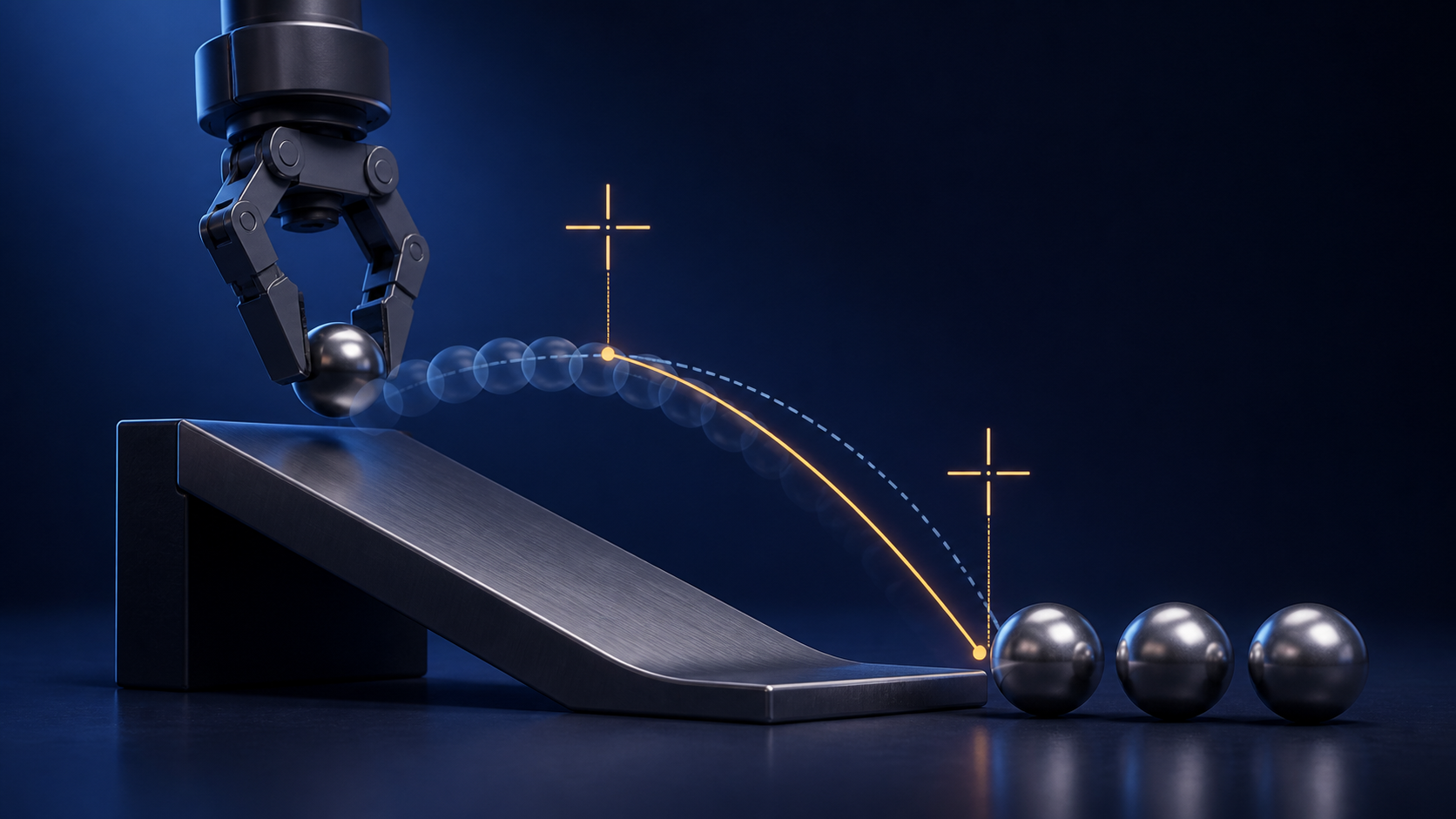
A physically credible-looking rollout cannot be treated as evidence of a faithful simulator. GAUGE reports no engine was uniformly faithful; its largest cited differences were impulsive contact, rapid textile motion and volumetric deformation. In five rigid-body video-model tasks, the authors found models could follow an expected curve while recovering wrong physical values: the closest reported bouncing-ball acceleration was 1.84 metres per second squared against 9.81 metres per second squared.[1]
That separates an attractive generated video from a useful robot-training or evaluation environment. A negative prompt improved one model's bouncing-ball curve score but made its wood-slope score far worse, so prompt tuning did not create a reliable fix. The important limit is that this is an unreplicated preprint and the world-model audit covers only five rigid-body tasks. Public benchmark artifacts and an independent rerun on robot interaction with soft bodies would be the decisive next check.[1]